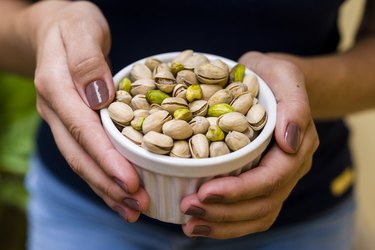
If you've ever eaten a handful of pistachios, you'd probably agree that these Hulk-hued nuts are nothing short of addicting.
And while it may be difficult to stop chomping once you've started, you'd be happy to learn that pistachios are one of the best healthy snacks you can grab and go with. These tiny-but-mighty nuts are linked to promoting satiety, improving heart and gut health and even curbing weight gain in the long run.
Video of the Day
Video of the Day
Ready to get cracking? Opting for raw, unsalted pistachios are the best way to go to get the most health benefits.
Pistachio Nutrition Facts
A one-ounce serving (about 49 kernels) contains:
- 159 calories
- 13 grams of fat
- 6 grams of protein
- 8 grams of carbohydrates (with 3 grams of fiber)
A serving of pistachios also packs in:
- Manganese: 0.3 milligrams or 15 percent of your Daily Value (DV)
- Phosphorous: 139.2 milligrams or 11 percent of your DV
- Copper: 0.4 milligrams or 41 percent of your DV
- Vitamin B6: 0.5 milligrams or 28 percent of your DV
The heart-healthy nut is also a source of iron, which helps support healthy bones and transports oxygen to the muscles, according to U.S. National Library of Medicine.
1. Eating Pistachios Is Linked to Heart-Health Benefits
Nuts, in general, are known for their positive heart-health benefits — pistachios included. Eating the green nuts is linked to significantly lower systolic blood pressure, according to a May 2016 study published in Nutrition Today.
What's more, making pistachios a part of your daily diet can also have a positive effect on your blood lipid profile, so long as you avoid increasing your overall calorie intake, according to a May 2016 study published in Acta Biomedica. Researchers observed that snacking on pistachios decreased study participants' LDL (bad) cholesterol levels while raising their HDL (good) cholesterol levels.
Read more: Are Macadamia Nuts Healthy?
2. Pistachios May Boost Gut Health
Getting enough fiber in your daily diet (about 25 grams for women and 38 grams for men per day), is crucial for regular digestion and overall health, according to the Academy of Nutrition and Dietetics. Not only can pistachios promote good digestion due to their fiber content, but the nut's antioxidant content supplies some beneficial anti-inflammatory effects, according to a July 2015 study published in the British Journal of Nutrition.
Plus, making pistachios your nut of choice may help balance your gut microbiome. One study found that eating pistachios can help increase your body's levels of butyrate-producing bacteria, a strain that's beneficial for your gut health, way more than almonds can, per June 2014 research published in the British Journal of Nutrition.
3. The Snack Can Help Manage Your Weight
High in fiber and protein, snacking on pistachios can help you feel full thanks to these two satiating nutrients.
A serving of pistachios will also provide about 11 percent of your daily recommended protein intake, which is generally about 0.8 grams of protein per kilogram of body weight, according to Harvard Health Publishing. Like fiber, protein can help promote appetite control and may reduce hunger, per a 2013 study published in Satiation, Satiety and the Control of Food Intake.
Plus, pistachios are high in fat, which is a calorically dense macronutrient. While carbohydrates and protein are only four calories to the gram, fat totals at about nine calories per gram. This is why nuts can be high in calories even though the portions are relatively small.
However, interestingly enough, eating more nuts isn't tied to weight gain, despite nuts' high caloric value. It's quite the opposite, actually: Replacing half a serving a day with nutrient-dense nuts like pistachios is associated with less long-term weight gain and a lower risk of obesity in adults, according to a September 2019 study published in BMJ Nutrition, Prevention and Health. So pack a small bag of pistachios to snack on during work to help you avoid that mid-afternoon vending-machine visit — your health and waistline will thank you.
Read more: 4 Good Reasons to Add Nuts to Your Weight-Loss Plan
- U.S. National Library of Medicine: "Definitions of Health Terms: Minerals"
- Academy of Nutrition and Dietetics: "Fiber"
- Harvard Health Publishing: "How Much Protein Do You Need Every Day?"
- Satiation, Satiety and the Control of Food Intake: "Protein and satiety"
- Nutrition Today: "Pistachios for Health"
- British Journal of Nutrition: "Nutrition Attributes and Health Effects of Pistachio Nuts"
- British Journal of Nutrition: "Effects of Almond and Pistachio Consumption on Gut Microbiota Composition in a Randomised Cross-over Human Feeding Study"
- BMJ Nutrition, Prevention and Health: "Changes in Nut Consumption Influence Long-term Weight Change in US Men and Women"
- USDA: "Pistachio Nuts"
- U.S. National Library of Medicine: "Definitions of Health Terms: Minerals"
- Academy of Nutrition and Dietetics: "Fiber"
- Harvard Health Publishing: "How Much Protein Do You Need Every Day?"
- Satiation, Satiety and the Control of Food Intake: "Protein and Satiety"
- Nutrition Today: "Pistachios for Health"
- Mayo Clinic: "Nuts and Your Heart: Eating Nuts for Heart Health"
- Acta Biomedica: "More Pistachio Nuts for Improving the Blood Lipid Profile. Systematic Review of Epidemiological Evidence."
- British Journal of Nutrition: "Nutrition Attributes and Health Effects of Pistachio Nuts"
- British Journal of Nutrition: "Effects of Almond and Pistachio Consumption on Gut Microbiota Composition in a Randomised Cross-Over Human Feeding Study"
- BMJ Nutrition, Prevention and Health: "Changes in Nut Consumption Influence Long-term Weight Change in US Men and Women"