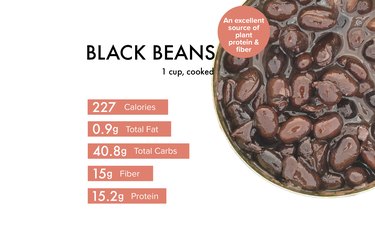
Black beans are an affordable plant-based protein source that's super versatile — and a delicious addition to a healthy diet.
They're nutrient powerhouses, packed full of vitamins and minerals and you'll often find them in dried or canned forms.
Video of the Day
Video of the Day
Black beans are generally the size of a pea, oval-shaped and jet-black with cream-colored flesh. They are part of the legume family, which also includes kidney, lima, navy and pinto beans as well as peas.
Black Beans Nutrition Facts
One cup of cooked black beans is equal to a single serving. One cup of cooked black beans contains:
- Calories: 227
- Total fat: 0.9 g
- Cholesterol: 0 mg
- Sodium: 1.7 mg
- Total carbs: 40.8 g
- Dietary fiber: 15 g
- Sugar: 0.6 g
- Added sugar: 0 g
- Protein: 15.2 g
Black Beans Macros
- Total fat: One cup of cooked black beans has 0.9 grams of total fat, which includes 0.4 grams polyunsaturated fat, 0.08 grams monounsaturated fat, 0.2 grams saturated fat and 0 grams trans fat.
- Carbohydrates: One cup of cooked black beans has 40.8 grams of carbohydrates, which includes 15 grams of fiber and 0.6 grams of naturally occurring sugar.
- Protein: One cup of cooked black beans has 15.2 grams of protein.
Vitamins, Minerals and Other Micronutrients
- Folate: 64% of your Daily Value (DV)
- Copper: 40% DV
- Thiamin (B1): 35% DV
- Manganese: 33% DV
- Magnesium: 29% DV
- Iron: 20% DV
- Phosphorous: 19% DV
- Zinc: 18% DV
- Potassium: 13% DV
- Vitamin E: 10% DV
- Choline: 10% DV
- Riboflavin (B2): 8% DV
- Pantothenic acid: 8% DV
- Vitamin B6: 7% DV
- Vitamin K: 5% DV
- Niacin: 5% DV
- Selenium: 4% DV
- Calcium: 4% DV
Black Beans vs. Other Types of Beans
Per 1 cup, cooked | Black Beans | Kidney Beans | Lima Beans | Navy Beans | Pinto Beans |
|---|---|---|---|---|---|
Calories | 227 | 225 | 216 | 255 | 245 |
Fat | 0.9 g | 0.9 g | 0.7 g | 1.1 g | 1.1 g |
Total Carbs | 40.8 g | 40.4 g | 39.3 g | 47.4 g | 44.8 g |
Fiber | 15 g | 11.3 g | 13.2 g | 19.1 g | 15.4 g |
Protein | 15.2 g | 15.3 g | 14.7 g | 15 g | 15.4 g |
Health Benefits of Black Beans
Like all legumes, black beans have a rich and varied nutrient profile. Black beans contain a wide range of vitamins, minerals, and fiber.
1. Black Beans Can Help With Weight Loss
Black beans are an excellent source of plant-based protein (15.2 grams) and dietary fiber (15 grams), a dynamic duo that work together to support healthy weight loss goals and to maintain a healthy weight.
Only found in plants, fiber is a non-digestible carb with many advantages. It slows down digestion and helps clean your colon and keeps your digestive system running smoothly to help prevent constipation, per the University of California San Francisco.
Eating a plant-forward diet full of whole fruits, vegetables, legumes and nuts — which are all sources of fiber — has been shown to be an effective strategy in weight management and obesity, according to a November 2018 study in Nutrition and Diabetes.
Researchers found that plant protein from sources such as black beans was associated with improvements in body weight, body composition and insulin resistance, to name a few.
Beans and legumes have a higher protein content than many other plant-based foods, making them an optimal choice for vegans, vegetarians and anyone looking to add more plant-based foods to their daily diet.
2. Black Beans Boast B Vitamins
B vitamins work in tandem to perform a variety of functions in the body. Black beans provide a mix of B vitamins, most notably thiamine (B1) and folate (aka folic acid or B9).
Thiamine helps the body metabolize food into energy and also supports nerve health.
You'll also get a whopping 64 percent of your daily requirement of folate in one cup of black beans. A deficiency in folate has been linked to mental health issues, according to a February 2016 study in Nutrients.
Folate supplementation was associated with a 10 percent lower risk of stroke and 4 percent lower risk of overall cardiovascular disease, according to an August 2016 study in the Journal of the American Heart Association.
The vitamin plays a role in lowering serum levels of homocysteine, an amino acid that is a risk factor for heart disease.
3. They're Linked to Good Heart Health
The contribution of black beans to heart health lies in their soluble fiber content, which can help reduce cholesterol levels, as well as their high levels of magnesium and folate.
As mentioned above, folate helps to decrease levels of homocysteine, which is a risk factor for heart attack, stroke and vascular disease.
Low levels of magnesium can alter biochemical pathways and increase the risk of disease over time, including cardiovascular disease. Getting enough magnesium is linked to a reduced risk of stroke and heart disease, according to the National Institutes of Health (NIH).
Adding black beans to a regular Western diet can improve post-meal blood sugar levels, according to a May 2015 study in Nutrients.
The researchers chalk it up to the black beans' high fiber content and conclude that eating beans regularly is linked to warding off heart disease and diabetes in people with metabolic syndrome.
Black Bean Health Risks
There are currently no known food allergies or drug interactions associated with black beans. Be sure to discuss any food and medication interactions with your health care professional.
Black Bean Preparation and Useful Tips
Black beans are widely available in canned and dried varieties. The dried version may be in pre-packaged containers as well as in bulk.
Make sure there is no evidence of moisture or damage and that the beans are whole and not cracked. Store dried black beans in an airtight container in a cool, dry, dark place for up to 12 months.
When preparing dried black beans:
- Inspect your dried beans, looking for any rocks or pebbles to discard and ensuring beans are not broken.
- Soak beans overnight, making sure beans are fully covered with water.
- After soaking, rinse and drain the beans until the water runs clear.
- To cook on the stovetop, place black beans in a pot, fill and cover the beans with water, and cook at a simmer until beans are tender, about 1 to 2 hours.
- To cook in a pressure cooker, place dried beans (soaking is not required prior to cooking), add eight cups of water with one pound of beans and cook on high pressure for 30 minutes. Once done, allow pressure to release naturally for 20 to 30 minutes.
If you buy canned beans, look for low-sodium versions that do not contain extra additives. Be sure to drain and rinse canned black beans prior to eating them, which can help ditch about 40 percent of the sodium content, per the Bean Institute.
Black beans can be used in a wide variety of dishes. Here are some quick serving ideas.
- Add to grains, salads, soups, stews and side dishes.
- Combine with other types of beans and some chopped vegetables and mix in some vinaigrette to make a colorful bean salad mix.
- Combine black beans in a food processor with cumin, garlic, lemon juice, olive oil, salt and pepper for a delicious bean dip.
- Top a baked sweet potato with black beans and yogurt.
- Make black bean veggie burgers by combining beans, onion, garlic, bell peppers, jalapeno, salt and pepper in a food processor. Place mixture in a bowl with an egg and some breadcrumbs, form into patties, bake and serve with salsa and avocado.
- Use as a filling for tacos and burritos.
Black Bean Recipes
Alternatives to Black Beans
There are many varieties of beans and other legumes available.
Black beans can easily be swapped out for pinto beans, lima beans, kidney beans, navy beans, cannellini beans, chickpeas as well as edamame.
All of these options provide a similar nutrient profile and are high in plant protein and fiber.
- University of California, San Francisco: "Why Fiber Is So Good for You"
- Nutrients: "Blacks Beans, Fiber, and Anti-oxidant Capacity Pilot Study"
- Nutrients: "B Vitamins and the Brain"
- JAHA: "Folic Acid Supplementation and the Risk of Cardiovascular Diseases"
- My Food Data: “black beans”
- My Food Data: “kidney beans”
- My Food Data: “lima beans”
- My Food Data: “navy beans”
- My Food Data: “pinto beans”
- Nutrition and Diabetes: “A plant-based diet in overweight individuals in a 16-week randomized clinical trial: metabolic benefits of plant protein”
- Health Professional Fact Sheet: “Magnesium”
- Bean Institute: "Rinse Beans the Right Way to Reduce Sodium"