Your body needs essential amino acids — one being leucine — to help you maintain muscle mass. Foods rich in leucine are part of a well-rounded diet and a varied diet can help you avoid a leucine deficiency.
Leucine, isoleucine and valine are known as branched-chain amino acids (BCAAs), per the National Institutes of Health (NIH). These make up about a quarter of the amino acids in foods that contain complete proteins, meaning they have all the essential amino acids.
Video of the Day
Video of the Day
BCAAs also make up about 14 to 18 percent of the amino acids in your skeletal muscle proteins and are good for providing energy during exercise. These amino acids — and particularly leucine — might also help build muscle after exercise. (In fact, many exercisers take supplements containing leucine for muscle growth).
Leucine may also have the ability to stimulate insulin production, helping to control blood sugar in people with type 2 diabetes, per a May 2010 review in Nutrition Reviews.
Keep in mind that it's usually best to get the amino acid naturally from the food you eat to reap leucine's benefits, as too much leucine from supplements can cause side effects like low blood sugar or pellagra (a systemic disease with symptoms like gastrointestinal problems and hair loss), per the University of Rochester Medical Center.
Here are the top leucine foods — and in some cases, they're high in isoleucine and valine as well.
How Much Leucine Do You Need Per Day?
The recommended daily intake (RDI) for leucine is 17.7 milligrams per pound of body weight. So a person weighing around 154 pounds should get about 2,730 milligrams of leucine per day.
Note that the RDI percentages below are based on eating about 2,730 milligrams of leucine per day.
1. Steak: 2,503 mg, 92% RDI
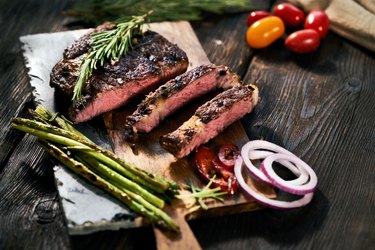
Skirt steak is one of the best sources of leucine, with 2,503 milligrams per 3 ounces cooked. It's also one of the top foods high in isoleucine with 96 percent of the RDI; steak also offers 78 percent of the RDI for valine.
Of course, while steak is the meat that has the most leucine, it's best eaten in moderation. A large body of evidence shows that a high intake of red meat is linked to a greater risk of heart diseases, cancer, diabetes and premature death, per Harvard Medical School. Treat red meat as a side dish in your meal, rather than the main course.
2. Pork Chops: 1,857 mg, 68% RDI
Pork chops contain 1,857 milligrams of leucine per 3 ounces cooked. They also offer 23 grams of protein and 65 percent of the DV for selenium, which is important for DNA production, reproduction, thyroid gland function and protecting the body from damage caused by free radicals and infection, per the NIH.
Prok chips are also one of the top isoleucine foods, packing 76 percent of the RDI.
3. Tuna: 1,833 mg, 67% RDI
Canned tuna has 1,833 milligrams of leucine per 3 ounces. It also provides 74 percent of the RDI for isoleucine and 64 percent of the RDI for valine.
Eating fish can help prevent heart disease any many ways, such as by protecting the heart from cardiac rhythm disturbances and lowering blood pressure and heart rate, per the Harvard T.H. Chan School of Public Health. However, only one-third of Americans eat seafood once a week and only half eat fish occasionally or not at all.
Try the seafood in these healthy canned tuna recipes.
4. Chicken: 1,700 mg, 62% RDI
Chicken drumsticks offer an impressive 1,700 milligrams per 3 ounces cooked. They also contain 70 percent of the RDI for isoleucine, plus 20 grams of protein.
Meats and fish contain nutritionally complete proteins with plentiful BCAAs, which is why they are the proteins with the most leucine. Round out your meal with plenty of fresh vegetables, grains, and legumes.
5. Low-Fat Ricotta: 1,531 mg, 56% RDI
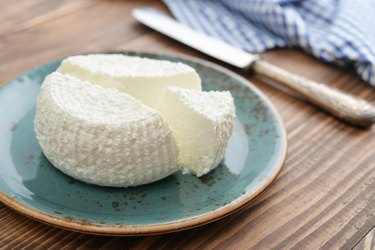
Low-fat ricotta offers 1,531 milligrams of leucine per 1/2 cup. It also contains 14 grams of protein and 26 percent of the DV for calcium.
Of course, calcium's claim to fame is its role in bone health, but you also need it for heart, muscle and nerve health — and some research suggests that calcium with vitamin D may help protect against cancer, diabetes and high blood pressure (but more evidence is needed), per the Mayo Clinic.
6. Firm Tofu: 1,184, 43% RDI
Firm tofu provides 1,184 milligrams of vegetarian leucine per 3 ounces raw. Soy products offer a unique source of protein because they are one of the few plant-based foods containing nutritionally complete proteins. In other words, soy proteins supply all the essential amino acids your body cannot synthesize and must get from your diet, per Cedars-Sinai.
Try it in these high-protein tofu recipes.
A source of vegan leucine, canned navy beans have 837 milligrams per 1/2 cup. Legumes, while relatively protein-rich, do not supply complete protein; however, they do offer moderate amounts of BCAAs.
While most animal sources of proteins provide greater amounts of BCAAs than plant sources of proteins, legumes contain a fair amount of these nutrients in a fiber-rich, low-fat package. Try them in these healthy bean recipes.
8. Skim Milk: 782 mg, 29% RDI
Skim milk provides 782 milligrams of leucine per cup. Men on a vegan diet had statistically significant lower levels of leucine in their blood, while vegetarians had similar (but still lower) levels of leucine compared to meat-eaters, in a September 2016 study in the European Journal of Clinical Nutrition.
The researchers suggest that the leucine found in the vegetarians' bloodstreams was likely from milk products, which are high in leucine.
9. Squash and Pumpkin Seeds: 678 mg, 25% RDI
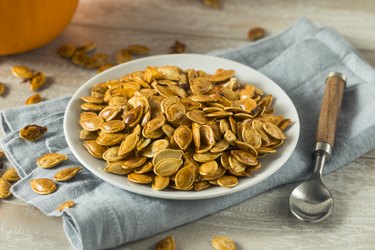
Squash and pumpkin seeds offer 678 milligrams of leucine per ounce roasted, making them excellent leucine plant sources and vegan BCAA sources. They also provide 26 percent of the RDI for isoleucine and 24 percent of the RDI for valine. You'll also get 37 percent of the daily value for magnesium, which helps to regulate muscle and nerve function, blood sugar levels and blood pressure, per the NIH.
You can also find leucine in oats and peanut butter, but in smaller amounts.
10. Eggs: 538 mg, 20% RDI
You'll get 538 milligrams of leucine per one hard-boiled egg. To maintain a healthy diet, eat eggs in moderation while opting for plant-based protein options when possible, per the Harvard T.H. Chan School of Public Health.
Try these healthy egg recipes.
- National Institutes of Health: "Dietary Supplements for Exercise and Athletic Performance"
- Journal of Nutrition, Health, and Aging: "Effects of leucine-rich protein supplements on anthropometric parameter and muscle strength in the elderly: a systematic review and meta-analysis"
- University of Rochester Medical Center: "Leucine"
- Nutrition Reviews: "Leucine metabolism in regulation of insulin secretion from pancreatic beta cells"
- MyFoodData: "Top 10 Foods Highest in Leucine"
- MyFoodData: "Roasted Chicken Leg"
- MyFoodData: "Skirt Steak"
- Harvard Medical School: "What’s the beef with red meat?"
- MyFoodData: "Pork Chops (With Fat)"
- National Institutes of Health: "Selenium"
- MyFoodData: "Canned White Tuna (Oil Packed)"
- MyFoodData: "Lowfat Ricotta"
- Mayo Clinic: "Calcium and calcium supplements: Achieving the right balance"
- MyFoodData: "Firm Tofu"
- Cedars-Sinai: "Are Animal Proteins Better for You Than Plant Proteins?"
- MyFoodData: "Canned Navy Beans"
- MyFoodData: "Skim Milk"
- European Journal of Clinical Nutrition: "Plasma concentrations and intakes of amino acids in male meat-eaters, fish-eaters, vegetarians and vegans: a cross-sectional analysis in the EPIC-Oxford cohort"
- MyFoodData: "Roasted Squash And Pumpkin Seeds (Unsalted)"
- National Institutes of Health: "Magnesium"
- MyFoodData: "Hard Boiled Eggs"
- Harvard T.H. Chan School of Public Health: "Eggs"