Herbs That Interact With Amlodipine
Amlodipine is the generic name for Norvasc 1. Doctors usually prescribe this medication to treat hypertension, or high blood pressure. Your physician might give you a prescription for amlodipine for other health conditions such as angina 1. Amlodipine is a calcium channel blocker that reduces blood pressure by dilating your blood vessels 1. Discuss the use of herbs and amlodipine with your physician 1.
Amlodipine Forms
Your doctor can give you a prescription for Norvasc, the brand name, or amlodipine, the generic form 1. Both versions have the same chemical properties. Certain prescription medicines that doctors recommend when you have high blood pressure and high cholesterol include amlodipine in a formulation that contains a cholesterol-lowering medication 1. In addition, several prescription high blood pressure medicines are formulations that contain amlodipine in combination with another medication 1. Ask your doctor or pharmacist if any medication that you take for blood pressure or for cholesterol control also contains amlodipine 1.
Ginger
Herbs That Lower Blood Pressure Quickly
Learn More
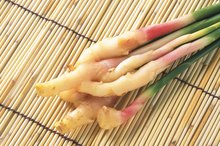
Ginger comes from the root of the ginger plant, and is mainly used to season foods such as baked goods and Asian dishes. You can also consume ginger as a tea, in ginger ale and as ginger beer. Ginger can reduce your blood pressure. When you take amlodipine and consume ginger, it is possible to have extremely low blood pressure, or hypotension, according to Medline Plus 1. The interaction between ginger and amlodipine can also cause an irregular heartbeat 1.
- Ginger comes from the root of the ginger plant, and is mainly used to season foods such as baked goods and Asian dishes.
- When you take amlodipine and consume ginger, it is possible to have extremely low blood pressure, or hypotension, according to Medline Plus 1.
Ginseng
In Chinese traditional medicine, ginseng root has mainly been used for treatment of circulatory problems and erectile dysfunction. In the Western world, ginseng has gained popularity as a tea and in powdered forms, available in health food stores. Ginseng is a stimulant that can increase your blood pressure. This might make your amlodipine dosage less effective 1.
- In Chinese traditional medicine, ginseng root has mainly been used for treatment of circulatory problems and erectile dysfunction.
- Ginseng is a stimulant that can increase your blood pressure.
Hawthorn
Can You Eat Too Much Ginger?
Learn More
The herb hawthorn has had a place in alternative medicine as a treatment for heart problems since the early part of the 20th century. It is also a traditional medicine for high blood pressure, according to the University of Maryland Medical Center 3. If you take amlodipine, avoid consuming hawthorn because it can intensify the effects of calcium channel blockers 1. This could make your blood pressure too low. Heart palpitations are also a known side effect of hawthorn consumption.
- The herb hawthorn has had a place in alternative medicine as a treatment for heart problems since the early part of the 20th century.
- It is also a traditional medicine for high blood pressure, according to the University of Maryland Medical Center 3.
Pleurisy Root
Pleurisy root and foxglove belong to the same plant family. They both contain naturally occurring cardiac glycosides, the source of prescription digitalis, a potent heart medication. A common adverse effect of combining pleurisy root and a calcium channel blocker is decreased kidney clearance of digoxin, the active cardiac glycoside in plants in the foxglove family. When you take calcium channel blockers and cardiac glycosides together, you risk having increased digoxin levels, which can result in a cardiac glycoside overdose.
- Pleurisy root and foxglove belong to the same plant family.
- A common adverse effect of combining pleurisy root and a calcium channel blocker is decreased kidney clearance of digoxin, the active cardiac glycoside in plants in the foxglove family.
Related Articles
Herbs That Lower Blood Pressure Quickly
Learn More
Can You Eat Too Much Ginger?
Learn More
What Herbs Are Similar to Metoprolol?
Learn More
Can Turmeric Cause Blood Sugar Levels to Drop?
Learn More

The Best Way to Lose Weight With Ephedrine
Learn More
Herbs That Would Act As a Natural Beta Blocker
Learn More
What Supplements & Herbs Interact With Hydrochlorothiazide?
Learn More

Warnings About Taking Skullcap
Learn More
Ibuprofen 600 Mg Side Effects
Learn More
Ginger & Heart Rate
Learn More
References
Resources
Writer Bio
Carol Luther has more than 25 years of business, technology, and freelance writing experience. She has held leadership roles in higher education management, international development, adult education, vocational education, and small business support programs