Uriel Sinai/Getty Images News/Getty Images
The Inuit are an indigenous group of people who live in the world's arctic regions. Traditionally, their diet has consisted solely of what was available in their immediate area. This and other hunter-gatherer diets are of interest today as people try to understand more about the different foods that humans may have evolved to eat in an effort to curb the rise of degenerative diseases and obesity.
Traditional Inuit Diet
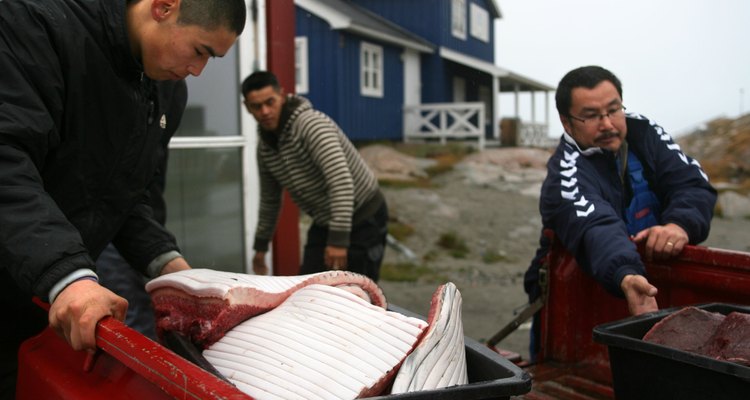
A traditional Inuit diet consists almost entirely of protein and fat. These indigenous people are unable to grow crops on the frozen tundra; they subsist on wild fish and game. While some proponents of low-carb dieting have pointed to the Inuit as an example of healthy people who do not consume many carbohydrates, it's important to consider the big picture. In the October 2004 issue of "Discovery Magazine," writer Patricia Gadsby explains that the Inuit's bodies have adapted to better handle the process of gluconeogenesis, in which the body turns fat and protein into useable glucose. The Inuit have larger livers and a larger volume of urine than the average human, which helps their bodies to process the byproducts of their diet.
Protein and Fat
The meat that Inuit eat is fatty meat from wild animals. The Inuit and other hunter-gatherer people tend to eat no more than 40 percent protein. Too much protein can stress the liver until ill health or death occurs, according to evolutionary nutritionist Loren Cordain in "Discover Magazine." Approximately 50 percent of the Inuit's calories are derived from fat. The nutritional profile of the fat that these animals provide is significantly different from that of the farm-raised animals that are consumed by the average American, however. Wild mammals and cold water fish are rich in healthy monounsaturated fat and omega-3 fatty acids. This may partially account for the health that the Inuit enjoy on this diet.
Vitamins and Minerals
The Inuit consume many parts of the animals they hunt, including bone marrow, brains and organ meats. These are a concentrated source of vitamin A, several B vitamins and iron. They also provide enough vitamin C to keep them from suffering a deficiency. Kelp, a sea vegetable, also is part of the Inuit diet, and it offers significant amounts of calcium, magnesium, iron, folate and other micronutrients. As a result of their traditional diet, the Inuit are protected against many diseases. In the September 2003 "Cancer Epidemiology, Biomarkers & Prevention," researchers note that the Inuits appear to be protected from prostate cancer, most likely as a function of their diet.
Concerns
As the Inuit people gain exposure to mainstream culture, their diet has changed. Western foods that include sugar, refined grains and trans fats are now part of many Inuit people's diet. Even 15 years ago, the Inuit had obesity rates rivaling those of mainstream Americans, according to research published in the April 1996 journal "Human Biology." Those who stick to a traditional diet are not free from health concerns, however, because their traditional foods are now contaminated with an array of industrial pollutants, including polychlorinated biphenyls -- popularly known as PCBs -- polychlorinated camphenes, and organochlorine, which is derived from pesticides. These and other chemical pollutants are already beginning to show an adverse effect on the Inuits' health, according to an article published in the March 2000 "Environmental Health Perspectives."
Related Articles

Asian Secret to Removing Cellulite
How do Mussels Protect Themselves?
Staple Foods in Greek Culture
Which Nuts Are Alkaline Forming?
About Jumano Indian Clothing
Traditional Uses of Cuscuta
Coconut Oil & Weight Gain
How to Julienne Jicama
The History of Smoking Meat
What Are the Benefits of Krill Oil on ...
Calories in Wild Alaskan Salmon

Types of Social Clubs
What Are the Benefits of Kyo-Green?

How Many Calories Are in Peanut M&Ms?
How to Cook Deer Brats
How to Cook Lightning Whelks
The History of Butternut Squash

Chemicals That Stop Testosterone ...
The History of Asian Food
How to Fillet a Goliath Grouper
References
- "Discover"; The Inuit Paradox; Patricia Gadsby; October 2004
- "Cancer Epidemiology, Biomarkers & Prevention"; Inuit Are Protected Against Prostate Cancer; Eric Dewailly, et al.; September 2003
- "Human Biology"; Are the Circumpolar Inuit Becoming Obese?; T. Young; April 2007
- "The Science of the Total Environment"; Inuit Foods and Diet -- A Preliminary Assessment of Benefits and Risks ; D. Kinloch, et al.; July 1992
- "Environmental Health Perspectives"; Susceptibility to Infections and Immune Status in Inuit Infants Exposed to Organochlorines; D. Wailly, et al.; March 2000
Writer Bio
Elise Wile has been a writer since 2003. Holding a master's degree in curriculum and Instruction, she has written training materials for three school districts. Her expertise includes mentoring, serving at-risk students and corporate training.
Photo Credits
Uriel Sinai/Getty Images News/Getty Images