
What does fact checked mean?
At SportsRec, we strive to deliver objective content that is accurate and up-to-date. Our team periodically reviews articles in order to ensure content quality. The sources cited below consist of evidence from peer-reviewed journals, prominent medical organizations, academic associations, and government data.
- BMC Sports Science, Medicine & Rehabilitation: Toward Evidence Based Strength Training: A Comparison of Muscle Forces During Deadlifts, Goodmornings and Split Squats
- BMC Sports Science, Medicine & Rehabilitation: Toward Evidence Based Strength Training: A Comparison of Muscle Forces During Deadlifts, Goodmornings and Split Squats
- International Journal of Sports Physical Therapy: Exercises That Facilitate Optimal Hamstring and Quadriceps Co-Activation to Help Decrease ACL Injury Risk in Healthy Females: A Systematic Review of the Literature
- International Journal of Sports Physical Therapy: Exercises That Facilitate Optimal Hamstring and Quadriceps Co-Activation to Help Decrease ACL Injury Risk in Healthy Females: A Systematic Review of the Literature
The information contained on this site is for informational purposes only, and should not be used as a substitute for the advice of a professional health care provider. Please check with the appropriate physician regarding health questions and concerns. Although we strive to deliver accurate and up-to-date information, no guarantee to that effect is made.
Squats for Working the Hamstrings
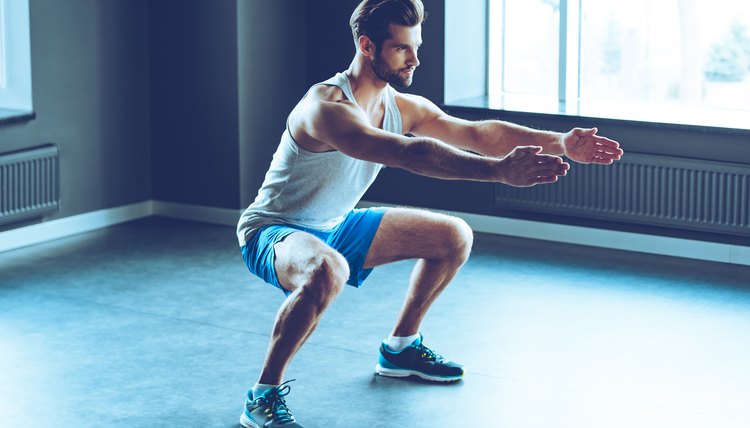
Squats are often thought of as booty-building exercises. Although your glutes are the workhorse muscles during a squat, these exercises also tone and strengthen other leg muscles, including the hamstrings along the back of your thighs. Certain types of squats target your hamstrings more than others.
Air Squat
Performing an air squat with proper form emphasizes the muscles in the back of your hips and thighs, including your hamstrings. These muscles are active regardless of how deep you squat, so only lower down as far as you can comfortably go. Perform squats in sets of 10 repetitions.
How-To: Stand with your feet shoulder-width apart. Push your butt back as if you are going to sit in a chair. Bend your knees and push them apart as you lower down into a squat. Keep your chest up throughout the movement. At the bottom of your squat, squeeze your buttock and thigh muscles and stand back up.
Squats for Working the Hamstrings
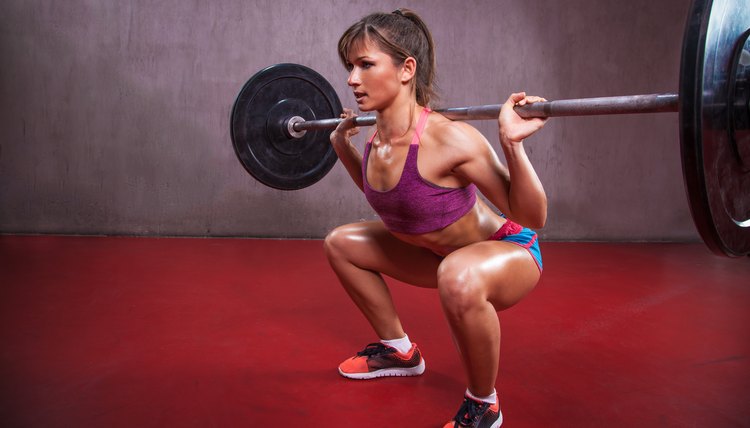
Barbell Back Squats
Barbells are a popular way to add weight to your squat. The position of your barbell can impact which leg muscles have to work harder during this movement. Hold your barbell across your upper back to help target your hamstring muscles. Focus on a spot in front of you throughout this movement to help keep you upright. Bending forward during a back squat can damage your low back.
How-To: Stand with your feet slightly more than shoulder-width apart and the barbell positioned across your upper back. Grab the bar next to your shoulders with your palms facing forward. Push your butt back and sit down into the squat. Lower down as far as you can without bending forward, then stand back up.
Squats for Working the Hamstrings
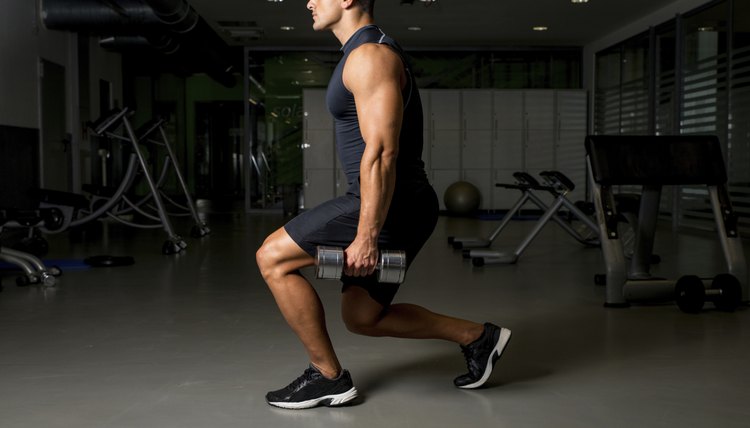
Split Squats
At first glance, split squats look a lot like a lunge. While lunges work both legs equally, the hamstring muscles are most active in the front leg during split squats. The back leg is used for balance. Practice this exercise without weights to make sure you can maintain your balance while using proper form. If needed, start with your back foot resting on the ground rather than an elevated surface. As with barbell squats, focus on a spot in front of you to prevent yourself from bending forward as you squat. Do not allow your knee to move in front of your toes during this movement. If it continues to occur, move your front leg further forward.
How-To: Stand with your feet staggered and the toes of your back foot resting on an elevated surface. Hold dumbbells by your sides with your elbows straight. Bend your front knee and slowly lower your body straight down until your thigh is parallel to the ground, then stand back up.
References
- BMC Sports Science, Medicine & Rehabilitation: Toward Evidence Based Strength Training: A Comparison of Muscle Forces During Deadlifts, Goodmornings and Split Squats
- Journal of Strength and Conditioning Research: Squatting Kinematics and Kinetics and Their Application to Exercise Performance
- Sands WA, Wurth JJ, Hewitt JK MD. National Strength and Conditioning Association’s (NSCA) Basics of Strength and Conditioning Manual. National Strength and Conditioning Association. 2012.
- Lorenzetti S, Ostermann M, Zeidler F, et al. How to squat? Effects of various stance widths, foot placement angles and level of experience on knee, hip and trunk motion and loading. BMC Sports Sci Med Rehabil. 2018;10:14. doi:10.1186/s13102-018-0103-7
- Myer GD, Kushner AM, Brent JL, et al. The back squat: A proposed assessment of functional deficits and technical factors that limit performance. Strength Cond J. 2014;36(6):4-27. doi:10.1519/SSC.0000000000000103
- Schoenfeld B. Squatting kinematics and kinetics. Journal of Strength and Conditioning. 2010; 24(12):3497-2506.
- Barbell back squat. Collegiate Strength & Conditioning Coaches Association. 2016.
- Conceição F, Fernandes J, Lewis M, Gonzaléz-badillo JJ, Jimenéz-reyes P. Movement velocity as a measure of exercise intensity in three lower limb exercises. J Sports Sci. 2016;34(12):1099-106. doi:10.1080/02640414.2015.1090010
- Rhea MR, Kenn JG, et al. Joint-angle specific strength adaptations influence improvements in power in highly trained athletes. Human Movement. 2017;17(1):43-49.
Writer Bio
Dr. Bailey is a physical therapist with an additionaldegree in psychology and board certification in hand therapy. She is a Level 1CrossFit Coach and former ACSM certified personal trainer. Dr. Bailey is alsoan Anatomy and Physiology professor and has been writing health and fitnessarticles for over 10 years.