
MCL Injuries in Cycling
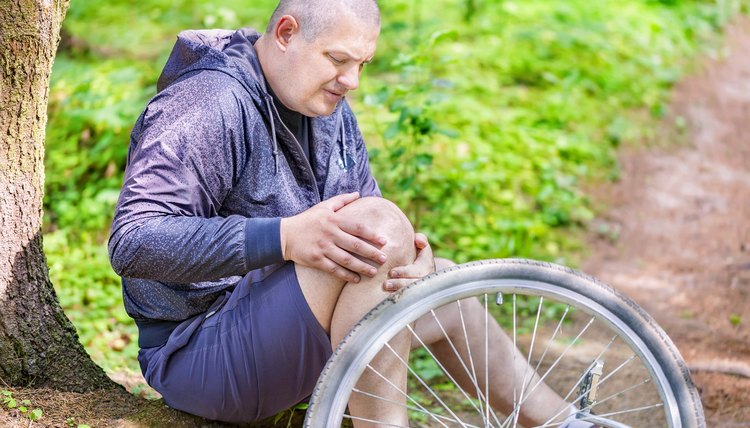
Cycling is arguably a joint-friendly alternative to running, provided you do not fall prey to a common source of sports injuries: training error. For, as large and complex as it is, your knee joint can easily be injured due to its dependence on surrounding muscles and ligaments for stability. The medial collateral ligament, or MCL, is one of these key stabilizing ligaments.
Anatomy
Four major ligaments connect your femur, or thighbone, to your lower leg bones: the anterior and posterior cruciate ligaments, which form an "X" in front and behind your knee joint, respectively; and the medial and lateral collateral ligaments, found on the inner and outer sides of your knee, respectively. The medial collateral ligament specifically helps maintain the alignment between your femur and tibia, or shinbone. Without an MCL, your knee would buckle inward. Because the MCL layers communicate with different structures in the knee, MCL injuries can cause secondary damages.
Causes
According to University of Pittsburgh orthopedist Patrick McMahon, the mechanism behind MCL sprains is a valgus stress, or outward turning, at the knee joint. Thus, overuse of the knee joint and twisting injuries can lead to MCL sprains. For instance, sudden increases in intensity or abrupt changes in direction while cycling at high speeds may cause hard muscle contractions that place excessive stress on the MCL Although less likely, a direct blow on the outside of the knee joint can also damage the MCL, such as during a cycling accident.
Classification
As with all ligaments, MCL injuries are considered "sprains" and classified in three grades. In a grade 1 MCL sprain, the ligament is mildly damaged but still able to stabilize the knee joint. Grade 2 MCL sprains are considered partial tears because they stretch the ligament to the point of looseness. However, the ligament is still functional. Grade 3 MCL sprains are complete tears wherein the ligament is split into two pieces, making the ligament non-functional and the knee joint unstable.
Signs & Symptoms
People who experience MCL sprains often report a popping, tearing or pulling sensation at the time of injury. Additional common indications of an MCL injury include knee stiffness; pain and tenderness on the inner side of the knee; limping with a bent knee; and swelling and bruising at the injury site after 24 hours. Immediate swelling at the time of an MCL injury may indicate that surrounding structures have also been damaged. Ironically, McMahon remarks that grade 1 and 2 MCL injuries are usually more painful than complete tears.
Treatment
The immediate management of MCL injuries involves rest, ice, compression and elevation. First and second-grade MCL injuries are typically treated conservatively with either a cast or a brace. The main goal is to protect the knee against valgus stress and resume knee motion within a week or two. There's more controversy surrounding the superiority of surgery over conservative treatment when it comes to grade 3 MCL injuries. However, McMahon notes more evidence in favor of surgical repair when multiple ligaments are torn in the same knee.
Prevention
Road safety measures and bicycle safety equipment are essential for overall injury prevention. You may prevent MCL injuries by a number of measures including proper physical conditioning to develop muscle strength and flexibility, safe training techniques, proprioceptive training and hinged braces to limit valgus stress. It’s equally important not to skip a warm-up and stretching before each cycling session. According to Navy Environmental Health Center Injury prevention specialist Diana Settles, you should also ensure a proper fit of your bicycle, and not place your knee in full extension or hyperextension when cycling.
References
- "Current Diagnosis & Treatment: Sports Medicine;" Patrick McMahon, M.D.; 2007
- "Athletic Training & Sports Medicine;" Chad Starkey, Ph.D. and Glen Johnson, M.D.; 2006
- Kazemi M, Dabiri Y, Li LP. Recent advances in computational mechanics of the human knee joint. Comput Math Methods Med. 2013;2013:718423. doi:10.1155/2013/718423
- American Academy of Orthopedic Surgeons. (Review March 2014) Collateral Ligament Injuries.
- Grawe B, Schroeder AJ, Kakazu R, Messer MS. Lateral Collateral Ligament Injury About the Knee: Anatomy, Evaluation, and Management. J Am Acad Orthop Surg. 2018;26(6):e120-e127.
- Naqvi U, Sherman Al. Medial Collateral Ligament (MCL) Knee Injuries. [Updated 2019 Jun 4]. In: StatPearls [Internet]. Treasure Island (FL): StatPearls Publishing; 2019 Jan-.
- Evans J, Nielson Jl. Anterior Cruciate Ligament (ACL) Knee Injuries. [Updated 2019 Mar 8]. In: StatPearls [Internet]. Treasure Island (FL): StatPearls Publishing; 2019 Jan-.
- Kiapour AM, Murray MM. Basic science of anterior cruciate ligament injury and repair. Bone Joint Res. 2014 Feb; 3(2): 20–31. doi: 10.1302/2046-3758.32.2000241
- American Association of Orthopedic Surgeons. (Reviewed March 2014). Anterior Cruciate Ligament Injuries.
- Blunt CW, Jonas CE. Knee Pain in Adults and Adolescents: The Initial Evaluation. Am Fam Physician. 2018 Nov 1;98(9):576-585.
- Marieswaran M, Jain I, Garg B, Sharma V, Kalyanasundaram D. A Review on Biomechanics of Anterior Cruciate Ligament and Materials for Reconstruction. Appl Bionics Biomech. 2018; 2018: 4657824. doi: 10.1155/2018/4657824
- Pache S, Aman ZS, Kennedy M, et al. Posterior Cruciate Ligament: Current Concepts Review. Arch Bone Jt Surg. 2018;6(1):8–18.
- American Academy of Orthopedic Surgeons. (Review February 2009). Posterior Cruciate Ligament Injuries.
- Johns Hopkins Medicine. (n.d.). Knee Ligament Repair.
- Eitzen I, Moksnes H, Snyder-Mackler L, Risberg MA. A progressive 5-week exercise therapy program leads to significant improvement in knee function early after anterior cruciate ligament injury. J Orthop Sports Phys Ther. 2010;40(11):705–721. doi:10.2519/jospt.2010.3345
Resources
Writer Bio
Suzanne Fantar has been writing online since 2009 as an outlet for her passion for fitness, nutrition and health. She enjoys researching and writing about health, but also takes interest in family issues, poetry, music, Christ, nature and learning. She holds a bachelor's degree in biological sciences from Goucher College and a MBA in healthcare management from the University of Baltimore.