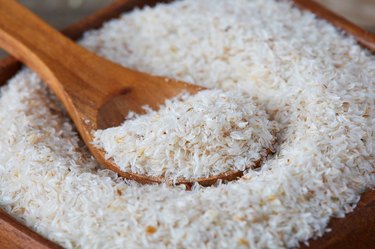
You hear "fiber is your friend" all the time, so you might have added psyllium husk to your daily regimen to get a boost. But if you experience psyllium husk side effects like gas and bloating, you don't have to stick them out — there are ways to avoid these issues and still get more fiber.
Read more: Is Daily Use of Psyllium Husk as a Laxative Harmful?
Video of the Day
Video of the Day
Psyllium Husk Side Effects
If you're taking psyllium husk, then you may know, as Mount Sinai notes, that it is a natural, plant-based fiber available in powder, tablet, capsule and wafer forms, with a bounty of digestive and whole-health benefits.
Villanova, Pennsylvania-based Lisa Diewald, RD, LDN, registered dietitian and nutritionist, and program manager of the MacDonald Center for Obesity Prevention and Education (COPE) at Villanova University, says that ramping up psyllium husk too quickly can cause gastrointestinal side effects like:
- Gas.
- Bloating.
- Abdominal cramping.
"Most people can tolerate psyllium husk very well in normal serving sizes, and the extra dose of fiber can help meet daily fiber goals," Diewald says. But, "higher amounts of psyllium husk can occasionally cause [these] unpleasant, but usually temporary, side effects," she says.
Mayo Clinic agrees, noting that bloating, cramping and flatulence are more likely when you start at a high dose.
How to Prevent Bloating and Gas
To prevent any bloating, gas and cramping, Diewald recommends taking a gradual approach to psyllium husk intake — and to hydrate, hydrate, hydrate. "To ward off side effects, gradually introduce psyllium husk in small amounts into your well-balanced diet, and wait a period to allow your body to adjust before increasing the amount you use," she says.
Mayo Clinic agrees, but cautions that you don't exceed 50 grams of supplemental fiber per day, as doing so could affect how your body absorbs nutrients.
"And always team psyllium husk up with plenty of water for best tolerance," Diewald says. So, when side effects like gas, bloating and cramping happen, back off the psyllium husk a bit, drink more H2O and resume a lesser, more gradual dosing of fiber. "For immediate relief of gas or bloating, try taking a walk or moving around to alleviate the symptoms, or try rubbing the area," Diewald says,
You should see your doctor if symptoms don't improve, the Mayo Clinic says.
Psyllium Husk Safety
For reference, the Mayo Clinic advises that if you're a woman age 50 or younger, your daily fiber intake should be at least 25 grams (and 21 grams for females 51 and older), and if you're a 50-year-old or younger man, you need 38 grams of fiber per day (and 30 grams for men over 50).
While the Mayo Clinic recommends that you first aim to get your daily fiber from your diet, it acknowledges that this is because most fiber supplements only provide one type of fiber (soluble or insoluble), as opposed to the myriad fibers and micronutrients you may need.
In that sense, the Mayo Clinic says, eating a wide variety of food is ideal. But if your diet is falling short and you are boosting your fiber intake, that's when a supplement can play a helpful supporting role — and psyllium husk is complete with both kinds of fiber, the Mayo Clinic says.
While a fiber supplement, including psyllium husk, is safe to take every day, according to the Mayo Clinic, you should always talk to your doctor or pharmacist first, as fiber can reduce your body's ability to absorb some medications, including some that treat:
- Thyroid disorders.
- Depression.
- Diabetes.
- High cholesterol.
- Seizures.
- Various heart ailments.
In fact, the Mayo Clinic says, even such common over-the-counter drugs as ibuprofen and aspirin can be affected by an upped fiber intake. To counteract this interaction, the Mayo Clinic recommends that you take your medicines one to two hours after your fiber.
Dietary Fiber Recommendations
It's important to note though that "there's no need to depend exclusively on psyllium husk for a fiber boost," Diewald says. She notes that high-fiber foods "can contribute ample fiber to help daily goals," including:
- Black beans.
- Bananas.
- Brussels sprouts.
- Barley.
- Avocados.
- Sweet potatoes.
- Apples.
- Pears.
And, ultimately, your doctor is your go-to for ensuring you are choosing the safest supplement, dosage and timing for you.
Is this an emergency? If you are experiencing serious medical symptoms, please see the National Library of Medicine’s list of signs you need emergency medical attention or call 911.