
What does fact checked mean?
At SportsRec, we strive to deliver objective content that is accurate and up-to-date. Our team periodically reviews articles in order to ensure content quality. The sources cited below consist of evidence from peer-reviewed journals, prominent medical organizations, academic associations, and government data.
- ACE: Physical Activity Calorie Counter
- NIH: Exercise for Your Bone Health
- Harvard Health Publications: Calories Burned in 30 Minutes for People of Three Different Weights
The information contained on this site is for informational purposes only, and should not be used as a substitute for the advice of a professional health care provider. Please check with the appropriate physician regarding health questions and concerns. Although we strive to deliver accurate and up-to-date information, no guarantee to that effect is made.
High-impact Aerobics Vs. Low Impact
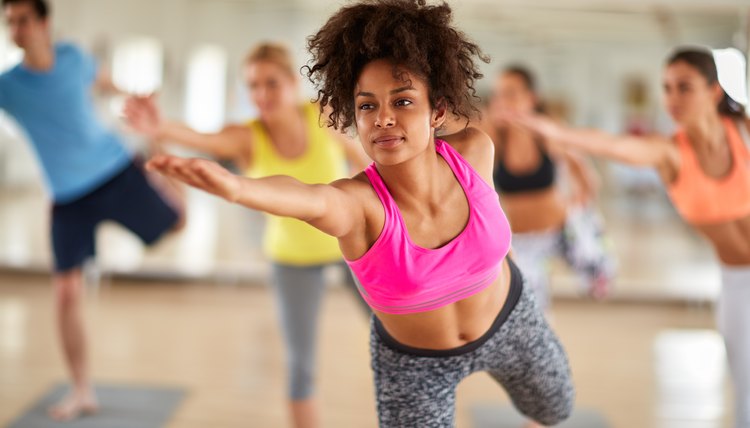
Half a century has passed since Dr. Kenneth H. Cooper introduced the concept of aerobic exercise in his book "Aerobics," which encouraged Americans to prevent chronic diseases by exercising regularly. Since thens, the majority of fitness facilities have offered a variety of high-impact and low-impact aerobic based classes, including boot camp, cycling and dance-based aerobics.
However, those with joint problems might be concerned about the level of impact on the spine, hips, knees and ankles, as well as the intensity level of the class. Knowing the characteristics of high-impact and low-impact aerobic exercise can help you decide which best suits your fitness goals and physical abilities.
The Lowdown on High Impact
High impact activity can be any kind of strenuous cardiovascular routine where both feet may be off the ground at the same time. High-impact aerobics tend to burn more calories than low-impact, however, the chance for injury either during the session or over time is higher than with low-impact workouts.
High-impact aerobic activities are better suited for advanced exercisers and may be discouraging for beginners. To prevent overuse injuries from high-impact activities, cross-train with low-impact activities and take a day off between vigorous workouts.

High-impact Aerobics Vs. Low Impact
Low Impact Means Lower Stress
During low-impact aerobics, at least one or both feet are on the floor at all times, reducing the stress on the musculoskeletal system. The lower impact makes the activity inclusive to fitness novices and people with physical limitations and injuries. Low impact does not mean the workout is less effective. While low-impact aerobics tend to burn fewer calories than high impact, a 30-minute session can still burn 165 for a 125-pound person, according to Harvard Health Publications.
Many low-impact dance aerobics moves are challenging as well. A creative instructor may choreograph a routine with lower-body strengthening exercises in beat with the music, followed by a salsa routine.
Bone up on Aerobic Benefits
Like muscle, bone is living tissue that responds to exercise by becoming stronger. High- and low-impact aerobic activities are weight-bearing, which helps maintain bone density and increases lean muscle mass.
Because bone mass peaks during early adulthood, women and men older than age 20 can help prevent bone loss with three 50-minute low-impact sessions or three 25-minute high-impact sessions a week to keep the musculoskeletal system strong and improve balance and coordination. Individuals with osteoporosis should consult a physician before starting an aerobic program.
Something for Everyone
In many gym environments, grandparents in their 70s queue up for classes, along with former college athletes and eager new mothers — so the workouts have to be accessible to all fitness levels. Many gyms offer classes with low-impact modifications for beginners or persons with physical limitations and high impact challenges for advanced participants.
Brisk walking is a modification for jogging across the floor during boot camp, while a "cha-cha-cha" between side-to-side mambos increases the intensity of a Latin dance class. Finish all workouts with a cool down and total body stretch to further reduce the chance of injury.
References
Writer Bio
Robin Marcel Gillespie has been in the fitness industry for more than 20 years. She is a National Academy of Sports Medicine Certified Personal Trainer and Corrective Exercise Specialist, Pilates and spin instructor who loves to dance.