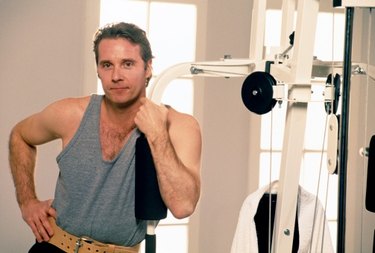
Lower back pain can be debilitating not only in the weight room but in your daily life. Walking, standing and even sitting can be made difficult, particularly if you have an office chair with poor lower back support. According to SpineUniverse.com, 85 percent of people experience some form of back or neck pain, and this can be difficult to heal. Certain exercise machines provide the right kind of exercise for your lower back to strengthen the muscles and reduce pain.
Lat Bar
Video of the Day
The lateral bar, often called the lat bar, is a bar positioned above the head of the lifter. It is designed to be pulled down with the hands and arms, working out the arms, shoulders and back muscles. It has an advantage over other workout machines because in an emergency, such as sharp back pain that makes it difficult to flex or complete the workout, the bar can be released immediately without any risk to the lifter, since it only flies up into the air where it is holstered. Other types of lifts can apply unwanted force on the lower back if the lifter stops the exercise, which can intensify pain and lead to injuries.
Video of the Day
Resistance Training
Some workout machines operate by using resistance training to exercise the muscles. This can be good for a volatile muscle group such as those found in the lower back because the exercise intensity is equivalent to the force exerted by the muscles. Additionally, the stress is not as jerky and dangerous to the muscles as weights, which are more likely to cause an injury. If you are not sure of the way a given workout machine operates, ask a personal trainer or weight room professional to explain the machine to you and/or guide you to a workout machine utilizing resistance training. Some of the most popular resistance training machines include the Bowflex and Soloflex.
Low-Intensity Lifts
One of the problems with lifting weights or using exercise machines is that high workloads can strain the lower back muscles, exacerbating any pain or injuries that might exist. However, many machines can still be used at very low weights that allow you to train for endurance rather than strength. You can make these exercises aerobic in nature and perform many more repetitions than you would lifting for strength, where you often strain to achieve eight to 10 reps. Use a weight that easily allows you to complete 30 or more repetitions in a set, and don't push your muscles--if you start to experience discomfort, stop. By limiting yourself to low-intensity lifting, you can make use of leg curl, leg press and toe press machines, among others.
Is this an emergency? If you are experiencing serious medical symptoms, please see the National Library of Medicine’s list of signs you need emergency medical attention or call 911.