What does fact checked mean?
At Healthfully, we strive to deliver objective content that is accurate and up-to-date. Our team periodically reviews articles in order to ensure content quality. The sources cited below consist of evidence from peer-reviewed journals, prominent medical organizations, academic associations, and government data.
The information contained on this site is for informational purposes only, and should not be used as a substitute for the advice of a professional health care provider. Please check with the appropriate physician regarding health questions and concerns. Although we strive to deliver accurate and up-to-date information, no guarantee to that effect is made.
Gout and Iodine
Iodine is a trace mineral that your body requires for normal cell metabolism. An iodine deficiency may affect the health of your thyroid gland. According to the University of Maryland Medical Center, thyroid problems can increase your risk of developing gout, a curable form of arthritis 1. Consult your doctor before taking iodine supplements to treat any medical condition.
Gout
Gout flare-ups occur when uric acid crystals build up in your joints. Your body produces uric acid as you break down purines in foods. The big toe is the most common site for gout attacks. This disease occurs most commonly in elderly individuals and in middle-aged men. A gout attack usually causes sudden pain and swelling in the affected joint. Gout tends to run in some families, although many factors can contribute to your risk of gout. In addition to thyroid problems, other factors that can increase the likelihood of developing gout include obesity, binge drinking, lead toxicity and the use of diuretics. Losing weight, restricting your intake of alcohol and cutting back on foods that contain purine, such as meat and seafood, may help prevent gout attacks.
- Gout flare-ups occur when uric acid crystals build up in your joints.
- In addition to thyroid problems, other factors that can increase the likelihood of developing gout include obesity, binge drinking, lead toxicity and the use of diuretics.
Iodine
Can I Eat Seaweed If I Have Hyperthyroidism?
Learn More
Iodine helps support the overall health of your thyroid. This trace mineral plays an important role in helping your thyroid produce hormones that control the way your body metabolizes food into energy. Although an iodine deficiency may not directly cause gout, it can increase your risk of hypothyroidism and goiter, two types of thyroid disorders. Seafood is a naturally rich source of iodine, although your doctor may recommend you this food to help minimize gout attacks. Iodized salt is a common source of this trace mineral.
- Iodine helps support the overall health of your thyroid.
- Seafood is a naturally rich source of iodine, although your doctor may recommend you this food to help minimize gout attacks.
Dosage
The recommended amount of iodine for adult men and women is 150 mcg per day. Pregnant and breastfeeding women require slightly higher amounts of this mineral. Consuming 1/4 tsp. of iodized salt provides about 95 mcg of iodine.
- The recommended amount of iodine for adult men and women is 150 mcg per day.
Precautions
Vitamin B12 as a Cause of Gout
Learn More
Consuming too much iodine may compromise your thyroid function, although iodine poisoning in the U.S. is rare 2. Talk to your doctor if you suspect you may have a thyroid problem or if you experience symptoms of gout. Diuretics can increase the amount of uric acid in your body and lead to a greater risk of gout attacks.
Related Articles

Can I Eat Seaweed If I Have Hyperthyroidism?
Learn More
Vitamin B12 as a Cause of Gout
Learn More

Symptoms of Excessive Iodine Intake
Learn More
Iodine & Selenium Dosage for Thyroid Problems
Learn More
How to Speed Up Your Thyroid to Lose Weight
Learn More

Gout and Shrimp
Learn More

Iodine & Shrimp
Learn More
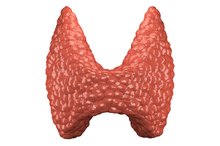
What Are the Causes of Fluctuating Thyroid Levels?
Learn More

Thyroid Shrinking With Herbs
Learn More

Thyroid Disease & Food to Stay Away From
Learn More
References
- Harvard Medical School: All About Gout
- MedlinePlus: Iodine in Diet
- American Thyroid Association. Iodine Deficiency. 2020.
- Eastman CJ, Zimmermann MB. The iodine deficiency disorders. In: Feingold KR, Anawalt B, Boyce A, et al., editors. Endotext. South Dartmouth, MA: MDText.com, Inc. Updated February 6, 2018.
- Ahad F, Ganie SA. Iodine, Iodine metabolism and Iodine deficiency disorders revisited. Indian J Endocrinol Metab. 2010;14(1):13-17.
- Kostoglou-athanassiou I, Ntalles K. Hypothyroidism - new aspects of an old disease. Hippokratia. 2010;14(2):82-87.
- American Thyroid Association. Hypothyroidism in Children and Adolescents. 2020.
- National Institutes of Health, Office of Dietary Supplements. Iodine. Updated July 9, 2019.
- U.S. National Library of Medicine. Congenital hypothyroidism. Updated February 11, 2020.
- Johnson LE. Iodine. Merck Manual Professional Version. Updated October 2018.
- Murthy MB, Krishnamurthy B. Severe irritant contact dermatitis induced by povidone iodine solution. Indian J Pharmacol. 2009;41(4):199-200. doi:10.4103/0253-7613.56069
- Puchalski AR, Chopra IJ. Radioiodine treatment of differentiated thyroid cancer despite history of 'iodine allergy'. Endocrinol Diabetes Metab Case Rep. 2014;2014:130084. doi:10.1530/EDM-13-0084
- Schabelman E, Witting M. The relationship of radiocontrast, iodine, and seafood allergies: a medical myth exposed. J Emerg Med. 2010;39(5):701-707. doi:10.1016/j.jemermed.2009.10.014
- National Institutes of Health, Office of Dietary Supplements. Iodine. Updated July 9, 2019.
- American Cancer Society. Radioactive Iodine (Radioiodine) Therapy for Thyroid Cancer. Updated March 14, 2019.
- Centers for Disease Control and Prevention. Potassium iodide (KI). Updated April 4, 2018.
- Kalra S, Unnikrishnan AG, Sahay R. The hypoglycemic side of hypothyroidism. Indian J Endocrinol Metab. 2014;18(1):1-3.doi:+10.4103/2230-8210.126517
Writer Bio
Laura Wallace Henderson, a professional freelance writer, began writing in 1989. Her articles appear online at Biz Mojo, Walden University and various other websites. She has served as the co-editor for "Kansas Women: Focus on Health." She continues to empower and encourage women everywhere by promoting health, career growth and business management skills.