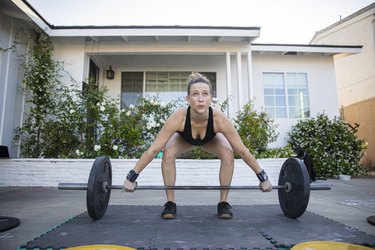
If you're a fitness enthusiast, you know how frustrating it is to be sidelined due to lower back pain after lifting weights. But by correcting your form, lifting the appropriate weight and allowing adequate recovery time, you should be able to minimize this post-exercise back pain.
Read more: 10 Popular Exercises That Can Hurt Your Back
Video of the Day
Video of the Day
Why Your Back Hurts
About 80 percent of American adults deal with back pain, according to the federal Office of Disease Prevention and Health Promotion. For some the pain is acute, meaning it lasts for a few days to a few weeks, says the National Institute of Neurological Disorders and Stroke. For others it's chronic, lasting longer than 12 weeks.
When it comes to back pain after lifting weights, most acute cases are related to sprains or strains, which can happen if you lift weights improperly or try to lift something too heavy. In many cases, your muscles are fatigued beyond their natural ability, and this can lead to small tears and irritation, explains Rahul Shah, MD, an orthopedic spine and neck surgeon with Premier Orthopaedic Spine Associates of southern New Jersey.
If a back injury moves beyond the muscles, Dr. Shah says, it can affect the spine. "The spine moves in two broad areas of hinges — in the disc and the joints — and if either is affected, you can get back pain," he says. And if the disc is affected and it hits the spinal nerve, this can shoot pain down the back, which then trickles down into the leg, he adds.
The most common signs of a pulled back muscle, says Dr. Shah, are tightness and pain in the back along with stiffness, tightness and localized swelling or spasms. One area of the back may feel more painful or swollen than the rest.
Origins of Back Pain
One contributing factor to low back pain after lifting is inadequate core strength, according to the American Council on Exercise (ACE). To help strengthen these powerhouse muscles, which include the internal and external obliques, rectus abdominis, transverse abdominis and erector spinae, ACE recommends regularly doing a variety of exercises, including planks, side planks, the bird dog, back extensions and the supine gluteal bridge.
These moves also help overcome the negative effects of too much sitting, at work or at home, which leaves muscles slack. Plus, these exercises use only your own body weight, minimizing the risk of injury from using weights that are too heavy for your fitness level.
In addition to exercises for the core, the Cleveland Clinic suggests focusing on good body mechanics while lifting, sitting and standing. For instance, make sure your back is straight, keep your shoulders down and back, engage your core before lifting anything and avoid twisting movements that compromise your lower back.
Treating Lower Back Pain
There are three stages to low back pain treatment, says Armia Abdo, DPT, a physical therapist and chief clinical officer of Alignmed, Santa Ana, California. "The first stage is allowing the area to heal, which can take up to 14 days, depending on the level of injury," he says, noting that the idea is to avoid putting more stress on the back, which could impede recovery.
Once your lower back is no longer painful at rest, Abdo says it's time to move to phase two, which involves working to regain any lost movement and coordination in your lower back. You move out of this phase when you can do your everyday activities without pain, he says.
The final phase is the return to fitness activities, says Abdo. "You should be able to start the same activities you did previously, but if it's been longer than two weeks, it's typical to lose some strength so you will need to gradually increase to get back to your previous routine," Abdo says.
If the back pain stems from more than pulled muscles and isn't localized to just one spot in the back, Dr. Shaw says that testing, possibly with X-rays or an MRI, may be needed to diagnose the problem and identify more specific treatment.
- Armia Abdo, DPT, doctor of physical therapy, chief clinical officer, Alignmed, Santa Ana, California
- American Council on Exercise: “5 Lower Back Bodyweight Exercises to Ward Off Low Back Pain”
- Cleveland Clinic: “Back Strains and Sprains: Prevention”
- National Institute of Neurological Disorders and Stroke: “Low Back Pain Fact Sheet”
- Rahul Shah, MD, orthopedic spine and neck surgeon, Premier Orthopaedic Spine Associates, southern New Jersey
- Office of Disease Prevention and Health Promotion: "Arthritis, Osteoporosis, and Chronic Back Conditions"
Is this an emergency? If you are experiencing serious medical symptoms, please see the National Library of Medicine’s list of signs you need emergency medical attention or call 911.