
Kickboxing Terms
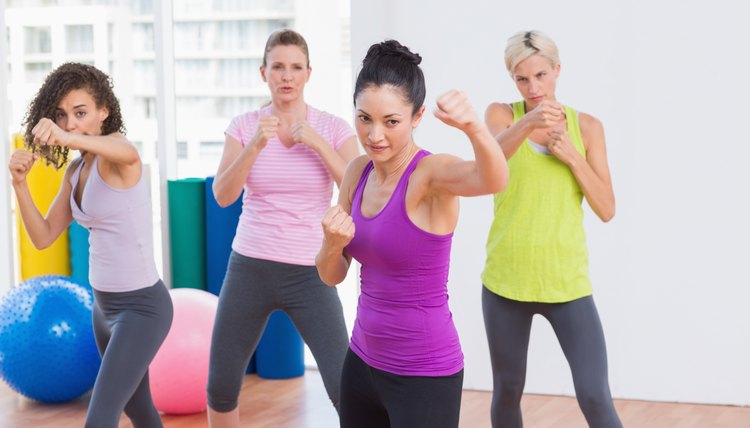
Whether participating in kickboxing for cardio and fitness or fighting, there are some common terms to know. Kickboxing combines elements of karate and strikes that make contact with an opponent and has been popular in the U.S. since the 1970s. As a workout, kickboxing combines changes in speed and resistance in a cycle to provide a work/rest training environment.
Fight Stance
Kickboxing starts with a basic stance that gets the body ready for movement. The feet in a basic fight stance are not next to each other. For right-handed people, the left leg is forward, knees slightly bent and the shoulder slightly forward. The hands come up to protect the chin with the left hand out farther from the face. Tuck the chin and keep the mouth closed.
Boxer's Shuffle
In kickboxing, a boxer’s shuffle is a basic movement to learn prior to throwing any punches or kicks. It is a slight movement that is more of a shuffle than a full step. Shift the body weight to the center, left foot or right foot.
Bob and Weave
The bob and weave in kickboxing terms is a way to avoid contact from an opponent. It is also a workout for the legs. To bob and weave, do a half squat that contracts the quadriceps (bob), then slightly turn the body away from the advancing hit. For example, if a right punch is coming, the bob would be a squat down and the weave would have the left shoulder come forward slightly to load the right hand for a strike.
Punches
There are four basic punches in kickboxing. The jab is a punch thrown from whatever shoulder is forward; in fight stance for right-handed people this would be the left, and comes from the shoulder using the front leg for power. It normally starts a combination of punches. The cross is a more powerful punch that uses the power from the rear leg and is thrown with the rear arm. The power here comes from the rotation of the body. The hook is a punch thrown from the forward leg with the arm parallel to the ground. The hips rotating towards the hook to create power. The uppercut punch is used in close situations and the arm comes up to hit the chin of the opponent. The power here comes from either leg.
Front Kick
A front kick in kickboxing can be done with the front or rear leg. The front kick starts by bringing the knee up, then extending the leg toward a target in a kick motion to hit with the ball of the foot then returning the leg to starting position.
Roundhouse Kick
A roundhouse kick starts with the lead leg stepping forward and the body beginning to rotate, then raise the knee of the kicking leg up, thigh parallel to the floor and toes pointed. Bend the knee slightly forward and down, then extend the leg so it is straight, hitting with the top of the foot. Bring the kicking leg back down to starting position.
Side Kick
A side kick is thrown at an opponent or target to the side with the kickboxer standing in basic fight stance. Bring the knee up with the thigh parallel to the ground. Push the heel of the kicking leg out to the side and straighten the leg, aiming to hit with the heel of the foot.
Blocks
A front high block in kickboxing starts with the elbows bent to 90 degrees and the fists tight with the palms facing out. The high block tries to connect with the advancing blow to deflect it at an angle, not head on with the forearm at head level. An outside middle block starts with the elbow bent to 90 degrees and the arm moves out from the body toward the side. An inside middle block starts the same as a high front or outside middle block and then has the arm move in towards the body with the forearm rotated slightly so the palm is inward.
Resources
Writer Bio
Karen Cashin began writing and working in public relations in 1999. Her work has appeared in the "hapwise" newsletter and on after5detroit.com. Cashin has experience in the health care, consumer and automotive fields, and holds a Health Insurance Associate designation from America’s Health Insurance Plans, along with her Master of Arts in public relations and organizational communication from Wayne State University.