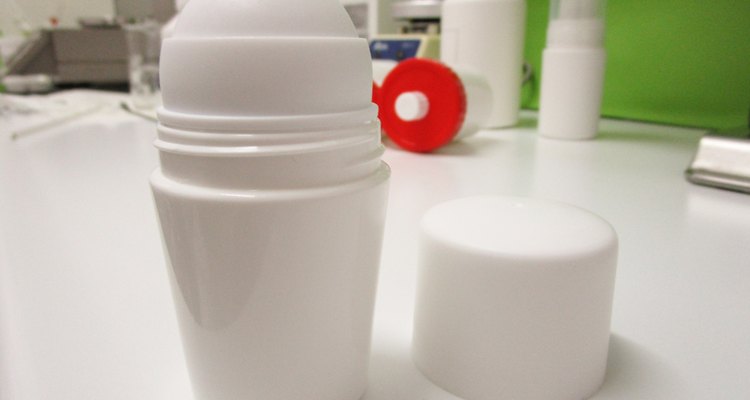
enriscapes/iStock/Getty Images
Propylene glycol is a small, carbon-based molecule that is in the alcohol family, along with the more familiar compounds ethanol (drinking alcohol) and isopropyl (rubbing alcohol). It’s perhaps most similar of all to the antifreeze compound ethylene glycol, and it too finds application as a de-icing compound and antifreeze. Mostly, however, propylene glycol is an effective solvent and is a common ingredient in pharmaceuticals, cosmetics and deodorant sticks.
Physical Properties
According to the Material Safety Data Sheet (MSDS) for propylene glycol, it’s a colorless liquid with a slightly sweet taste and is notably more viscous than water, meaning that it flows slowly, like syrup. Its melting point is -72.4 degrees F, and its boiling point is 370.8 degrees F. It has a specific gravity of 1.036, meaning that it is only slightly more dense than water. Its vapor pressure at normal room temperature is negligible, so propylene glycol does not evaporate to any significant degree.
Molecular Properties
Propylene glycol is a fairly small molecule consisting of three carbon atoms, two oxygen atoms and eight hydrogen atoms. Its molecular weight is 76.09 g/mol, according to the CRC Handbook of Chemistry and Physics. The compound’s small size and structural similarity to drinking alcohol makes it very soluble in water; in fact, propylene glycol is hygroscopic, meaning that it can pull water out of the air and dissolve the water. As a result, a sample of propylene glycol left open to the air will gain volume over time as it gains water.
Chemical Properties
The propylene glycol molecule is quite stable and doesn’t decompose over time. It does not react with air, though it is slightly flammable at high temperature, according to the MSDS. Because propylene glycol is both flammable and water soluble, water is an inappropriate fire-containment method; dry non-flammable powder is recommended for fire fighting. A significant and important chemical property of propylene glycol is that when it mixes with water, it disturbs the formation of ice, which leads to its antifreeze utility. While water alone freezes at 32 degrees F, 36 percent solutions of propylene glycol are liquid to 0 degrees Fahrenheit, and more concentrated solutions freeze at lower temperatures still.
Biological Properties
According to the MSDS, propylene glycol is slightly toxic to the skin and eyes and is toxic in large doses if ingested. Of some concern is that the compound is absorbed through the skin, meaning that large surface exposures result in symptoms similar to those produced through ingestion. In particular, propylene glycol causes damage to the central nervous system, which includes the brain and spinal cord. There is also animal evidence that it has mutagenic properties, meaning it can lead to cancer, and that it is a teratogen, meaning it causes birth defects. While large dose inhalation is rare due to the low volatility of propylene glycol, if heated and inhaled it can cause respiratory irritation and central nervous system disruption.
Related Articles

What Is Cognac Amber?

What Happens to the Alcohol ...

The Effects of Inhaling Air Dusters
Difference Between Percent Alcohol & ...

What Are the Types of Fine China?
Safety Hazards of Acetone

Why Does the Hair Fall Off of Your ...

What Foods Provide Calcium D-Glucarate?

Potassium Permanganate to Wash ...

How to Clean Turquoise & Silver Jewelry

What Is 916 in Jewelry?
Types of Polyester Fabric

The Disadvantages of Polyester Cotton

How to Remove Liquid Downy Stains
Is Allantoin a Relative of the Lanolin ...

Ingredients in Restylane

Ingredients of Fingernail Polish Remover

Does Vodka Settle to the Bottom of a ...

The Ingredients of Neutrogena Sensitive ...

Liquid Smoke Ingredients
References
- "Material Safety Data Sheet"; Propylene Glycol; Rev October, 2005
- "CRC Handbook of Chemistry and Physics"; David Lide; 1974
Writer Bio
Kirstin Hendrickson is a writer, teacher, coach, athlete and author of the textbook "Chemistry In The World." She's been teaching and writing about health, wellness and nutrition for more than 10 years. She has a Bachelor of Science in zoology, a Bachelor of Science in psychology, a Master of Science in chemistry and a doctoral degree in bioorganic chemistry.
Photo Credits
enriscapes/iStock/Getty Images