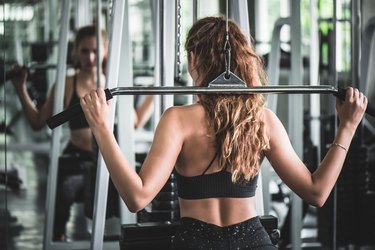
The multi-gym routine has been around since 1959 when Marcy introduced the All-in-One Gym, featuring a variety of weight-based strength-training stations all on a single frame. Since then, the gear has evolved, but many of the exercise staples accommodated by multi-gyms remain unchanged.
Every multi-gym workout plan, for beginners and fitness buffs alike, varies just as multi-gym machines themselves differ from one another. By using the exercise stations commonly offered by multi-purpose devices, you can fill your workout regimen with solid, old-school resistance exercises for all muscle groups.
Video of the Day
Video of the Day
All About Multi-Gyms
Legendary strongman and competitive weightlifter Walter Marcyan began to design multi-use fitness equipment for his House of Health gym chain in the Los Angeles area as far back as 1946. Eventually, his fitness brand, the Marcy Gymnasium Equipment Company of Glendale, California, brought the All-In-One-Gym to the mass market in 1959. Marcyan's systems were so popular that they ended up in the homes of fitness icons, such as Bruce Lee.
Retro devices like Marcy's All-In-One-Gym or, later, his Multi-Station Home Gym Machine were bulky and simple by modern standards. Still, they have contributed to the rising popularity of the home-gym trend. The all-in-one workout stations that appear in homes, gyms and garages today still share many of their baseline features, including specific types of workout stations that have become incredibly common among multi-gyms.
From the 1950s onward, multi-purpose home gyms have often centered around a seat-bench combo, which can be used for time-tested strength exercises like presses and curls.
Pulley and lever systems connected to stacks of flat weight plates, which allow users to select a variety of different load levels, accommodate staple exercises like flyes. Many units add a separate lever for leg presses, while pulley bars for pushdowns and pulldowns are also a fixture.
These common features will, of course, have a huge effect on the design of your multi-gym routine. For most multi-gyms, though, the name of the game is usually "full-body workout."
Read more: 5 Must-Have Items for At-Home Workouts
Multi-Gym Considerations
Before you start Googling "free multi-gym exercises chart," it's important to keep a few multi-gym and home-gym realities in mind. Most of all, it's crucial to understand that — while there are lots of commonalities — multi-gym routines are not a one-size-fits-all solution.
For instance, some machines use proprietary systems, relying on unique mechanisms (like flexible rods, for example) to create resistance. For the multi-gyms that favor their own set of exercises rather than classic workout staples, always adhere to the manufacturer's workout instructions.
That said, even multi-gyms that accommodate standard exercises may vary a bit in their form factors, so it's still important to refer to the manufacturer-provided guidelines and warnings.
Safety is paramount, especially when using multi-gyms at home — and that's a universal aspect. The International Association of Certified Home Inspectors reminds you to always keep free weights in a stable position when not in use.
Limit children's access to your gym equipment as they might get injured. Position your machines so that you have a clear, distraction-free view of your surroundings when working out. You'll also want to wash your hands before exercise and give your machine a wipe-down afterward to prevent the spread of pathogens.
Multi-Gym Program: Pec Flyes
You'd be hard-pressed to find a modern multi-gym that doesn't include a set of padded levers just for pec flyes. This isolation exercise uses a pushing force to target the sternal pectoralis major while engaging the clavicular pectoralis major, pectoralis minor and serratus anterior as synergists.
Here are some recommendations from ExRx.net for lever pec flyes:
- Sit on the machine's seat with your back fully supported by the pad, or in a position that is slightly leaned back. Plant your feet flat on the ground, keeping your head in line with your spine.
- Position your forearms on the lever's pads, gripping the handles. Your arms should each form a 90-degree angle.
- Push the levers with a slow, controlled motion until they meet, exhaling and engaging your chest muscles as you push. Keep your abdominal muscles tight.
- Inhale as you return to the starting position, feeling the chest muscles stretch. Repeat.
Multi-Gym Program: Lat Pulldowns
Lat pulldowns, a beginner-friendly exercise, can be performed on multi-gyms that have an overhead pulldown bar (usually above the seat, connected to the weight plate selector system by a pulley). This movement focuses on the back, working the latissimus dorsi muscle.
The American Council on Exercise offers some guidance on performing seated lat pulldowns:
- Sit with your back leaned slightly back (at no more than a 30-degree angle). Keep your lower body anchored and feet planted on the ground, with your legs forming a 90-degree angle at the knee (if available, adjust the machine's thigh pad so that it fits firmly atop your thighs).
- Grasp the pulldown bar at the indicated grip positions, with your arms overhead. You may use either a supinated or pronated grip. Focus on pulling your shoulders back and down throughout the exercise.
- Exhale as you pull the bar downward, all the way to the top or midsection of your chest. Drive the downward motion with your shoulders.
- Pause for a beat and slowly, smoothly return to the starting position as you inhale. Repeat.
Tip
Some multi-gyms feature pulldown bars that accommodate exercises in the standing position.
For standing lat pulldowns, keep your feet in a staggered, walking position with a slight bend in your knees. Shift your weight onto your rear leg with a very slight backward lean as you pull down, but avoid flexing your hips.
Multi-Gym Program: Triceps Pushdowns
Many pulley-based multi-gyms come equipped with a pulldown bar ready to bust out some triceps pushdowns, also known as cable pushdowns.
According to ExRx.net, this isolation exercise works the triceps brachii while also engaging a whole ton of stabilizers such as the lats, teres major, deltoids, pecs, traps, abs, obliques and wrist flexors. It's a simple yet effective movement that helps increase arm strength and muscle tone.
Follow these steps to perform triceps pushdowns safely:
- Face the high pulley bar, standing with your back straight, feet shoulder-length apart and shoulders squared.
- Grasp the bar with a narrow, overhand grip. This starting position should leave your elbows resting at your sides.
- Slowly extend your arms down until they are straight, exhaling on the force of the downward push.
- Inhale as you return to the starting position, ending with the back of your forearm near the front of your bicep. Repeat.
Tip
Throughout the entirety of the motion, stay close to the cable to create resistance at the top of the movement, preventing your elbows from traveling too far from your body.
Multi-Gym Program: Seated Curls
If your multi-gym has a slanted pad (sometimes in the form of an attachment) that sits at about chest-height next to the seat or bench, it's ideal for seated biceps curls. Sometimes, the pad is there just to accommodate curls with a barbell or a set of dumbbells, while other machines feature a lever for curls.
In any case, as the American Council on Exercise illustrates, the basic movement remains consistent. As the name implies, this timeless arm exercise works the biceps, so get ready to oil up those guns.
- Sit on the bench or seat with the soles of your feet flat on the ground. Place your arms over the inclined pad, with your biceps and palms facing upward. Keep your head and spine aligned.
- Adjust the height of the pad so that the middle of your elbows rest just about in line with the lower edge of the pad when you pull your forearms in toward your biceps.
- Grasp the handles with an underhand or (to place more focus on the forearms) overhand grip. If you're using your free weights, you'll have positioned yourself with dumbbells or barbells already in-hand, or, ideally, had a spotter pass them to you. With bars or levers, your hands should be about shoulder-width apart, your wrists in a neutral position and elbows extended at the starting position.
- Exhale as you lift the bar or lever upward toward your chest, pulling your forearms in toward your biceps with a controlled motion until you can bend your elbows no further. Keep your abs engaged throughout.
- Inhale as you smoothly return to the starting position, once again extending your elbows downward. Stop when your arms are extended, but avoid locking your elbows. Repeat.
Bicep curls performed with the assistance of pad like this are also known as preacher curls, according to ExRx.net. In a small study published in August 2014, the American Council on Exercise used electromyography (EMG) readings to assess muscle activation in a variety of biceps-focused exercises. The study found nearly 70 percent muscle activation in the biceps brachii during preacher curls.
Multi-Gym Program: Leg Press
Oftentimes, multi-gym systems feature a padded lever at the bottom of the seat. Don't mistake this for a fancy footrest — it's there for a thigh-shaping leg press workout.
As ExRx.net notes, the classic seated leg press engages the quadriceps while also working out the glutes, adductor magnus and soleus muscles as synergists, as well as the hamstrings and gastrocnemius as dynamic stabilizers.
Here's how to do the lever seated leg press:
- Sit with your back on the padded backrest or positioned with a slight backward lean. You can stabilize your upper body by grasping the bottom of the seat, or the side handles if available, with your arms straight down.
- Place the soles of your feet on either side of the lever. Your feet should be about shoulder-width apart.
- Push the lever away from your body with a smooth, controlled motion, pushing from both the heel and forefoot as you exhale. At the top of the movement, your legs will be fully extended at the knees. Keep the knees pointed in the same direction as the feet, never allowing your feet to lift off of the lever.
- Inhale as you return to the starting position with a controlled motion. Repeat.
Tip
Position your feet a little lower on the lever to put even more focus on working the quads. Place them a little higher to put more emphasis on the gluteus maximus.
Are Multi-Gyms Worth It?
Debates pitting home gyms against professional gyms will probably be around for as long as multi-gyms exist (and unfortunately, many multi-gym-focused studies are sponsored by multi-gym manufacturers), but if the accessibility, privacy and affordability of a home workout system get you moving, that's a net positive.
Speaking of net positives, your time on a multi-gym will be filled with resistance-based workouts, which research shows to be broadly beneficial. In May 2015, the Journal of the American Medical Directors Association published a study involving 195 older men and women who engaged in resistance training. Their progress was assessed after 12 and 24 weeks.
The first nine words of the study's title should be a dead giveaway: "There Are No Nonresponders to Resistance-Type Exercise Training."
That's right — in certain metrics, including lean body mass, muscle fiber size, leg strength and physical function, the researchers found that "nonresponsiveness was not apparent in any subject, as a positive adaptive response on at least one training outcome was apparent in every subject." In other words, don't let the home-gym shamers keep you from getting your pump on.
- MarcyFitness: Blog: "Marcy History With Walt Marcyan"
- International Association of Certified Home Inspectors, Inc.: "Exercise Equipment Dangers"
- ExRx.net: "Lever Pec Deck Fly"
- American Council on Exercise: "Seated Lat Pulldown"
- ExRx.net: "Cable Pushdown"
- ExRx.net: "Lever Seated Leg Press"
- American Council on Exercise: "Seated Biceps Curls"
- ExRx.net: "Dumbbell Preacher Curl"
- American Council on Exercise: "ACE Study Reveals Best Biceps Exercises"
- ScienceDirect: Journal of the American Medical Directors Association: "There Are No Nonresponders to Resistance-Type Exercise Training in Older Men and Women"