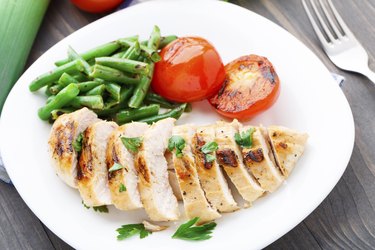
Chicken breast meat is rich in protein but low in fat, making it one of the leanest cuts of poultry you can consume. Cooked chicken breast's nutrition includes various vitamins and minerals, such as large amounts of selenium and B-complex vitamins.
Video of the Day
Video of the Day
Protein Consumption and Healthy Diets
According to ChooseMyPlate.gov, the United States Department of Agriculture's website, most adults need between 5 and 6.5 ounces of protein each day. The exact amount of protein you need depends on your age and sex.
In general, women need less than men (5 to 5.5 ounces per day), while men need 5.5 to 6.5 ounces per day. However, the amount of protein you should consume may increase based on your physical activity levels. People with very active jobs or who perform strenuous exercise regularly are likely to need more protein than average.
Protein comes in a wide variety of forms. A can of tuna has around 3 to 4 ounces. Your average small, lean hamburger has a little less, at 2 to 3 ounces. When it comes to chicken, 3 ounces of chicken breast protein is the equivalent to around half of a small breast.
Chicken breast is one of the healthiest animal proteins you can consume. This is because the meat is lean compared to other proteins; it's even fairly low in fat compared to other cuts of chicken. Additionally, chicken breast is low in cholesterol and rich in a wide variety of nutrients.
Cooked Chicken Breast Nutrition Facts
According to the USDA, 3 ounces (85 grams) of cooked chicken breast's nutrition contains 133 calories. Lean chicken breast has 27.3 grams of protein and 2.8 grams of fat, 0.9 grams of which come from saturated fat. Cooked chicken breast nutrition features no carbohydrates as long as you're not incorporating any additional ingredients like breadcrumbs.
Cooked chicken breast's nutrition also features a variety of vitamins and minerals:
- 6 percent of the daily value (DV) for potassium
- 6 percent of the DV for magnesium
- 16 percent of the DV for phosphorus
- 7 percent of the DV for zinc
- 49 percent of the DV for selenium
- 50 percent of the DV for vitamin B3 (niacin)
- 27 percent of the DV for vitamin B5
- 46 percent of the DV for vitamin B6
- 7 percent of the DV for vitamin B12
As you can see, chicken breast is richest in B-complex vitamins, selenium and protein. It also contains other nutrients, like choline (18 percent of the DV) and small amounts (between 1 and 4 percent) of other essential vitamins and minerals.
Skin-on vs. Skinless Chicken Breast
As you might imagine, a skinless chicken breast's calories will be lower than one that still has the skin on. You don't lose many nutrients by removing chicken skin, but you may obtain less iron and vitamins B3 and B12 when you consume skinless chicken breast.
Nutrient content can also change because of other factors, like the way you cook your chicken breast. The Mayo Clinic recommends cooking methods that involve less fat — like steaming, baking and grilling — over pan-frying and frying.
However, regardless of these variations, skinless chicken breast is considered the healthier choice. Removing chicken skin enables you to eliminate some saturated fat from your meal. The USDA recommends consuming low-fat and lean cuts of meat whenever possible.
This is ideal, because according to the American Heart Association, saturated fat can be bad for your cardiovascular health. It has the potential to increase your cholesterol and triglyceride levels. When these become too high, they can increase your likelihood of health issues like heart disease and stroke.