
Standard vs. Olympic Weight Bench
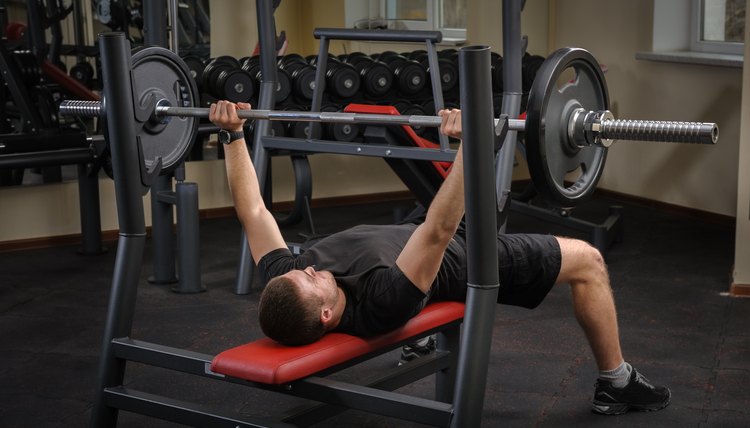
If you're shopping for a home gym or to outfit a fitness facility, you're faced with two options when it comes to bench pressing equipment: standard vs. Olympic. Lifts attached to a bench, including the bench press, don't have role in a sport at the official Olympic games; however, benches and equipment may be denoted as "Olympic" by manufacturers. The benches differ from those noted as "standard" or those that lack a specification altogether. Olympic benches tend to be wider, more stable and support a greater amount of weight. The difference in Olympic and standard equipment extends to the weights and bars, too.
The Bench
Many manufacturers sell "Olympic" benches, but they vary in specifications. For the most part, Olympic benches are wider to give you greater leverage when lifting the usually heavier, longer Olympic bar. Olympic benches also tend to be longer than standard variations.
The Bar
Olympic bars come with specifications set by the International Weight Lifting Federation. They're 7 feet long and 1 1/4-inches in diameter in the center, with thicker ends measuring 1 31/32 inch (or 50 milimeters) around. They weigh 45 pounds.
Standard bars tend to be thinner — just 1-inch in diameter — and uniform along the whole bar, rather than sporting thicker ends. Depending on the manufacturer, the bar may be 7 feet long or shorter.
Standard bars are sometimes made of material of lesser quality, meaning they're more likely to bend under weight of 200 pounds or more. Olympic bars, crafted from steel, can tolerate far more weight — up to 1,100 pounds. They bend slightly when heavily loaded, but that's part of their design. These quality bars spring back into place when the weights are removed.
The equipment you use to bench press matters.
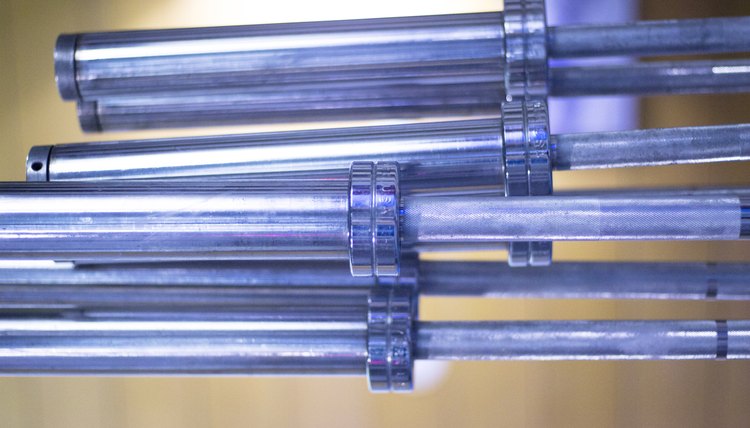
Olympic bars for the bench press also have very specific knurling, or ridged texture. These bars are smooth in the middle, so as not to catch clothing and undermine your lift, and knurled in the grip.
Plates
Olympic plates are always made of solid iron. Some standard plates may be, but shop around. Cheaper versions can be composed of concrete surrounded by plastic. Olympic plates also come as bumper plates; they're coated in rubber so that when you drop them from a lift, they bounce slightly and absorb impact.
Olympic plates are the only type that will fit onto an Olympic bar, as the hold in the center is 2 inches in diameter. The exact weight of these plates tends to be more precise, too.
Quality Costs
Equipment labeled "Olympic" is, for the most part, of higher quality and appropriate for high usage, such as in a fitness facility. You'll invest more in it, but if you're serious about bench pressing and other barbell-based lifts, it's worth the cost.
Writer Bio
Andrea Boldt has been in the fitness industry for more than 20 years. A personal trainer, run coach, group fitness instructor and master yoga teacher, she also holds certifications in holistic and fitness nutrition.