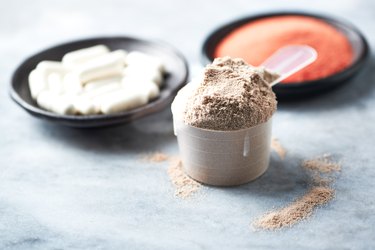
A weight gainer for women offers them an effective way to build lean muscle. Some health products rapidly build muscle, while others have no impact on your weight. Even worse, many nutritional supplements have side effects. Dietary aids work best when you combine them with resistance exercises like weight lifting. Learning about the best supplements and techniques will help you quickly, easily and safely improve your physique.
Read more: Define Lean Muscle
Video of the Day
Video of the Day
Gain Mass With Whey Protein
Manufacturers create the byproduct whey during the cheese-making process. This milk protein has performance-enhancing properties. For example, a February 2018 article in the journal Nutrients showed that ingesting whey facilitates recovery from exercise-related fatigue. These potent effects suggest that whey might also be a weight gainer for women as you often experience hypertrophy after recovering from resistance exercises.
A March 2016 report in Applied Physiology, Nutrition, and Metabolism explored this possibility in eight collegiate, female athletes. These researchers gave the women about 1 ounce of whey protein each day for 8 weeks during training. Compared to baseline, that treatment caused a 3-pound increase in muscle mass. This effect appeared irrespective of training as a control group didn't show an increase.
Most studies on whey have focused on its effects on male participants. In fact, 92 percent of the subjects tested in the February 2018 report in Nutrients were men. Yet women can also benefit from taking whey.
A July 2018 paper in Nutrition Reviews describes the many advantages that women can get from ingesting whey. These benefits include small increases in muscle mass and no loss in fat mass. Some women fear getting bulky from resistance exercises, so the modest gains in muscle size caused by whey will help you prevent that problem.
Gain Mass With Amino Acids
Whey protein features several amino acids like leucine, and taking them as a supplement can also help you build muscle. For example, an April 2015 article in the Journal of Nutrition, Health and Aging showed that leucine intake increased muscle mass in older adults at risk for age-related muscle wasting. That study mostly tested men, but the anabolic effects of leucine should also be a weight gainer for women as well.
A June 2015 paper in the American Journal of Physiology tested this hypothesis in eight postmenopausal women. Participants received either amino acids or whey protein during a single testing session. In this session, the women did leg extensions with one leg while the other leg served as a control. Results indicated that the supplement only affected muscle protein synthesis in the exercised leg. Amino acids and whey protein had very similar effects with no treatment having superiority over the other.
A March 2019 fact sheet from Brigham and Women's Hospital gives you some tips on how to get started with leucine. The author recommends combining leucine with other amino acids such as isoleucine and valine. They note that you can easily get your daily quota of amino acids by eating enough protein. The author reminds you to stay aware of the possible side effects of leucine like overworking your kidneys. Finally, they encourage pregnant women to avoid leucine supplements.
Read more: How Women Can Build Muscle Fast
Use Weight Gain Pills
The large demand for supplements for weight gain for females has led manufacturers to develop dietary aids that are essentially weight gain pills. Using supplements like this has caused weight gain in mixed-gender studies.
For example, a July 2015 paper in the American Journal of Clinical Nutrition showed that pills with fish-oil-derived polyunsaturated fatty acids, PUFA, increased thigh muscle size in 29 older adults compared to 15 control subjects. These PUFA supplements should have anabolic effects in an all-women sample as well.
A March 2019 report in the FASEB Journal explored this possibility in 20 younger women. These researchers prevented a single leg of each participant from moving for two weeks. Compared to a control group, women given pills with PUFA had less muscle loss in the movement-restricted leg. Tissue samples confirmed the anabolic properties of PUFA therapy. Women taking PUFA had greater levels of muscle protein synthesis during the study.
You can also benefit from PUFA therapy. A June 2015 fact sheet from the American Heart Association shows you how. In this fact sheet, the author answers many common questions about PUFA. They recommended taking in abundant PUFA while avoiding saturated fats and trans fats. The author lists the many foods rich in PUFA you can benefit from like sunflower seeds and walnuts.
Read more: How to Build Leg Muscles for Women
Eat Healthy and Gain Mass
Your doctor will likely ask about your activity and diet during your next physical. That inquiry shouldn't surprise you given the benefits of regular exercise and a healthy diet. In fact, this combination can help you fight disease and slow aging. Combining resistance exercises and a healthy diet might also let you gain weight in a safe way.
An October 2015 paper in the Journal of Applied Physiology tracked the progress of 63 postmenopausal women for 24 weeks. These researchers assigned the women to one of three conditions: (1) no treatment, (2) resistance exercises and (3) resistance exercises and a healthy diet. All women doing resistance exercises showed an increase in leg strength. Interestingly, only the latter group showed an increase in leg mass. The women in that group showed about a 2 percent increase in mass by the end of the study.
You can adopt a healthy diet similar to one described in the October 2015 paper in the Journal of Applied Physiology. Those women followed a diet with 44 percent of their calories coming from carbohydrates, 36 percent from fat and 20 percent from protein. They also consumed at least 25 grams of fiber, avoided saturated and trans fats and had an n-6/n-3 fatty acids ratio of less than two. The latter ratio helps keep your inflammation down, according to a November 2018 report in Open Heart.
Keep Muscle Using Vitamin D
Vitamin D plays a unique hormone-like role in your body. It can, for example, affect your muscle and bone tissue. An April 2018 review in the Annals of Laboratory Medicine indicated that vitamin D has an anabolic effect when you are getting enough calcium. An October 2015 report in Osteoporosis International showed this muscle-building effect in older women.
These researchers above gave the women oral doses of 1,000 IU of vitamin D each day for nine months. A control group received no treatment. Results indicated that the control group lost nearly 7 percent of their muscle mass by the end of the study. In contrast, the treatment group kept most of their muscle mass. That group also showed an increase in muscle strength.
It's easy for women to reap the benefits of keeping their vitamin D levels raised. You can increase your circulating levels of vitamin D by taking a nutritional supplement, having a healthy diet or getting abundant sunshine. All of these methods can cause hypervitaminosis, so please use them in moderation. Keeping your daily intake below 400 IU and getting a sensible amount of sunshine — using sunscreen — should prevent this medical condition from happening, according to an August 2018 review in Clinical Medicine.
Vitamin D deficiency is common in women and may be something you need to take into consideration when you're trying to gain weight. About 50 percent of pregnant women living in an area with abundant sunshine have a deficiency, according to a February 2016 paper in Nutrients. Older women are also at risk for a vitamin D deficiency. A November 2015 article in Nutrition and Metabolism showed that nearly 80 percent of postmenopausal women didn't have enough circulating vitamin D.
- Nutrients: "Effect of Whey Protein Supplementation on the Temporal Recovery of Muscle Function Following Resistance Training"
- Applied Physiology, Nutrition and Metabolism: "Eight Weeks of Pre- and Postexercise Whey Protein Supplementation Increases Lean Body Mass and Improves Performance in Division III Collegiate Female Basketball Players"
- Nutrition Reviews: "Effect of Whey Protein Supplementation on Body Composition Changes in Women"
- Journal of Nutrition, Health and Aging: "Effects of Leucine-Rich Protein Supplements on Anthropometric Parameter and Muscle Strength in the Elderly"
- American Journal of Physiology: "Intake of Low-Dose Leucine-Rich Essential Amino Acids Stimulates Muscle Anabolism Equivalently to Bolus Whey Protein in Older Women at Rest and After Exercise"
- Brigham and Women's Hospital: "Leucine"
- American Journal of Clinical Nutrition: "Fish Oil–Derived N–3 PUFA Therapy Increases Muscle Mass and Function in Healthy Older Adults"
- FASEB Journal: "Omega-3 Fatty Acid Supplementation Attenuates Skeletal Muscle Disuse Atrophy During Two Weeks of Unilateral Leg Immobilization in Healthy Young Women"
- American Heart Association: "Polyunsaturated Fat"
- Journal of Applied Physiology: "Influence of Combined Resistance Training and Healthy Diet on Muscle Mass in Healthy Elderly Women"
- Open Heart: "Importance of Maintaining a Low Omega-6/Omega-3 Ratio for Reducing Inflammation"
- Annals of Laboratory Medicine: "Vitamin D Activities for Health Outcomes
- Osteoporosis International: "Effect of Vitamin D Supplementation Alone on Muscle Function in Postmenopausal Women"
- Clinical Medicine: "Risks of the ‘Sunshine Pill’ — A Case of Hypervitaminosis D"
- Nutrients: "High Prevalence of Vitamin D Deficiency Among Pregnant Saudi Women"
- Nutrition and Metabolism: "Influence of Obesity on Vertebral Fracture Prevalence and Vitamin D Status in Postmenopausal Women"