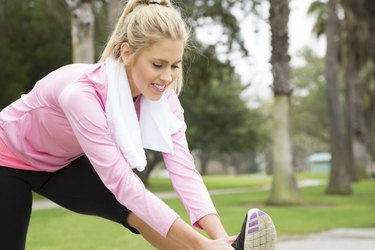
Blood clots can occur in any vein in your body, but they most commonly develop in the deep veins of the legs. A clot that forms in this area is called a venous thrombosis and the condition is referred to as deep vein thrombosis, or DVT for short. One of the main risk factors for DVT is inactivity, so regular exercise to get the blood moving is generally recommended as part of preventing and treating a blood clot.
About DVT
Video of the Day
You are most at risk of developing DVT if you have been inactive for a long period of time, for example, after surgery, illness or long-distance travel. Those who are elderly or have had a heart attack or stroke are also at risk as are pregnant people and those using the contraceptive pill.
Video of the Day
When a clot forms in your leg it blocks the flow of blood into and away from the area. This can result in swelling and pain. The skin around the area takes on a shiny appearance and changes to red, blue or pale, says Dr Trisha MacNair on the BBC Health website.
If you experience any of these symptoms, you should see your doctor immediately because a clot can break away from the vein and travel to your lungs causing a fatal pulmonary embolism.
As always, prevention is better than cure, and one of the ways you can do this is to avoid sitting or lying down for long periods of time. When you move around regularly, your muscles get your blood moving and prevent it from pooling in your legs.
Single Knee Hugs
While Qantas Airways recommends you do this exercise during long-haul flights, you can also do it while sitting in a chair at home or lying on your bed. Clasp your hands just below one knee and pull it as far in toward your chest as you can. Hold for about 15 seconds and, if you are in a seated position, keep the other foot flat on the floor. If you are lying down, try to keep the resting leg flat along the floor or bed. You should feel a stretch down the back of the raised leg and in your buttock and hip. Return the working leg to the floor and repeat the stretch 10 times on each side.
Heel Raises
Depending on how good your balance is, you may need to do this exercise while holding on to a stable chair or wall. Stand up straight and place your feet about hip-width distance apart and then lift your heels off the floor, slowly rising up on to your toes until you are balancing on the balls of your feet only, says James Chapman on the Mail Online website. Lower your heels back down to the floor, and then bend your knees into a gentle squat, keeping your heels firmly on the floor and without rolling them inwards when you bend. As you lift, lower and squat, try not to slouch forwards – your back should remain straight, with the top of your head reaching towards the ceiling throughout the entire exercise. Repeat the series 10 times.
Ankle Circles
There's no excuse for not doing this exercise because it's easy to do while sitting or standing, watching TV, cooking or lying bed. If you choose to do it while sitting down, Chapman suggests placing a pillow under the knee of the leg you're working. Lift the foot on this leg slightly off the floor and then circle it as wide as you can 10 times in both directions. Repeat on the other leg. Try to keep your leg still as you circle – the movement should be restricted to your ankle joint.