What does fact checked mean?
At Healthfully, we strive to deliver objective content that is accurate and up-to-date. Our team periodically reviews articles in order to ensure content quality. The sources cited below consist of evidence from peer-reviewed journals, prominent medical organizations, academic associations, and government data.
- European Journal of Obstetrics, Gynecology and Reproductive Biology: Body Art and Pregnancy
- European Journal of Obstetrics, Gynecology and Reproductive Biology: Body Art and Pregnancy
- MedlinePlus: Keloids
The information contained on this site is for informational purposes only, and should not be used as a substitute for the advice of a professional health care provider. Please check with the appropriate physician regarding health questions and concerns. Although we strive to deliver accurate and up-to-date information, no guarantee to that effect is made.
Navel Piercings & Keloid Scarring
Piercings in general, and navel piercings in particular, are gaining popularity in Western societies. A pierced navel, particularly popular with young women, can be a visually pleasing way to show off a flat stomach or to commemorate a special life event or experience. However, navel piercings -- like other piercings -- may develop keloid scarring in susceptible individuals.
Navel Piercing
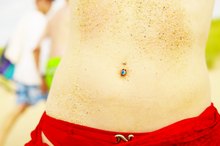
A study in the "British Medical Journal," published in June 2008, found that one in 10 English adults had a piercing in a place other than the ear lobe 5. Women were found more likely than men to have a body piercing -- and one third of those English adults who had piercings in places other than ear lobes reported having a navel piercing. A navel piercing is typically placed through the flap of skin directly above the belly button, with a curved piece of jewelry passing through the piercing and sitting both above and over the navel.
Keloids
How to Prevent Infection in Pierced Ears
Learn More
Keloids are raised areas of skin caused by the overgrowth of scar tissue. A range of skin injuries can cause:
- keloids to form -- some of the most common causes of keloids include burns
- chickenpox
- acne
- wounds
- surgical incisions
- vaccinations
- piercings
You may have a genetic predisposition to keloids, which are often observed to run in the family. Additionally, keloids are generally more common among younger females and individuals of African heritage.
Keloid Treatment Options
If you have a navel piercing and a keloid scar forms, several treatment options are available. However, keloids may resolve and disappear without treatment. Typical treatments for keloids include freezing, pressure, injections of corticosteroids, laser treatment, radiation or surgical removal. Keloid removal may not be permanently effective and, in fact, surgical keloid removal carries the risk of possibly causing a larger keloid scar to form.
- If you have a navel piercing and a keloid scar forms, several treatment options are available.
- However, keloids may resolve and disappear without treatment.
Expert Insight
Scars From Belly Rings
Learn More
Writing in the "European Journal of Obstetrics, Gynecology and Reproductive Biology" June 2010 issue, Nicolas Kruger reports an increase in the number of pregnant women with body piercings seen in the past 20 years 2. Kruger reports that navel piercings may cause stretch marks during pregnancy, as the area around the navel and stomach distends. This means that women may be more prone to developing keloid scars during pregnancy. For this reason, many women choose to remove pierced navel jewelry during pregnancy.
- Writing in the "European Journal of Obstetrics, Gynecology and Reproductive Biology" June 2010 issue, Nicolas Kruger reports an increase in the number of pregnant women with body piercings seen in the past 20 years 2.
- Kruger reports that navel piercings may cause stretch marks during pregnancy, as the area around the navel and stomach distends.
Prevention/Solution
Practice thorough aftercare of your navel piercing to reduce the risk of infection, tearing or scarring. Clean your navel piercing once or twice per day, using antibacterial soap. Make sure your hands are clean when handling your piercing or jewelry. A particular problem with navel piercings is the ability of clothing to snag and irritate the piercing -- this can lead to irritation or scarring. Keep clothing waistbands and belts away from your navel piercing site during the healing period to reduce the likelihood of keloid scarring.
- Practice thorough aftercare of your navel piercing to reduce the risk of infection, tearing or scarring.
- Keep clothing waistbands and belts away from your navel piercing site during the healing period to reduce the likelihood of keloid scarring.
Related Articles

How to Prevent Infection in Pierced Ears
Learn More
Scars From Belly Rings
Learn More
Nipple-Piercing Facts
Learn More
How to Minimize Scarring With Monroe Piercings
Learn More

Reasons People Practice Ear Stretching
Learn More
How to Get Rid of Hypertrophic Scars From Piercings
Learn More
What Are the Dangers of Pierced Ears?
Learn More

How to Get Rid of a Keloid From Piercing
Learn More
How to Reduce a Keloid
Learn More

How to Heal a Nipple Piercing
Learn More
References
- American Family Physician: Complications of Body Piercing
- European Journal of Obstetrics, Gynecology and Reproductive Biology: Body Art and Pregnancy
- MedlinePlus: Keloids
- Medical News Today: Body Piercing Popular in England, but Also Risky
- British Medical Journal: Body piercing in England: A Survey of Piercing at Sites Other Than Earlobe
- National Conference of State Legislatures. Tattooing and body piercing | state laws, statutes and regulations. March 13, 2019.
- Koenig, L. M., & Carnes, M. (1999). Body Piercing: Medical Concerns with Cutting-Edge Fashion. Journal of General Internal Medicine, 14(6), 379–385.
- Palo Alto Medical Foundation, Body Piercing
- National Conference of State Legislatures. Tattooing and body piercing | state laws, statutes and regulations. March 13, 2019.
- American Academy of Pediatrics. HealthyChildren.org. Body piercings, teens & potential health risks: AAP report explained. Updated September 18, 2017.
- Johns Hopkins All Children’s Hospital. Adolescent tattoos, body piercings and body modifications. November 21, 2017.
- Koenig, L. M., & Carnes, M. (1999). Body Piercing: Medical Concerns with Cutting-Edge Fashion. Journal of General Internal Medicine, 14(6), 379–385.
- Palo Alto Medical Foundation, Body Piercing
Writer Bio
Jae Allen has been a writer since 1999, with articles published in "The Hub," "Innocent Words" and "Rhythm." She has worked as a medical writer, paralegal, veterinary assistant, stage manager, session musician, ghostwriter and university professor. Allen specializes in travel, health/fitness, animals and other topics.