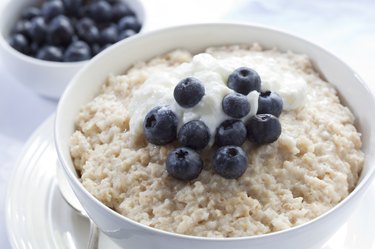
Oatmeal is a staple of many a childhood, the "stick-to-your-ribs" breakfast that helped you make it through the school day. Recent research has shown that the moms of yore were onto something — oatmeal does, in fact, stay with you longer than other grains and can be a valuable ally in the battle against belly fat. However, not just any oatmeal will do — instant packets with sugary flavorings just aren't the same and may actually work against you.
Satiety
Video of the Day
To many, the worst part of dieting is the hunger, followed by the lack of satisfaction after a calorie-restricted meal. Fiber-rich foods like oatmeal help you avoid the hunger in several ways. First, such foods are generally chewier and take longer to eat than low-fiber foods, which make you eat slowly enough that your body has time to notice when it is full. Second, fiber absorbs moisture, which can help you feel full longer, occupying more room in your stomach and taking longer to digest. This effect increases if you drink plenty of water with your meal. Third, oats, in particular, have fewer calories per serving than many low-fiber alternatives. Compare a serving of oatmeal to a calorically-equivalent serving of your favorite cereal and decide which one is more satisfying.
Video of the Day
Glycemic Index
There is conflicting evidence regarding oatmeal and weight loss. A 1999 study in the journal "Pediatrics" found that boys who consumed instant oatmeal ate 81 percent more calories later in the day than boys who ate a vegetable omelet. The blame falls on instant oatmeal's high glycemic index, which means that it makes your blood sugar spike and rapidly fall, leaving you hungry. The effect wasn't as pronounced when the boys consumed lower-GI steel-cut oats, although they still ate more than the omelet group. Steel-cut oats supply a steadier stream of glucose to your bloodstream, allowing your body to feel satisfied longer, but the protein and carb combination of the vegetable omelet still outperformed the oats. Adding protein to your oatmeal, such as almonds, pecans or other nuts, will lower the glycemic index and may help keep you feeling full longer.
Waist Circumference
There is evidence, though, that oats can contribute to the loss of belly fat,. A 2010 study in the "Journal of the American Dietetic Association" found that participants with overweight and obesity who ate a whole-grain oat cereal twice per day reduced their waist circumference more than the group eating a low-fiber cereal of equal calories, though there was no difference in total weight loss. This means that both groups lost weight, probably due to the daily caloric deficit, but the oats eaters lost more belly fat. The oat group also experienced lowered cholesterol levels, and results were seen as early as four weeks into the study.
Bottom Line
All available evidence suggests that oats are a healthy food; however, whether or not it helps you lose belly fat is up to you. Simply adding oats to your diet won't do the job — you must still have a daily caloric deficit to lose fat, so try replacing a high-calorie doughnut with oatmeal instead. Choosing steel-cut oats over instant gives you a better shot at controlling your appetite, and drinking plenty of water helps the fiber in the oats fill you up. Skip high-calorie toppings like sugar and syrup. Eat it plain or use a handful of berries. If you like milk, use nonfat or a milk alternative — unsweetened almond milk has as little as 40 calories per serving.
- Colorado State University: Dietary FIber
- "Journal of the American Dietetic Association": Whole-Grain Ready-to-Eat Cereal, as Part of a Dietary Program for Weight Loss, Reduces Low-Density Lipoprotein Cholesterol in Adults With Overweight and Obesity
- "Pediatrics": High Glycemic Index Foods, Overeating and Obesity