Seated Calf Stretches
Your calf muscles, comprised of the soleus and the gastrocnemius, are important in your bipedal motion. You use them to walk, run and jump. As such integral muscles, they are prone to injury if not properly strengthened and stretched. If you participate in activities that use your calf muscles, stretching after a warm up and after heavy activity may be beneficial. If you are recovering from a calf injury, follow your physical therapist's recommendations for stretches.
Seated Calf Stretch
Begin by sitting on the ground or a mat with your legs extended in front of you. Bend your knees slightly and flex your feet. Lean forward and place your hands around the ball of your foot and pull gently so that your toes begin to point towards your body. Breathe normally and hold the pose for up to 20 seconds before releasing. Repeat on the other side.
- Begin by sitting on the ground or a mat with your legs extended in front of you.
- Lean forward and place your hands around the ball of your foot and pull gently so that your toes begin to point towards your body.
Isometric Calf Stretch
How To Stretch the Gastrocnemius & Soleus Muscles
Learn More
Isometric stretches involve working a muscle against an immovable force. To isometrically stretch your calf, begin in the same position as the above-mentioned stretch. Bend your legs and place your hands on the balls of your feet, using your hands to move your toes back towards your shin. Once you feel a stretch in your calf, try to point your toes forward, against the force of your hands. Provide enough force so that your feet do not actually move, but stay in place. Hold this position for up to 20 seconds before releasing.
- Isometric stretches involve working a muscle against an immovable force.
- Once you feel a stretch in your calf, try to point your toes forward, against the force of your hands.
Chair Calf Stretch
You can also perform a calf stretch while sitting in a chair at the office or at home. Sit towards the edge of the seat with your back straight and both legs bent, feet flat on the floor. Straighten your right leg, and put your heel on the floor. Flex your foot as much as possible, trying to bring your toes toward your shin. You can reach forward and pull on the ball of your foot, as in the above exercises. You can also lean your upper body forward, keeping your back straight, and move your torso toward your thigh while simultaneously keeping your foot flexed. This forward motion gives you a greater stretch in the back of your calf and thigh.
- You can also perform a calf stretch while sitting in a chair at the office or at home.
- You can reach forward and pull on the ball of your foot, as in the above exercises.
Achilles Tendon
Exercises for Tendonitis of the Foot
Learn More
Although not technically a muscle, the Achilles tendon attaches the calf muscle group to your heel. As it is an integral part of your walking, running and jumping motions, targeting the Achilles when you stretch is also important. To stretch your Achilles, sit on the floor with your legs straight in front of you. Bend one leg until your heel is close to your buttocks and place your heel on the ground. Use your hands to pull your toes, at the ball of the foot, toward your body. Hold for up to 20 seconds and repeat with the other tendon.
- Although not technically a muscle, the Achilles tendon attaches the calf muscle group to your heel.
- As it is an integral part of your walking, running and jumping motions, targeting the Achilles when you stretch is also important.
Related Articles
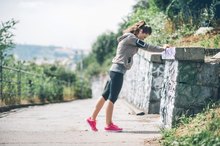
How To Stretch the Gastrocnemius & Soleus Muscles
Learn More

Exercises for Tendonitis of the Foot
Learn More
Stretching Exercises for ACL Injuries
Learn More
How to Stretch the Foot Arch
Learn More
How to Massage a Knee After Total Replacement
Learn More
How to Straighten a Leg Easier After a Total Knee Replacement
Learn More
How to Strengthen the Patella Tendon
Learn More
Physical Therapy Exercises for Lumbar Spondylosis
Learn More
Shin Stretches for Runners
Learn More
Rehab Exercises After MCL Injury
Learn More
References
Writer Bio
Christy Callahan has been researching and writing in the integrative health care field for over five years, focusing on neuro-endocrinology. She has a Bachelor of Science degree in biology, earned credits toward a licensure in traditional Chinese medicine and is a certified Pilates and sport yoga instructor.