
Therapeutic Exercises for a Biceps Femoris Tear
Contrary to popular belief, the biceps femoris has nothing to do with the arms. That muscle is known as the biceps brachii. The biceps femoris is one part of the hamstrings muscle group, located on the back of the thighs. A tear in the biceps femoris is known as a strain or pull. Therapeutic exercises are used to keep the muscle flexible and slowly improve strength. Before you do any exercises for your hamstrings, make sure your doctor has approved physical activity.
Partner Stretch
A partner-assisted stretch is performed one leg at a time. Begin in a face-up position on the floor with your legs straight in front of you and your partner standing by your feet. After lifting your injured leg in the air, have your partner grasp your foot and push your leg toward your body. As you do this, keep your leg straight and only go to a point that does not cause discomfort. Hold for 20 to 30 seconds and slowly release.
Seated Forward Bend
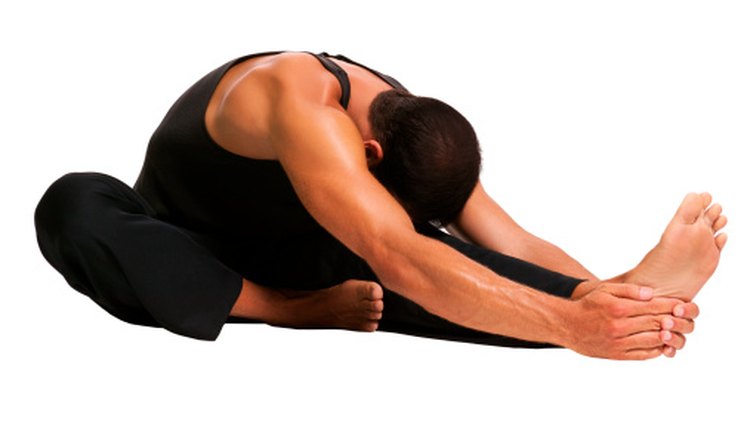
A seated forward bend stretches the biceps femoris and lower back at the same time. Begin in a seated position on the floor with your legs extended and together in front of you. Keeping your back as straight as possible, bend forward and reach for your feet. If you can, grab your feet with your hands. Hold the stretch for 20 to 30 seconds and slowly release. For a variation, place your legs in a "V" shape and bend forward. You also have the option of stretching one side at a time. With this variation, place the sole of one foot on the inner thigh of your other leg and bend forward on the side of your straight leg.
Reclining Big Toe Pose
The reclining big toe pose stretches the biceps femoris with the aid of a towel or tie. Lie in a face-up position on the floor with both legs straight in front of you. Carefully raise your injured leg in the air, wrap the center of the tie around your big toe or the ball of your foot and grab the ends with your hands. Gently raise your leg in the air by pulling back with the tie. Stop as soon as you feel discomfort and hold for 20 to 30 seconds.
Lying Hamstring Curl
A hamstring curl strengthens all parts of the hamstrings. You need a resistance band to do this exercise. After fastening one end to a sofa leg, attach the other end to the lower part of your injured leg and lie on your stomach with your feet facing the anchor. Keeping your thigh flat on the floor, bend your knee and move your heel toward your butt. Hold this position for a second, slowly lower your leg and repeat. You also have the option of strapping an ankle weight to your lower leg. The goal with both exercises is to use light resistance when first starting out, gradually increasing it as you regain your strength.
Isometric Hamstring Exercise
An isometric exercise strengthens a muscle without repetitive movement. An isometric hamstring exercise works the biceps femoris from a seated position. Extend your injured leg out in front of you and place your heel on the floor. Steadily push down and back toward your body until you feel a good contraction in your hamstrings. Hold for five to 10 seconds, slowly release and repeat.
References
Writer Bio
I am very genuine and magnetic on camera, and have made numerous videos on my own for clients and other organizations that I'm affiliated with. I also have a degree in Sport Management, and multiple certifications to back up my validity. I've also been featured in three different exercise infomercials and had a speaking role in a National Lampoons movie.