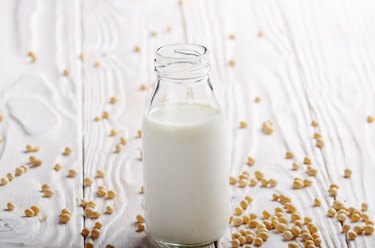
Soy milk's reputation regarding its health benefits for women has seesawed in the past few decades, but recent research indicates that soy milk is safe and actually healthy for most women to drink.
Tip
Soy milk is full of anti-inflammatory agents called isoflavones. Soy milk is also an excellent source of protein. For most women, soy milk is a beneficial substitute for cow's milk, because it's loaded with protein and is usually fortified with calcium.
Video of the Day
Soy Milk Benefits for Women
Soy milk is a good alternative to cow's milk for many people. For women who don't like cow's milk or have an intolerance to dairy, soy milk is a good way to get needed protein and calcium.
Video of the Day
Soy milk has lots of isoflavones which have been found to protect against cancer. But their estrogen-like qualities have caused some concerns, because estrogen had been linked to breast cancer., as outlined in a 1996 study in the journal Cancer Epidemiology, Biomarkers and Prevention. However, the latest research indicates that soy milk isn't linked to higher rates of breast cancer in women.
Women with normal thyroid levels can also safely drink soy milk. Women who take thyroid medication should check with their doctor before drinking soy milk. Typically, it's best to wait four hours after taking thyroid medicine before consuming any soy product. If you don't, your body may have trouble absorbing your thyroid medication.
Read more: Soy Milk Advantages and Disadvantages
Conflicting Soy Studies
Studies of soy's impact on women's health have reported wide-ranging results. There were studies in the 1990s saying soy reduced breast cancer risk. Another study published in 2003 in the Journal of the National Cancer Institute reported that there could be an increase in cancer risk.
A study reported in JAMA in 2009, the Shanghai Breast Cancer Survival Study, followed 5,000 breast cancer survivors in China, ages 20 to 75. The study found that women who consumed high amounts of soy had much lower rates of cancer recurrence and death, including among women who took tamoxifen, a breast cancer treatment drug. Even in that study, researchers concluded that the amount of soy required to impart protective qualities is about 11 grams of soy per day. An 8-ounce glass of soy milk contains anywhere from 3 to 11 grams of soy.
An American Cancer Society study in 2017 reinforced those findings and put concerns about soy and breast cancer to rest. Claims of soy for women's health now have solid research behind them.
The American Heart Association in 2008 said it couldn't confirm earlier assertions that consuming soy food and drink offered protection from heart disease. Still, swapping out dairy milk for soy milk means you'll take in less saturated fat, according to a Harvard Health Publishing news brief from March 2018, which can be a good thing.
What to Believe
Earlier studies resulted in claims that soy milk was bad for females and that women shouldn't eat soy products, but dietitians and researchers are now saying that soy milk benefits for women are many. For example, a January 2018 study from McGill University says that nutritionally speaking, soy milk is the best plant-based milk.
The only caveat, again, is for women who take thyroid medicine. Although you shouldn't drink soy milk for at least four hours after taking your medicine, according to the Mayo Clinic, it's still best to discuss your soy consumption with your doctor.
Soy Milk's Appeal
Soy is a good, low-calorie source of protein. Two to four servings a day of soy milk or other soy foods is a good way to get your protein.
If you're a vegetarian who doesn't consume dairy products, are lactose intolerant or prefer not to eat dairy products, soy milk comes in many different varieties. Chocolate and vanilla soy milk offer taste varieties. Yogurt lovers can buy yogurt made from soy.
Another popular cow's milk alternative, almond milk, may be off limits to people allergic to nuts, so soy milk offers a good alternative in this case.
Nutrients in Soy Milk
One cup of Silk Original Soy Milk has:
- 110 calories
- 9 grams of carbohydrate
- 4.5 grams of fat
- 8 grams of protein
Soy milk has no cholesterol, because it doesn't come from animal fat. If you're looking to add probiotics or fermented food to your diet, probiotic and fermented soy milk are also available.
The calorie content in 1 cup of soy milk, about 80 to 110 calories, is lower than that of a comparable serving of dairy whole milk. One cup of whole dairy milk is 149 calories with 8 grams of fat, 8 grams of protein and 12 grams of carbohydrates.
Soy milk, on the other hand, has 7 grams of protein, 5 grams of fat and 4 grams of carbohydrates.
Fortified Soy Milk
Soy milk, like milk from dairy and other sources, is usually sold fortified, generally with calcium and vitamin D. For example, Silk's Original Soy Milk has calcium carbonate, vitamin D, riboflavin and vitamin B 12 added. This is why it has 450 milligrams of the recommended daily allowance (RDA) of calcium for women and men.
Women and men ages 19 to 50 should get 1,000 milligrams of calcium, while women and men 51 and older should get 1,200 milligrams. So, 1 cup of Silk Original Soy Milk offers at least one third of the RDA of calcium.
Silk Soy Milk has 3 micrograms of Vitamin D, or 15 percent of the RDA, according to the Silk label. The RDA of vitamin D for most adults ranges between 10 and 20 micrograms.
Soy milk also has significant percentages of potassium, vitamin A, folate, riboflavin, vitamin B12, phosphorus and magnesium. So it truly is a good source of some of your daily vitamin needs.
Read more: Soy Protein Vs. Whey Protein
Soy Yogurt and Ice Cream
If you are switching from dairy milk to soy milk, you might feel bad about giving up dairy milk products like yogurt and ice cream. No need to avoid these, however.
Soy yogurt is made with soy milk. An 8-ounce serving contains 66 calories and 1.8 grams of fat, with only 0.2 grams of saturated fat. It also has 10 grams of protein and 500 milligrams of calcium, about half the calcium you need in a day.
Soy frozen dessert, like dairy ice cream, is probably going to contain a lot of sugar. But it's also likely to contain a little less fat and calories than dairy ice cream, so you can still have your soy frozen dessert and eat it too.
- Cancer: "Dietary Isoflavone Intake and All‐Cause Mortality In Breast Cancer Survivors: The Breast Cancer Family Registry"
- Tufts University: "Soy and Survival"
- JAMA: "Soy Food Intake and Breast Cancer Survival"
- NPR: "For Breast Cancer Survivors, Eating Soy Tied to a Longevity Boost"
- Cancer Epidemiology, Biomarkers and Prevention: "Stimulatory Influence of Soy Protein Isolate on Breast Secretion In Pre- and Postmenopausal Women"
- Journal of the National Cancer Institute: "Soy, Isoflavones, and Breast Cancer Risk in Japan"
- American Heart Association: "Docket No. 2007N-0464"
- Mayo Clinic: "Calcium and Calcium Supplements: Achieving the Right Balance"
- Silk: "Original Soy Milk"
- Nutrients: "Isoflavones: Anti-Inflammatory Benefit and Possible Caveats"
- EndocrineWeb: "Soy and Your Thyroid: How Much Is Too Much?"
- Mayo Clinic: "Is It True That People Who Have Hypothyroidism Should Avoid Soy?"
- UCSF Health: "Soy Protein Content of Foods"
- McGill University: "Nutritionally Speaking, Soy Milk Is the Best Plant-Based Milk"
- Harvard Health Publishing: "Confused About Eating Soy?"
- Silk: "Plant-Based Products"
- National Institutes of Health: "Vitamin D"
- Silk: "Plain Soy Yogurt"
- Health: "Is Dairy Free Ice Cream Actually Better for You?"
- USDA Food Composition Database: "Milk, Whole"
Is this an emergency? If you are experiencing serious medical symptoms, please see the National Library of Medicine’s list of signs you need emergency medical attention or call 911.