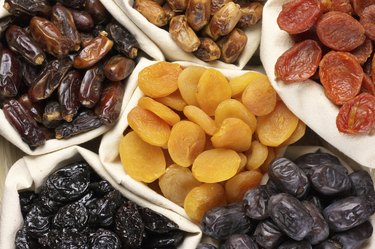
If you're starting an alkaline diet, approximately 80 percent of your meals should consist of alkaline foods. The remaining 20 percent can be acidic foods. A food's PRAL score, or potential renal acid load, determines whether it's defined as alkaline or acidic. A positive PRAL indicates a food is acidic. These include grains, dairy products, meat, poultry and seafood. Foods with a negative PRAL are alkaline and include most plant-based products. A scientific review published in the "Journal of Environmental and Public Health" in 2012 suggests that a diet based heavily on alkaline foods can benefit your health, but more research is needed. Your top 10 best choices for highly alkaline foods could be parsley, basil, dill weed, dried apricots, dehydrated bananas, beet greens, Swiss chard, spinach, coffee and wine.
Pile on the Herbs
Video of the Day
According to the U.S. Department of Agriculture, herbs are one of the most alkaline foods you can eat. Parsley is especially rich in alkaline compounds: freeze-dried parsley has a PRAL score of -108. Other commonly used, highly alkaline herbs include basil, with a PRAL of -85, and dried dill weed which has a -75 PRAL. As a food category, fresh and dried herbs are more alkaline than any other group, with an average PRAL of -8.2.
Video of the Day
Pick Dried Fruit
While fruit and fruit juices are considered alkaline because they have an average PRAL of -3.1, dried fruit is by far the most alkaline of the bunch. This is because the cations, or positively charged ions, that are high in all alkaline foods become more concentrated in dried fruit when water is lost during the dehydration process. For example, fresh apricots have a PRAL of -4.3, while dried apricots are the most alkaline of all dried fruits, with a score of -33. Dehydrated bananas are another good choice, with a PRAL of nearly -30.
Eat Your Green Vegetables
Cooked or raw, dark green leafy vegetables are among the most alkaline of all vegetables. Cooked, drained beet greens have a PRAL of -19, while the greens consumed raw have a score of almost -17. The same is true for Swiss chard -- cooked, it scores -12; raw, it's at -8. For spinach, though, it's the reverse -- raw spinach comes in at nearly -12, while the PRAL of the same amount of boiled, drained spinach is -10. Kale, borage, chicory or mustard greens and collards are equally alkaline.
Enjoy Coffee and Some Alcohol
Unlike many other restrictive diet plans, an alkaline diet allows you to consume coffee and some types of alcohol since they are considered strongly alkaline beverages. Regular coffee has a PRAL of -1.4, though you'll make the value more acidic if you add milk, which has a PRAL of 1.1. Avoid beer, particularly lagers, in favor of wine: white wine's PRAL is -1.2, and red wine's score, at -2.4, is even more alkaline than mineral water.
- U.S. News & World Report: Acid Alkaline Diet -- Overview
- Acid Alkaline Association: Acid Alkaline Food Chart
- International Fruit and Vegetable Alliance: Acid-Base Balance and Alkalinizing Foods
- Journal of Environmental and Public Health: The Alkaline Diet -- Is There Evidence That an Alkaline pH Diet Benefits Health?
- Alkalizinggreens.com: Excerpt From USDA PRAL List