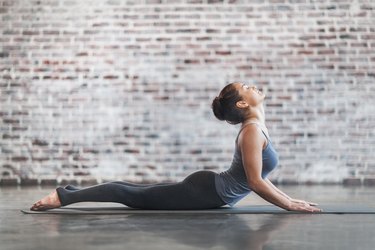
Is yoga strength training? Depending on the style you practice, yes — but its suitability also depends on your fitness goals. Light yoga won't build strength for a power-lifting competition, but muscle-building yoga styles can provide the benefits of regular strength training.
Tip
The more strenuous, muscle-building styles of yoga can be considered strength-training activities, as long as they target the muscles in your entire body.
Video of the Day
Is Yoga Strength Training?
If there's one authority on how much you should exercise to stay fit, it's the Department of Health and Human Services, which releases a new set of physical activity guidelines every few years. Those guidelines are based on the latest exercise science, and the 2015-2020 version recommends strength-training all your major muscle groups twice a week.
Video of the Day
If you dive a little deeper into the extended version of the HHS guidelines, you'll find that "some yoga postures" are mentioned specifically as an option for strength training. So if you're doing the right type of muscle-building yoga then yes, it can count as strength training for health purposes.
However, it's important to remember that not all yoga styles are created equal, which is part of what draws many yogis to the practice in the first place. If your practice resolves around a gentle, restorative style like yin yoga or Kripalu yoga, then strength-training won't be among the benefits it can provide. But if you're doing a more strenuous style like Hatha yoga, Ashtanga yoga or power yoga, you'll be developing muscular strength and endurance.
That doesn't mean you should stop doing gentle yoga. Gentle styles may be a better fit for some bodies, lifestyles and spiritual attitudes than the vigorous styles — and they can provide many of the potential benefits of yoga spelled out by the National Center for Complementary and Integrative Health. These include stress relief; improving sleep and emotional balance; better emotional health and resilience; managing anxiety and depression; increased flexibility; and more.
Read more: 5 Workouts for Strength Training at Home
Tip
Even if you do a strenuous, strength-intensive style of yoga, take a moment and ask yourself if you're using all your major muscle groups. Usually, the answer will be yes. But if the postures you're practicing focus on one part of your body and neglect others, you can add some targeted strength training workouts to address any muscles that you didn't work out doing yoga.
Yoga Can Be Cardio Too
The HHS also recommends doing 150 to 300 minutes of moderate-intensity cardio per week, or 75 to 150 minutes of vigorous-intensity cardio. While gentler yoga styles usually don't count toward this recommendation for cardiovascular exercise, the extended version of the HHS guidelines notes that the more active forms of yoga — for example, Vinyasa or power yoga — can count as moderate-intensity cardiovascular activity.
However, just showing up to yoga class isn't an excuse to put another notch on your fitness belt for the week. Whether you're doing yoga as a form of cardiovascular exercise or strength training (or both), you have to actually put in the work if you want to see the benefits. For the strength training aspect, tired muscles or a feeling that you're really pushing yourself in the more challenging asanas are both good clues that you're working hard enough to see some serious benefits.
Tip
Aiming for strength training doesn't mean you should be reduced to crawling out of yoga class. It's OK — and in fact common — to feel refreshed, recharged and invigorated after a yoga session. But if you walk out feeling like your muscles haven't been challenged, it's a clue that you haven't reached the right level of exertion to get the health benefits of strength training.
To gauge your cardiovascular intensity, the "talk test" is an easy way to check how hard you're working. The usual gauge is that if you can breathe well enough to carry on a two-sided conversation, but not well enough to sing or deliver a monologue, you're working out at moderate intensity.
Mind you, chit-chatting, singing and monologuing (villainous or otherwise) tends to be discouraged in yoga classes. But if you use the talk test for other types of aerobic exercise, you'll be able to compare that feeling to your level of exertion during yoga class. And if gauging exercise intensity is really important to you, you can always ask the instructor to come over and help you "try out" a quiet conversation.
Read more: 11 Essential Yoga Poses Everyone Should Practice
Is Pilates Strength Training?
Yoga and Pilates are often lumped into the same "exercise bucket," if only because they both encourage the development of physical balance, good posture and a long, lean physique. But if yoga qualifies as strength training, does the subtle, challenging guidance you'll get in a Pilates class qualify too?
Not necessarily — and here's why. The type of strength training for health that the HHS recommends requires you to train all your major muscle groups for muscular strength, endurance or both. And although Pilates can provide a fantastic core workout for anybody, it doesn't typically focus on all the big muscle groups that you must work out for optimal health.
That doesn't mean Pilates can't be beneficial, improve your strength, help your posture or otherwise make you feel better — and ultimately, all physical activity is good activity as long as you're not overtraining or working out in a way that'll injure you. You should just supplement your Pilates workout with strength training — or yoga — to target the major muscle groups that aren't addressed in your Pilates workout.
The Benefits of Strength Training
Isn't strength training just for flexing in front of a mirror? Actually, no — science has proven that, just like cardiovascular activity, regular strength training provides some serious full-body health benefits. An analysis published in a July 2012 issue of Current Sports Medicine Reports offers a nice overview of strength training's many proven benefits:
- Improving resting blood pressure, cholesterol and triglycerides
- Promoting bone density
- Reducing pain related to arthritis and fibromyalgia
- Boosting your metabolism
- Sharpening cognitive abilities
- Decreasing visceral fat and inflammation markers
- Improving insulin sensitivity
And, of course, there's the very real, tangible benefit of having the strength and endurance to perform everyday activities, whether that be carrying bags of groceries, walking up and down stairs, or lifting your children or grandkids over your head.
- University of Rochester Medical Center: "Why You Should Try Yoga"
- Health.gov: "Dietary Guidelines for Americans, 2015-2020: Appendix 1: Physical Activity Guidelines for Americans"
- Health.gov: "Physical Activity Guidelines for Americans, 2nd Edition (Complete PDF)"
- Harvard Health Publishing: "Yoga for the Body and Mind"
- National Center for Complementary and Integrative Health: "Yoga: What You Need to Know"
- Current Sports Medicine Reports: "Resistance Training Is Medicine: Effects of Strength Training on Health"