
When you think "strength training equipment," free weights and resistance bands are probably two of the first things that come to mind. They're both pretty straightforward to use, available in virtually any gym and relatively inexpensive compared to barbells or machines.
The thing is, bands and free weights don't work your body in the exact same way. So in the resistance bands vs. weights debate, which one wins?
Video of the Day
Video of the Day
When it comes to building muscle, free weights like dumbbells, kettlebells and barbells are going to be the most effective, but resistance bands deserve a spot in your strength-training routine, too.
Learning how both resistance bands and free weights work can help you figure out which one to pick up for your next workout — and how to incorporate both into a well-rounded strength routine.
Ready to see the power of resistance bands for yourself? Try our 4-Week Resistance Bands Challenge!
4 Benefits of Resistance Bands
1. They’re Accessible
Resistance bands are inexpensive — you can get a whole set with varying levels of resistance for as low as $10. Bands are also portable and take up virtually no space. They can stow away in a bag, drawer or closet. They pack easily for travel and you can use them anywhere.
You can use bands for most movements that you usually perform with free weights, including squats, lateral raises, rows, triceps extensions and biceps curls.
They also come with a relatively low risk of injury. Overextending your joints is more difficult when using resistance bands as opposed to free weights because the elastic naturally limits your range of motion.
Plus, with bands, there's no real risk of dropping a heavy weight on your foot. (If your bands are old, they can snap, so make sure to replace them if they are wearing thin or fraying.)
2. They Can Help You Master New Moves
Band-assisted exercises are excellent tools for working up to new, challenging moves, Roxie Jones, CPT, a certified personal trainer in NYC and founder of BodyROX, tells LIVESTRONG.
Take band-assisted pull-ups, for example. Secure one end to the pull-up bar, place your knees or feet in the sling of the other end and you're good to go. Bands take on some of the load, making it easier to get to the top of each rep.
3. They’re Great for Activating Small Muscles
Resistance bands are often used in rehab and prehab exercises because they allow you to target small muscles that otherwise don't get as much love when your big movers (think: glutes, quads, delts) take over.
This also makes resistance bands great tools for warming up before a more intense strength workout or run.
4. They Can Build Strength
Although they aren't necessarily as heavy as free weights, bands still create tension and resistance on your muscles. So yes, over time, they help strengthen your muscles, especially if you're building beginner-level strength.
For beginners, bands can build upper- and lower-body strength much like free weights, according to a February 2019 review in SAGE Open Medicine.
4 Ways Weights Are Better Than Resistance Bands
Resistance bands are great tools, but there are a few ways they fall short — and situations when free weights are a better choice.
1. They Use Constant, Rather Than Variable, Resistance
The main difference between resistance bands and dumbbells or other free weights is their resistance type. While resistance bands challenge your muscles using variable resistance, free weights use non-variable, or constant, resistance, explains Ava Fagin, CSCS.
When you do a resistance-band row, there's no resistance on your muscles when your arms are fully extended. The farther you pull the band to your torso, the more resistance it puts on your muscles. As you straighten your arms back out, the resistance eases up.
But with weights, the resistance level stays the same throughout the movement. When you row 20 pounds, it's going to be 20 pounds at every point, whereas resistance bands have varying resistance.
Of course, 20 pounds will feel lighter and heavier at different points of each rep, but you still have the same weight in your hands. This constant resistance can be gentler on your joints in certain exercises.
Imagine the top of a dumbbell lateral shoulder raise. When your arms are parallel to the ground, the weights don't put a ton of stress on your shoulders. But if you do a shoulder raise with a band, you get the most resistance on the joints when they're in their weakest position (a T shape).
Another perk: With dumbbells, you always know how much you're lifting and can track your progress in a systematic way.
2. They're Functional
The truth is, you rarely ever pull or lift large stretchy bands in everyday life. It's a lot more functional to lift a free weight because it's a lot like the heavy items you may lift in real life (like a suitcase or grocery bag).
Using dumbbells and other free weights also trains you to move through full ranges of motion (ROM). After all, resistance bands have a limit to how far they can stretch — and only move in straight lines. A limited ROM might be helpful for beginners to nail exercise form safely, but there is a functional benefit to (safely) moving weights in different directions or planes of movement.
3. They're Easy to Overload and Track
"If you're trying to put on muscle and make moves in terms of strength gains, it's going to be a lot harder with resistance bands because you don't know how much weight is on there," Fagin says.
The way to build muscle and strength is through progressive overload, or gradually increasing weight as you get stronger to keep challenging your muscles. That concept is hard to follow with bands because you can't really track and increase the exact resistance, Fagin says. You can go from a light to a medium to a heavy band, but it's far from precise.
With dumbbells and barbells, you can measure the exact weight you add or take away. You can add large amounts or increase the weight in gradual, small increments, all while knowing exactly how much you're moving. For the simple sake of tracking progress, free weights win out.
4. They Build Significant Muscle
Jones calls free weights "the next step in strength training for people wanting to get stronger." While you may notice changes in your strength when you first start using bands, at some point, your progress will plateau. In other words: think of resistance bands like a stepping stone to more advanced lifting.
"When someone is no longer challenged or reaching a plateau with bands, it's time to graduate to using free weights," Jones says.
Resistance bands are available in quite limited resistances compared with free weights — the weight you can lift with a barbell is virtually limitless — so there's an upper limit with how much "weight" you can use. If you're trying to build muscle, you'll need to use equipment that lets you increase resistance over and over and over again.
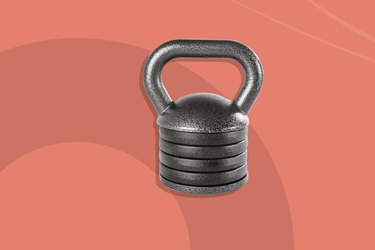
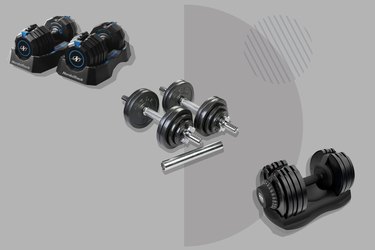
Free Weights We Love


Resistance Bands vs. Free Weights: How to Use Each
Both resistance bands and weights have a time and place, Fagin says.
Ideally, you should work both into your routine for different reasons. Resistance bands can still play a role in activation, or warm-up, exercises. Plus, they're easy to toss in your bag for hotel room workouts while traveling.
The bottom line is that you don't need to pick one or the other. By incorporating both resistance bands and free weights into your routine, you give your muscles everything they need to get stronger in a healthy, sustainable way.
Resistance Bands vs. Weights
Bands | Weights |
|---|---|
Good for Beginners | Best for Strength and Muscle |
Takes Up Less Space | More Precise Loads |
Less Money | More Function |
Variable Resistance | Constant Resistance |
Was this article helpful?
150 Characters Max
0/150
Thank you for sharing!
Thank you for your feedback!