HCG Levels & Spotting
Many women associate bleeding or spotting during pregnancy as a bad sign or as if something has gone wrong, but, according to the American Congress of Obstetricians and Gynecologists, this is not necessarily true. Spotting during pregnancy is actually quite common, but you should know the warning signs. Always consult with your health care provider if you begin to spot or bleed to ensure that you have a healthy pregnancy.
Normal hCG Levels During Pregnancy
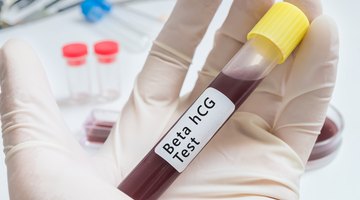
Human chorionic gonadotropin is commonly referred to as hCG. From the time of conception, your system will begin to produce this hormone in response to the developing placenta. As your pregnancy progresses, these levels will rise. Within the first two months of pregnancy, these numbers will double approximately every two to three days. By your third month, the numbers may take up to 96 hours to double. Normal ranges of hCG levels vary between 5 to 288,000 ml during your first trimester. After that time, the numbers begin to drop and range between 254,000 to 165,400 ml during your second trimester. In your last trimester, the numbers will continue to decrease to 117,000 ml until the birth of your baby.
Spotting During Pregnancy

What Causes Raised HCG Levels?
Learn More
Spotting can be normal during early stages of pregnancy. You may not be aware that you’re pregnant and have light spotting around the time of your menstrual period soon after you become pregnant. This happens as a result of the implantation that’s taking place in your uterus. Implantation is the process of which the egg begins to burrow into your uterine lining. Due to the egg burrowing into your uterine lining, it may result in spotting which is considered normal. In fact, some women may have become pregnant and lost the embryo and may not be aware that the pregnancy even occurred. This is known as a chemical pregnancy.
Complications Related to Spotting
In certain instances, such as a miscarriage, spotting may occur. This happens because your uterus contracts, as it would during a menstrual period, to expel the embryo. Your hCG levels may stay the same for a short period of time or deplete soon after a miscarriage. Symptoms of a miscarriage include light spotting or heavy vaginal bleeding, cramping and tissue passing through the vagina. Spotting may also be a sign of an ectopic pregnancy. When an ectopic pregnancy occurs, the egg did not implant in your uterine lining and may have taken place in your fallopian tubes. The egg cannot properly grow or develop in your fallopian tubes, which also results in a miscarriage. Symptoms of an ectopic pregnancy include sharp abdominal pains, spotting or bleeding and a decreased level of hCG.
Risks

What Are the Causes of Low HCG Levels?
Learn More
Women who have already experienced a miscarriage or an ectopic pregnancy are at a greater risk of having another. If you’ve had an infection in your fallopian tubes or have had pelvic surgery, this also puts you at a greater risk of miscarrying. Women over 35 are also have a higher risk of miscarriage. Drug use and certain medical conditions such as sickle cell or hypertension also have an increased risk of miscarriage.
Considerations
Before becoming pregnant, ask your health care provider what are the possible risks or complications that you may face during pregnancy. If you begin to experience spotting or bleeding at any point during your pregnancy, notify your health care provider immediately. If you think you may have passed fetal tissue, your doctor may ask for the specimen for additional lab testing.
Related Articles

What Causes Raised HCG Levels?
Learn More
What Are the Causes of Low HCG Levels?
Learn More
Reasons for Spotting When Pregnant
Learn More

hCG Levels After a Miscarriage
Learn More
A Period While Pregnant and Having a Negative Test
Learn More

Signs of Miscarriage at 5 Weeks Pregnant
Learn More

Possible Complications of a Pap Smear
Learn More

What Happens if My hCG Levels Do Not Go Up?
Learn More

When Can You Start to Exercise After a Cone Biopsy?
Learn More

Signs & Symptoms of Pregnancy With a Tubal Ligation
Learn More

Kristin Davis has been writing since 2004, specializing in the health and fitness fields. She has written for online and print publications including Fitness Monthly and Creative Circle. Davis has certification through the International Fitness Professionals Association as a personal trainer.
