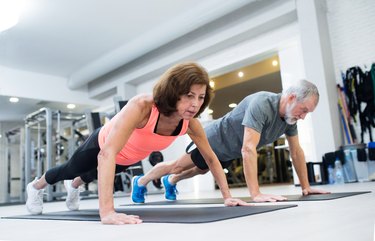
Building and maintaining muscle at any age is challenging and at a certain point, age-related muscle loss (also known as sarcopenia) becomes inevitable.
But that doesn't mean you can't regain the muscle and strength you may have lost. Yes, you definitely can build muscle later in life. Learn how to strengthen your body as a 50-year-old and what daily habits can help promote muscle gain.
Video of the Day
Video of the Day
How to Gain Muscle After 50
Age-related muscle loss is common for most adults — actually, it happens to just about everyone. This condition can cause you to lose as much as 5 percent of your muscle mass per decade after the age of 30, according to Harvard Health Publishing.
Sarcopenia has more risk than just muscle loss. Losing muscle can impair your mobility and balance, putting you at a higher risk of fall-related injury. Luckily, sarcopenia can be managed and you can regain lost muscle, per Harvard Health Publishing. Re-building muscle isn't easy but it's still possible with a strength-training routine, even later in life.
Build Muscle by Strength Training
It's never too late to start building muscle and enjoy the benefits of strength training, according to Carolina Araujo, CPT, a New York-based strength coach who works with plenty of later-in-life clients.
"And contrary to popular belief, building strength won't necessarily make older adults look 'bulky,' unless that's their goal," Araujo says. "Building strength is just a good way to keep moving with confidence and doing your favorite activities with ease."
If you're new to strength training, Araujo recommends working with a personal trainer (at least briefly), to ensure you're getting the safest exercises for your body. There's no one best exercise for building muscle later in life but for the most part, you want to prioritize compound movements, assuming you have no pre-existing injuries.
Compound exercises help you gain total-body strength, as they work multiple muscle groups at once, according to the American Council on Exercise (ACE). Squats, deadlifts and chest presses are just a few moves you can try during your strength workouts.
"Start with only body-weight exercises until you have the form nailed down," Araujo says. "Then, you can slowly add a little resistance with light dumbbells or resistance bands."
How many times a week should older adults work out? Well, that completely depends on your fitness level. For beginners, though, Araujo only recommends about 2 to 3 resistance workouts per week, doing exercises for 8 to 10 reps.
As you progress, only select weights you can lift comfortably with good form for each set, Araujo says. Then over time, you can increase the weights to build more muscle. Or, add more repetitions to build muscular endurance.
Make sure to give yourself plenty of rest and recovery time, though. When you strength train, you create microtears in your muscles. Then, when you sleep, your body works to repair those tissues, building larger and stronger muscles. It's no surprise why greater sleep quality is associated with greater muscle strength, according to a December 2017 study in the Journal of Musculoskeletal and Neuronal Interactions.
Warning
If you have any existing injuries or health concerns, it's best to consult your doctor or physical therapist before you try any new exercises or workout routines.
Don't Neglect Cardio
People often use high-intensity interval training (HIIT) to lose weight. And although HIIT is commonly associated with burpees and box jumps, you can do high-intensity intervals with just about any kind of cardio exercise, like running, elliptical training or cycling.
In a 2017 article in Cell Metabolism, scientists tested participants during two three-month periods. During one phase, the subjects did HIIT cycling workouts. During the other phase, they followed their normal, relatively inactive routine. In the cycling phase, subjects biked three days a week and walked two days a week. The cycling sessions lasted for about 15 minutes and the walking sessions for 45 minutes.
Researchers compared the results obtained during high-intensity cycling training to those obtained during inactivity. Endurance training increased muscle mass, but it didn't affect muscle strength. So, high-intensity cardio is another factor that can help build muscle later in life.
If you have any previous injuries, nagging issues or joint sensitivity, it's best to stick with low-impact forms of cardio, like cycling or swimming. The bike and water both provide resistance, so you'll still get the muscle-building benefits without harming your bones and joints.
Get More Protein
"If you want to build strength and muscle at any age, you need to be getting enough calories, especially protein," Araujo says.
For those looking to build muscle, eating between 0.5 grams and 0.8 grams of protein per pound of body weight is recommended, according to the American College of Sports Medicine. So, a 200-pound adult would need to eat between 100 grams and 160 grams of protein daily.
A 2015 report in the Journal of Nutrition tested the impact of excess protein intake on lean muscle mass in older adults. The treatment group consumed extra protein twice a day at meals for six months. The control group consumed a placebo during this time. Compared to the control group, the treatment group had greater lean muscle tissue mass by the end of the study.
Watch Your Vitamin D Intake
The exact mechanisms triggering sarcopenia remain unknown, but age-related vitamin deficiencies may play a role. Vitamin D deficiency, for example, affects people of all ages and can contribute to loss of bone density over time, according to the National Library of Medicine.
Vitamin D may even help support muscle growth. Researchers of a 2013 article in the Journal of Clinical Endocrinology and Metabolism gave older adults with limited mobility and vitamin D deficiency supplements daily for four months. At the end of the timeframe, adults who received vitamin D supplements showed a 10.6 percent increase in muscle fiber size, while adults who received no supplementation showed a 7.4 percent decrease in muscle fiber size.
Warning
Before you start taking any supplements, it's best to confirm with your doctor to find the appropriate dosage for your body.
- Harvard Health Publishing: "Preserve Your Muscle Mass"
- ACE: "5 Benefits of Compound Exercises"
- Cell Metabolism: "Enhanced Protein Translation Underlies Improved Metabolic and Physical Adaptations to Different Exercise Training Modes in Young and Old Humans"
- American College of Sports Medicine: "Protein Intake for Optimal Muscle Maintenance"
- Journals of Gerontology: "Protein Ingestion to Stimulate Myofibrillar Protein Synthesis Requires Greater Relative Protein Intakes in Healthy Older Versus Younger Men"
- Journal of Nutrition: "Protein Supplementation at Breakfast and Lunch for 24 Weeks beyond Habitual Intakes Increases Whole-Body Lean Tissue Mass in Healthy Older Adults"
- National Library of Medicine: "Vitamin D Deficiency"
- Journal of Clinical Endocrinology and Metabolism: "A Randomized Study on the Effect of Vitamin D-3 Supplementation on Skeletal Muscle Morphology and Vitamin D Receptor Concentration in Older Women"