
What does fact checked mean?
At SportsRec, we strive to deliver objective content that is accurate and up-to-date. Our team periodically reviews articles in order to ensure content quality. The sources cited below consist of evidence from peer-reviewed journals, prominent medical organizations, academic associations, and government data.
The information contained on this site is for informational purposes only, and should not be used as a substitute for the advice of a professional health care provider. Please check with the appropriate physician regarding health questions and concerns. Although we strive to deliver accurate and up-to-date information, no guarantee to that effect is made.
Games for Kids Using Exercise Balls
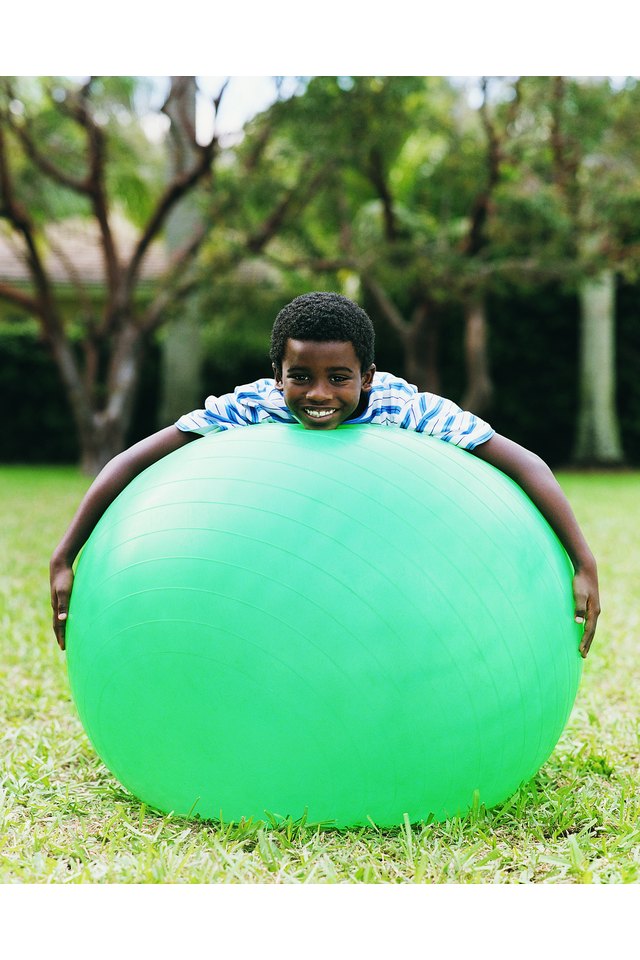
Large, inflatable exercise balls are versatile objects well-suited for children bored with routine exercise. According to “Having a Ball: Stability Ball Games” by John Bly, Ph.D., rather than teaching children adult exercises on the exercise or stability ball, encourage kids to actively participate in youth-oriented games with the ball. Children can strengthen their arms, shoulders, abdomen and legs with exercise balls. Organize multiplayer games to improve a child's physical fitness.
Tag Games
Provide each child with an exercise ball. The American Council on Exercise recommends that people under 4 feet 6 inches tall use a 12-inch exercise ball, while those between 4 foot 6 and 5 foot 7 use an 18- to 22-inch exercise ball. Choose a child who will be “It.” All the kids, including “It,” should sit on their ball and move around the room by rolling their ball forward using their feet. The object of the game is to dodge “It” and be the last person left who is not tagged. If “It” tags you, you become “It” as well.
Partner Games
Have kids pair up and sit back to back with one holding an exercise ball. The one with the ball must turn right and pass the exercise ball to her partner, then turn left to receive the ball back to complete one rotation. The partners who complete 20 or 30 rotations the fastest win. For another partner game, divide players into teams of two and provide each team with an exercise ball. Have the pairs see how many times they can kick the ball back and forth to each other in a minute. The partners with the most successive passes win.
Relay Games
Divide players into teams of three and provide each team with one exercise ball. Mark a square relay course that is 10 yards across using cones and choose a starting cone for the game. Beginning at the starting cone, have the first players of each team roll their exercise ball with their hands once around the square cones. When they return to the starting cone, they must pass the ball to a teammate. Teammates take turns rolling the ball around the cones. The first team to complete 24 laps around the cones wins. Instead of rolling it, kids can dribble or kick their ball, too.
Hot Potato Games
Ask kids to stand in a circle and have one child remain outside the circle to control the music. While music is playing, kids pass an exercise ball around the circle to the person on their left. The player controlling the music stops it randomly. Whoever is holding the exercise ball when the music stops is out. Have the music start again and kids continue playing until only one child remains. A different version is to have children randomly toss the exercise ball to another player in the circle while simultaneously saying that person's name. The player holding the ball when the music stops is out.
References
- "Having a Ball: Stability Ball Games"; John Byl, Ph.D.; 2008
- American Council on Exercise: Strengthen Your Abdominals with Stability Balls
- "Kids on the Ball: Using Swiss Balls in a Complete Fitness Program"; Anne Spalding, et al.; 1999
- Sekendiz B, Cuğ M, Korkusuz F. Effects of Swiss-ball core strength training on strength, endurance, flexibility, and balance in sedentary women. J Strength Cond Res. 2010;24(11):3032-40. doi:10.1519/JSC.0b013e3181d82e70
- Yu W, Cha S, Seo S. The effect of ball exercise on the balance ability of young adults. J Phys Ther Sci. 2017;29(12):2087-2089. doi:10.1589/jpts.29.2087
Resources
Writer Bio
Julia Drake has been writing since 2007 when she had her first article published in “The Beltane Papers.” She received her Bachelor of Arts in women studies from the University of Washington. She recently completed her Master of Arts in women’s spirituality at the Institute of Transpersonal Psychology.