
Roller Ski vs. Rollerblade Training
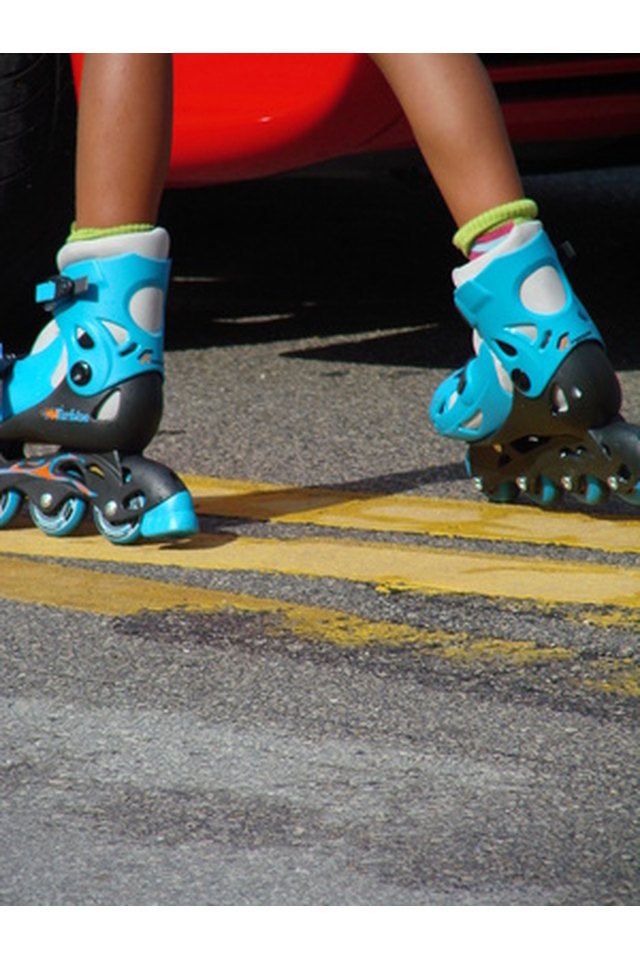
Roller ski training differs markedly from rollerblade training. According to the ABC of Skiing website, roller skiing is a specific type of dry-land training for recreational, competitive and elite cross-country skiers, whereas rollerblading is a more widely practiced activity. Both sports or activities use wheels mounted to boots to move from one place to another. Roller skiing is a popular summer sport in Europe, where many high-level races are held.
Equipment
Roller skiing equipment and that used with rollerblading differ considerably. According to the XC Ski World website, the most important piece of roller skiing equipment are roller skis. Roller skis comes in many different lengths and wheel speeds, but they usually consist of a 1.5-meter-long shaft, upon which regular ski bindings are mounted. If you are a roller skier, you will use regular ski boots with your roller skis. Other roller skiing-specific equipment includes poles fitted with sharp metal tips that dig into the pavement. Unlike roller skis, which possess only two wheels, rollerblades usually have four wheels, which are located directly under your foot.
Technique
Simply skating is the principle rollerblading technique, whereas there are two possible techniques practiced if you are a roller skier: skating and classic or diagonal striding. The skating technique in roller skiing is similar to the skating technique used by rollerbladers or inline skaters, except that the side-to-side pushing force you use comes from your heel, not your toes as it usually does with rollerblading. As a roller skier, you'll also use poles to help propel yourself in a forward direction. Unlike some rollerblades, roller skis are not designed to go in a reverse direction or to turn sharply.
Purpose
Both roller skiing and rollerblading are recreational activities that improve your fitness and quality of life. In most cases, however, a person who practices roller skiing is a dedicated cross-country skier training for the upcoming winter racing season. The purpose of rollerblading depends on your motivation. You may be rollerblading for fun, health and fitness, as a method of commuting from one place to another or for competition. You can perform both activities in groups for the purpose of a physically active social gathering.
Locations
Because it usually involves the use of sharp-tipped poles, and because it is more difficult to come to a complete stop, roller skiing is usually performed on quiet country roads, away from other exercise enthusiasts and busy traffic intersections. Unlike rollerblades, most roller skis are not equipped with a braking system, which means that, if you are a roller skier, you usually ski on flat terrain, avoiding steep downhills. In some cases, you may ski up a long hill and be shuttled back down to the bottom by a friend waiting in a car at the top of the hill. Rollerblades are better suited for urban trails or paths than roller skis.
Difficulty
Both roller skiing and rollerblading can be difficult activities to learn, especially if you lack an ice skating background. Roller skiing may be more challenging to learn, only because the skis themselves can be harder to balance on and all four of your limbs are required to perform both roller skiing techniques. If you are a roller skier or a rollerblader, you should wear a helmet, kneepads, elbow pads and gloves to protect your body in the event of a fall. Most people who are learning these activities -- and even veterans of the sports -- fall periodically.
References
Writer Bio
Martin Hughes is a chiropractic physician, health writer and the co-owner of a website devoted to natural footgear. He writes about health, fitness, diet and lifestyle. Hughes earned his Bachelor of Science in kinesiology at the University of Waterloo and his doctoral degree from Western States Chiropractic College in Portland, Ore.