Causes of a Pimple-Like Rash on the Face
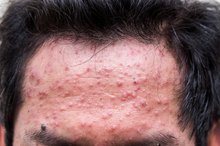
**A pimple-like rash on the face can arise with a variety of infectious and noninfectious skin conditions that affect people of all ages 2.
If you are experiencing serious medical symptoms, seek emergency treatment immediately.
In many cases, the condition resolves without treatment. ** For chronic conditions, doctors often recommend topical or oral medications. Although pimple-like rashes often resemble acne, the causes and treatments often prove distinctly different.
Rosacea
Rosacea, also known as acne rosacea, is a chronic skin disorder that most commonly affects fair-complected people between the ages of 30 and 50. The disorder typically begins with redness of the cheeks and nose, known as flushing. In some people, pimple-like eruptions accompany the red rash.
People with pimple-like lesions have the rosacea variant known as papulopustular rosacea. Treatment may include topical or oral antibiotics and other medicated lotions, creams or washes.
- Rosacea, also known as acne rosacea, is a chronic skin disorder that most commonly affects fair-complected people between the ages of 30 and 50.
- The disorder typically begins with redness of the cheeks and nose, known as flushing.
Sycosis Barbae
Common Skin Rashes on the Face
Learn More
Folliculitis is a local infection of the hair pores, or follicles. Sycosis barbae refers to folliculitis of the skin area of the male beard. The bacterium Staphylococcus aureus most commonly causes sycosis barbae. Tender, pus-filled, pimple-like lesions occur on the chin, cheeks and the area between the nose and upper lip. In most men, the condition resolves with topical washes and antibiotics. A break from shaving may help speed the resolution of the disorder. Doctors may prescribe oral antibiotics or other treatments for men with severe or repeated episodes of sycosis barbae.
- Folliculitis is a local infection of the hair pores, or follicles.
Milia
Milia are white, pimple-like bumps representing an accumulation of dead skin cells, commonly occurring on the face.
**Newborn babies often have milia, which usually clear without treatment.
** Adults can also develop facial milia, which may resemble acne. Although milia pose no medical threat, they tend to persist in adults. Some people opt for simple removal of milia for cosmetic reasons.
- Milia are white, pimple-like bumps representing an accumulation of dead skin cells, commonly occurring on the face.
Measles
The Stages of Shingles Rash
Learn More
Measles is a systemic viral illness characterized by fever, runny nose, cough and a pimple-like rash.
The rash typically begins near the hairline and spreads to the face, neck and chest.
The rash continues spreading to the arms and legs before resolving in approximately 5 to 6 days. Measles is a vaccine-preventable disease but unvaccinated children and adults remain susceptible to the illness.
- Measles is a systemic viral illness characterized by fever, runny nose, cough and a pimple-like rash.
Shingles
Shingles, or herpes zoster, occurs when the varicella-zoster virus reactivates after a previous case of chickenpox 5. The varicella-zoster virus, which causes both chickenpox and shingles, remains inactive in the nerves after recovery from chickenpox 5. Many years later, the virus can reactivate, causing shingles. The face is the second most common site for shingles. A pimple-like rash usually erupts on one side of the face after several days of pain, itching or burning in the affected skin region. The bumps first appear as red blisters, which gradually become pus-filled before crusting and healing. The painful, pimple-like rash of shingles typically resolves in a few weeks.
- Shingles, or herpes zoster, occurs when the varicella-zoster virus reactivates after a previous case of chickenpox 5.
- The bumps first appear as red blisters, which gradually become pus-filled before crusting and healing.
Many adults continue to have periodic outbreaks of acne, which can be difficult to distinguish from other pimple-like rashes on the face.
Seeing your doctor is the best course of action if you have an unexplained facial rash. She can accurately diagnose your condition and prescribe appropriate therapy.
If you suspect facial shingles, see your doctor right away as there can be serious complications. Antiviral therapy is most effective if started within 72 hours of the appearance of the shingles rash.
- Many adults continue to have periodic outbreaks of acne, which can be difficult to distinguish from other pimple-like rashes on the face.
- Seeing your doctor is the best course of action if you have an unexplained facial rash.
Related Articles
Common Skin Rashes on the Face
Learn More
The Stages of Shingles Rash
Learn More

Causes of Fluid Filled Bumps on the Skin That Cause Itching
Learn More

Pain in Lymph Nodes Shingles
Learn More
Causes of Itching on the Face and Neck
Learn More

What Are the Treatments for Chickenpox on the Scalp?
Learn More

Diseases Causing Skin Rash
Learn More
How Long Does an Outbreak of Genital Warts Last?
Learn More

How Long Does Shingles Pain Last?
Learn More
How to Tell if You Have Scabies
Learn More
References
- Acne and Rosacea: Epidemiology, Diagnosis and Treatment; David J. Goldberg and Alexander Berlin
- Mandell, Douglas, and Bennett's Principles and Practice of Infectious Diseases, Eighth Edition; John E. Bennett, et al.
- Manual of Dermatologic Therapeutics, Eighth Edition; Kenneth A. Arndt, et al.
- Centers for Disease Control and Prevention, Pink Book: Measles
- Merck Manual Professional Version: Herpes Zoster (Shingles; Acute Posterior Ganglionitis)
- Centers for Disease Control and Prevention. Shingles (Herpes Zoster) Signs & Symptoms.
- Centers for Disease Control and Prevention. Shingles (Herpes Zoster) Signs & Symptoms.
- John AR, Canaday DH. Herpes Zoster in the Older Adult. Infect Dis Clin North Am. 2017;31(4):811-826. doi: 10.1016/j.idc.2017.07.016
- Yun H, Xie F, Baddley JW, Winthrop K, Saag KG, Curtis JR. Longterm Effectiveness of Herpes Zoster Vaccine among Patients with Autoimmune and Inflammatory Diseases. J Rheumatol. 2017;44(7):1083-1087. doi: 10.3899/jrheum.160685
- Cohen KR, Salbu RL, Frank J, Israel I. Presentation and Management of Herpes Zoster (Shingles) in the Geriatric Population. P T. 2013;38(4): 217-224, 227.
- Galetta KM, Gilden D. Zeroing in on zoster: A tale of many disorders produced by one virus. J Neurol Sci. 2015;358(1-2):38-45. doi: 10.1016/j.jns.2015.10.004
- Blank LJ, Polydefkis MJ, Moore RD, Gebo KA. Herpes zoster among persons living with HIV in the current antiretroviral therapy era. J Acquir Immune Defic Syndr. 2012;61(2):203-7. doi: 10.1097/QAI.0b013e318266cd3c
- Mallick-searle T, Snodgrass B, Brant JM. Postherpetic neuralgia: epidemiology, pathophysiology, and pain management pharmacology. J Multidiscip Healthc. 2016;9:447-454. doi: 10.2147/JMDH.S106340
- Johnson RW, Bouhassira D, Kassianos G, Leplège A, Schmader KE, Weinke T. The impact of herpes zoster and post-herpetic neuralgia on quality-of-life. BMC Med. 2010;8:37. doi: 10.1186/1741-7015-8-37
- Sampathkumar P, Drage LA, Martin DP. Herpes zoster (shingles) and postherpetic neuralgia. Mayo Clin Proc. 2009;84(3):274-80.
- Pereira LB. Impetigo - review. An Bras Dermatol. 2014;89(2):293-9. doi: 10.1590/abd1806-4841.20142283
- Gershon AA, Breuer J, Cohen JI, et al. Varicella zoster virus infection. Nat Rev Dis Primers. 2015;1:15016. doi: 10.1038/nrdp.2015.16
- Naveen KN, Pradeep AV, Kumar JS, Hegde SP, Pai VV, Athanikar SB. Herpes zoster affecting all three divisions of trigeminal nerve in an immunocompetent male: a rare presentation. Indian J Dermatol. 2014;59(4):423. doi: 10.4103/0019-5154.135548
- Opstelten W, Zaal MJ. Managing ophthalmic herpes zoster in primary care. BMJ. 2005;331(7509):147-51. doi: 10.1136/bmj.331.7509.147
- Jeon Y, Lee H. Ramsay Hunt syndrome. J Dent Anesth Pain Med. 2018;18(6):333-337. doi: 10.17245/jdapm.2018.18.6.333
- Kim SH, Choi SM, Kim BC, et al. Risk Factors for Aseptic Meningitis in Herpes Zoster Patients. Ann Dermatol. 2017;29(3):283-287. doi: 10.5021/ad.2017.29.3.283
- Saxena A, Khiangte B, Tiewsoh I, Jajoo UN. Herpes zoster encephalitis presenting as multiple cerebral hemorrhages - a rare presentation: a case report. J Med Case Rep. 2013;7:155. doi: 10.1186/1752-1947-7-155
- Teo HK, Chawla M, Kaushik M. A Rare Complication of Herpes Zoster: Segmental Zoster Paresis. Case Rep Med. 2016;2016:7827140. doi: 10.1155/2016/7827140
- American Academy of Dermatology. Cellulitis: Overview.
- American Academy of Ophthalmology. Herpes Zoster Ophthalmicus.
- Centers for Disease Control and Prevention. Shingles (Herpes Zoster): Clinical Overview. Feb 21, 2018.
- Mayo Clinic. Postherpetic Neuralgia. Sept 16, 2015.
Writer Bio
Dr. Tina M. St. John owns and operates a health communications and consulting firm. She is also an accomplished medical writer and editor, and was formerly a senior medical officer with the U.S. Centers for Disease Control and Prevention. St. John holds an M.D. from Emory University School of Medicine.