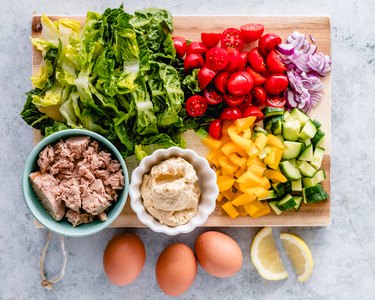
Foods that are low in carbs aren't necessarily low in calories, too (hello, avocado). But understanding which foods best fit into both categories can help you stick to your low-carb diet and lose a bit of weight.
Because of their significant carbohydrate content, large servings of grains and starchy vegetables are off the table for low-carb diets.
Video of the Day
Video of the Day
When you're trying to lose weight, it's cutting calories that matters the most — not cutting carbs — although both may be helpful.
Non-Starchy Vegetables
When you're looking for foods that are low in both carbs and calories, your best choices are low- and non-starchy vegetables.
They often have a high water and fiber content, so they are low in energy density (or calories) per gram. This makes it easier to eat a large portion and fill up on them without going over your daily calories.
Here are some non-starchy veggies to add to your plate — all contain less than 6 grams of carbs per 1 cup raw:
- Romaine lettuce: 8 calories, 1.5 g carbs
- Spinach: 7 calories, 1.1 g carbs
- Arugula: 5 calories, 0.7 g carbs
- Radishes: 19 calories, 3.9 g carbs
- Kale: 8 calories, 1.4 g carbs
- Zucchini: 21 calories, 3.9 g carbs
- Summer squash: 18 calories, 3.8 g carbs
- Celery: 16 calories, 3 g carbs
- Asparagus: 27 calories, 5.2 g carbs
Low-Sugar Fruits
Fruits tend to be higher in both carbs and calories than vegetables, but still lower in calories than many other low-carb foods.
For fewer than 10 grams of carbs and 50 calories, reach for the following fruit:
- Clementine (one fruit): 35 calories, 8.9 g carbs
- Grapefruit (half a small fruit): 32 calories, 8.1 g carbs
- Raspberries (half-cup): 32 calories, 7.3 g carbs
- Apricot (one fruit): 17 calories, 3.9 g carbs
Meat, Poultry and Seafood
Meat, poultry and seafood typically have very few carbohydrates, but they can be high in calories. Fish is usually lower in calories than meat.
Options with fewer than 100 calories and less than 1 gram of carbs per 3-ounce serving include:
- Canned light tuna
- Pork tenderloin with the fat trimmed
- Chicken breast
- Turkey breast
- Crab
- Mahi-mahi
- Bass
- Cod
- Shrimp
Eggs and Dairy
Eggs and certain dairy products can be very low in carbs, but at the same time high in calories. Opt for these low-carb foods:
- One large egg: 72 calories, 0.4 g carbs
- Soft goat cheese (1 oz.): 75 calories, 0 g carbs
- Brie (1 oz.): 95 calories, 0.1 g carbs
- Camembert (1 oz.): 85 calories, 0.1 g carbs
- Mozzarella (1 oz.): 85 calories, 0.7 g carbs
- Low-fat Swiss (1 oz.): 70 calories, 0 g carbs
- Plain nonfat Greek yogurt (half cup): 110 calories, 4.5 g carbs
- Skim milk (one cup): 83 calories, 12.2 g carbs
Nuts
Because nuts are high in fat, they also tend to be high in calories.
If you're including nuts and nut butter in a low-calorie, low-carb diet plan, stick to eating one-ounce servings of nuts and one-tablespoon servings of nut butter.
Nuts that are closer to 200 calories and 4 grams of carbs per ounce include:
- Walnuts
- Hazelnuts
- Pecans
Nut butters under 5 grams of carbs and under 100 calories, including:
- One tablespoon of sunflower seed butter
- One tablespoon of cashew butter
Although almonds and pistachios have fewer than 200 calories per ounce, they have 6 and 8 grams of carbs, respectively.