
The Average Pitching Velocity
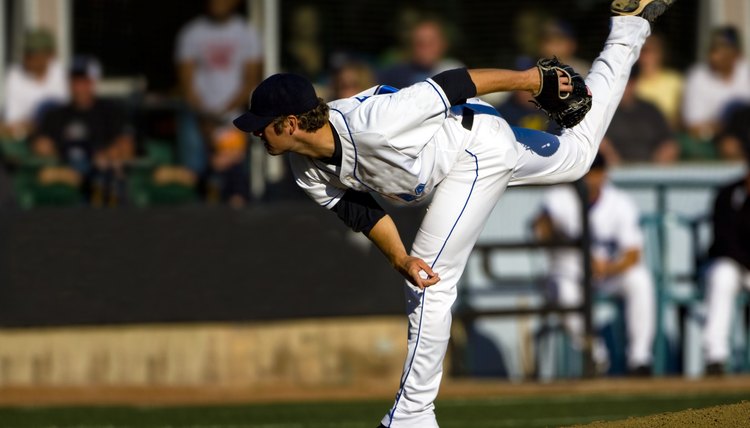
The baseball radar gun is a familiar tool used by scouts who are interested in learning everything they can about a pitcher. Knowing how fast a pitcher can throw is a key factor in making a decision to draft or trade for a particular pitcher. Velocity is a better tool for measuring a pitcher's arm strength than it is for judging a pitcher's overall effectiveness. Hard throwers may be impressive to watch, but unless they have command and control of their pitches, they will have a hard time winning games consistently.
Major League Velocity
The average fastball of a Major League Baseball pitcher reaches a speed of 91 mph. Efastball.com studies pitch velocity at all levels and collects data at all major-league games to reach that conclusion. A 91-mph fastball will not get major league hitters out if it is thrown over the middle of the plate. If a pitcher can throw that pitch to the inside and outside corners, a 91-mph fastball can be a dynamic, out-producing pitch. It is especially effective when the pitcher can throw breaking pitches and a changeup to complement that pitch.
College Fastball
The average college fastball is estimated to be between 85 and 95 mph. There is a much greater range in the average speed at this level because major league baseball scouts and college scouts have to estimate; they simply don't have the data on every pitch to get more exact readings. College pitchers are almost always physically mature, and that's why they are able to reach similar speeds to professional pitchers.
High School Fastball
High school pitchers are still growing and developing their pitching styles. The average fastball at the high school level is between 75 and 85 mph, according to efastball.com. High school coaches have access to radar guns and use them to get a reading on their pitcher's development. These figures are usually not publicized, but they help coaches in their game preparation.
Lower Speeds
Other types of pitches such as the knuckleball, the breaking ball -- curve and slider -- and the changeup, average between 50 to 75 mph; with the knuckleball being at the lower end of the velocity scale.
Injury Factor
The radar gun can be a useful tool in helping diagnose potential arm injuries. When a pitcher has been throwing the ball in the 92- to 93-mph range on a consistent basis and then suddenly is throwing in the 85- to 86-mph range, it may be an indication that the pitcher is fatigued or injured. Pitching a baseball is an unnatural motion and injuries occur regularly. A coach or trainer who sees a sudden drop in velocity can pull a pitcher from the rotation and get him checked out to prevent a potential arm, shoulder or elbow injury from getting more aggravated.
Writer Bio
Steve Silverman is an award-winning writer, covering sports since 1980. Silverman authored The Minnesota Vikings: The Good, The Bad and The Ugly and Who's Better, Who's Best in Football -- The Top 60 Players of All-Time, among others, and placed in the Pro Football Writers of America awards three times. Silverman holds a Master of Science in journalism from the Medill School of Journalism.