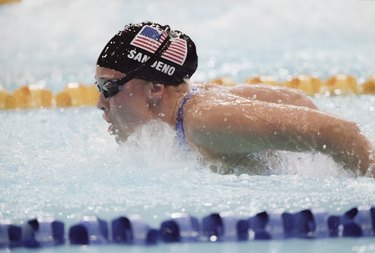
Olympic gold medalist Kaitlin Sandeno remembers starting out as a swimmer.
As soon as she could walk, she was off to the pool. "I wanted to go off the diving board," she says, "and my dad would be at the bottom, waiting for me to jump in." Her mom was a little freaked out, Sandeno recalls, but "I wouldn't hesitate. I would just plop right in and come to the top with a huge smile on my face."
Video of the Day
Video of the Day
Sandeno went on to make the U.S. Olympic team and win four medals. Now retired from competition, she coaches, manages a professional swim team and covers the sport as a commentator. She continues to tout swimming as a therapeutic activity that's "really nice for the mindset."
It's also nice for the body. A May 2016 study in the official journal of the Portuguese Society of Pulmonology says swimming engages the entire muscular system (legs, back, core and arms). Plus, swimmers meet more resistance when moving in the water than athletes do on land, so the sport builds endurance and strength. And of course, you're also exercising your heart and lungs.
Better yet, swimming works these muscles without overtaxing your joints. It's a low-impact activity with no weight-bearing component, making it ideal for people susceptible to joint pain, such as the older adults and people with obesity.
Read more: Can You Do Cardio Exercise Every Day?
Swimmers expend calories at a rate similar to runners and cyclists. According to the American Council on Exercise, a 155-pound swimmer burns 492 calories an hour. A cyclist pedaling moderately fast (12 to 15 miles per hour) burns 562 calories in an hour, and runner burns 703 calories running at a 10-minute mile pace for the same amount of time.
Still can't stand swimming laps? Here are some ways to make swimming more fun.
Join a Club
Where do you start if, unlike Sandeno, you weren't jumping off the diving board as soon as you could walk? U.S. Masters Swimming (USMS) coach Cokie Lepinski urges beginners to find an instructor. "It's a very daunting thing," she says of learning to swim. "Beginner swimmers are going to need a lot of encouragement."
The good news is, you're not on your own. USMS offers swimming programs to anyone over 18 through its nationwide network of clubs, many of which have coaches specifically trained to help adults learn to swim.
Joel Stager, a kinesiology professor emeritus at Indiana University and former competitive swimmer, likes the community aspect of USMS. "Swimming by yourself is pretty antisocial," he says. Clubs give beginners a support group that helps them stay committed, provided they don't get caught up in comparing themselves to other members.
Be Patient
On the surface, lap swimming looks simple enough. You jump into the pool, go from one end to the other and repeat. But try it and all kinds of questions bubble up. When should I breathe? What stroke should I be doing? Why can't I swim as long as the people around me?
Stager says he sees beginners hit the water in "attack mode," which is unsustainable. Developing proficiency as a swimmer "isn't going to happen overnight," he emphasizes. "It's probably not going to happen in a month."
Plus, patience is connected to relaxation, another crux of swimming. To those in attack mode, Stager's message is simple: If you fight the water, you're not going to win.
Lepinski explains why. "Your body sinks when you're tense," she says. "But you float when you're relaxed and leave some air in your lungs."
Practice Breathing Properly
One barrier to relaxation for many beginners is breathing. "Deep in our subconscious, we have this protective measure to hold our breath when our face is in the water," says Lepinski.
Read more: Why Breathe Out of the Nose When Swimming?
To overcome this barrier, Lepinski suggests a bobbing exercise. Stand somewhere along the pool wall with your head above water. Take a deep breath, then submerge your head. Blow bubbles for a count of three. Come back up and repeat until the cycle becomes relaxing.
Then, apply the practice to swimming laps. When your face goes underwater during a stroke, breathe out. In beginner swimmers, "breathing dictates the mechanics of the stroke," says Stager. "You need to get to a point where your stroke is dictating your breathing."
Find Your Favorite Stroke
What stroke should beginners start with? For most, the answer is freestyle. Don't let the name fool you — it technically refers to a competition category in which swimmers can choose any stroke, but it's used synonymously with "the front crawl," the stroke most swimmers pick. The crawl entails pulling yourself forward through the water with your arms while you kick your legs up and down.
If you're not comfortable swimming freestyle, try the sidestroke, which lets you keep your head above water. While scissor-kicking your legs, your above-water arm makes an apple-picking motion. Transfer the imaginary apple to your underwater hand, which throws the apple away at your side.
The sidestroke may not be the stuff Olympic competitions are made of, but it moves you through the water. And in Lepinski's view, if you're moving, you're benefiting. As your swimming skills develop, you can progress to the back crawl, breaststroke and butterfly.
Pace Yourself
The key to monitoring and improving performance is counting your strokes. "If I were working with a bunch of high school kids, I'd say, 'Our first goal is 15 strokes per 25 yards while swimming freestyle. And then two weeks from now, our goal is going to be 14 strokes per 25 yards,'" says Stager.
When it comes to distance, Lepinski preaches a 10-percent rule. Increase your swimming yardage by no more than 10-percent each week, she tells beginners. "As with any sport, you really want to ease into it."
So, how often should beginners hit the pool? "Start with two days a week, and then try to bump it up to three days a week," says Sandeno. Like Lepinski, she cautions against overdoing things.
Go for the Goal
Stager notes that swimming lends itself naturally to goal-setting. "It's you against the clock," he says. "There's always another goal."
Sandeno's career mirrors his message. Swimming prodigy though she was, Sandeno had her struggles. Just months after making the Olympic team, she suffered a back injury so baffling and painful that she considered quitting.
Instead, she kept going, a decision she attributes to setting goals and "the mindset of wanting to continue and to do better." Her perseverance paid off at the 2004 Olympics in Athens, where she won a gold, silver and bronze medal and broke a freestyle-relay world record with her teammates.
If you're learning to swim, keep her story in mind but also in perspective. "You've got to be realistic with yourself," says Stager. If you're a real beginner, start with five minutes of swimming at a time. "The key is setting realistic goals and being patient."
Was this article helpful?
150 Characters Max
0/150
Thank you for sharing!
Thank you for your feedback!