Non-dairy milk alternatives have taken the grocery store shelves by storm. Dairy-free milk sales have grown over 60 percent in recent years, according to January 2018 Mintel data. Almond milk leads the group followed by soy and coconut milk.
But many people still wonder if almond milk is good for you. Certain types of almond milk can be a nutritious addition to your eating plan. It's low in calories and fat, but it's not a significant source of protein. Almond milk may also have some health benefits associated with it.
Video of the Day
Video of the Day
What Is Almond Milk?
Almond milk is a liquid made of ground almonds and filtered water. Store-bought varieties are available at most grocery stores. You can also make almond milk at home.
Both store-bought and homemade almond milk is made by blending almonds and water. The almonds may be soaked to make them easier to pulverize. The water and almond mixture is strained to remove the pulp. The result is smooth, pulp-free almond milk, per the Harvard T.H. Chan School of Public Health.
Almond milk is naturally dairy- and lactose-free, making it a suitable dairy alternative for people with milk allergies and lactose intolerance. It's also a safe choice for vegans or anyone who chooses to avoid dairy products.
Warning
Because almond milk is made with almonds, people who are allergic to tree nuts should avoid it. While almond milk is inherently gluten-free, it may have additives that aren't gluten-free.
Is Almond Milk Good for You?
Not all almond milk varieties are made equally. There are many types, including sweetened, unsweetened, original, chocolate and more.
If you're wondering if almond milk is good for you, the answer is that it can be. Look for unsweetened almond milk that is fortified with vitamins and minerals. Vitamin D and calcium are often added to almond milk.
Homemade versions may have fewer nutrients than fortified almond milks available at the supermarket. This can be a nutritious drink because it's low in calories, making it a better alternative than cow's milk and other plant-based milks for weight management.
But almond milk doesn't replace all of the nutrients in cow's milk. It's lower in protein, which is an essential part of a balanced diet. If you replace cow's milk with almond milk, be sure to make up for the lost protein with another dietary source.
Almond Milk Nutrition
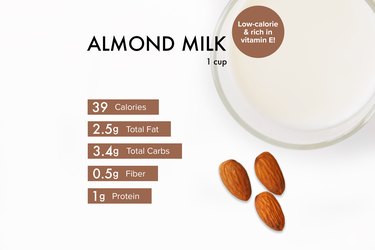
According to the USDA, a 1-cup serving of unsweetened almond milk contains:
- Calories: 39
- Total fat: 2.5 g
- Saturated fat:0.2 g
- Trans fat: 0 g
- Cholesterol: 0 mg
- Sodium: 188 mg
- Total carbs: 3.4 g
- Dietary fiber: 0.5 g
- Sugar: 2.1 g
- Protein: 1 g
Almond Milk Macronutrients
Total fat: A 1-cup serving of unsweetened almond milk has 2.5 grams of fat. This breaks down to 0.2 grams of saturated fat, 0.6 grams polyunsaturated fat and 1.5 grams of monounsaturated fat. Unsweetened almond milk is cholesterol- and trans-fat free.
Carbohydrates: A 1-cup serving of unsweetened almond milk has 3.4 grams of carbohydrates, 0 grams of fiber and 2.1 grams of naturally occurring sugar.
Protein: A 1-cup serving of unsweetened almond milk has 1 gram of protein.
Flavored Almond Milks Have Different Macro Profiles
There are a variety of flavors of almond milk available other than unsweetened, such as vanilla and chocolate. The flavors will vary the calorie, carb and added sugar content of each cup significantly.
A cup of sweetened vanilla almond milk has 91 calories, 16 grams of carbs and 15 grams of sugar. A cup of sweetened chocolate almond milk provides 120 calories, 22.5 grams of carbs and 21 grams of sugar. The fat and protein content is typically the same for all types of almond milk.
Vitamins, Minerals and Other Micronutrients
Most almond milks have been fortified with calcium and vitamin D. Check the nutrition facts panel to be sure.
- Vitamin D: 13% of your Daily Value (DV)
- Vitamin E: 111% DV
- Calcium: 37% DV
Almond Milk vs. Milk vs. Other Non-Dairy Milk Alternatives
Calories | 39 | 122 | 80 | 120 | 46 |
Total Fat | 2.5 g | 4.8 g | 4 g | 5 g | 4.5 g |
Carbs | 3.4 g | 11.7 g | 4 g | 16 g | 2 g |
Fiber | 0.5 g | 0 g | 1 g | 2 g | 1 g |
Protein | 1 g | 8 g | 7 g | 3 g | 0 g |
Health Benefits of Almond Milk
One reason almond milk is a popular dairy alternative is because it boasts many health benefits.
1. It's Good for People With Lactose Intolerance
Approximately 65 percent of adults are lactose intolerant. This is when you're unable to break down lactose, a type of sugar found in cow's milk, according to the National Institutes of Health (NIH). Eating or drinking dairy with this condition can result in bloating, abdominal pain, nausea, gas and diarrhea.
For a long time, there were limited options for anyone with lactose intolerance. Now, with the rise of plant-based milks, yogurts and cheeses, there are plenty of choices. Because almond milk is made from almonds and is completely dairy-free, it is considered safe for those who are lactose intolerant.
2. It's Weight-Management Friendly
This benefit comes with a catch — you need to read the labels carefully.
Under the umbrella of almond milk, there are different levels of sweetness and added flavors. Original almond milk doesn't have added flavors, but it may have added sugars. Unsweetened vanilla almond milk doesn't have added sugars, but it have vanilla flavoring. There are different combinations, but unsweetened original almond milk tends to be the lowest in sugar and calories.
Unsweetened almond milk can be very low in calories, averaging around 30 to 40 calories per cup. This is much less than cow's milk, which can range from about 80 calories per cup of skim milk to 150 calories in a cup of whole milk.
Almond milk is also a source of monounsaturated fats, aka MUFAs. These healthy fats can help with weight management, along with decreasing LDL cholesterol levels, according to a January 2018 paper in the Journal of Food Science and Technology.
3. It's a Rich Source of Vitamin E
A cup of almond milk meets 111 percent of your vitamin E needs for the day.
Vitamin E is a fat-soluble antioxidant that protects our bodies from damage from free radicals. Vitamin E has also been linked to a reduced risk of heart disease, according to the NIH. Some studies have shown an association, but more research is needed.
4. It May Be Helpful In Preventing Acne
Although almond milk itself doesn't cure acne, some research suggests that swapping cow's milk for non-dairy replacements like almond milk may help relieve breakouts in acne-prone individuals.
Drinking milk during high school, especially skim milk, is linked to significantly higher rates of acne in teenagers, according to a February 2005 study in the Journal of the American Academy of Dermatology. The researchers suggest that the bioactive compounds and hormones in dairy products may contribute to acne.
If you are interested in swapping out cow's milk for a non-dairy alternative, choose one without added sugars. Diets rich in fast-digesting carbohydrates like sugar may increase skin lesions and worsen acne, per a July 2007 study in the American Journal of Clinical Nutrition.
Unlike dairy milk, almond milk may be good for the skin. Almond milk has a number of skin-nourishing compounds that can potentially benefit your skin and improve your complexion. Catechins found in almonds help prevent skin cells from oxidizing and dying, according to February 2020 research in Biomedical Dermatology.
The monounsaturated fats in almonds have also been associated with improved skin quality, per a December 2019 study in Phytotherapy Research.
The vitamin E content in almond milk may play a specific role in acne. Low levels of vitamin E are associated with severe acne, according to a May 2006 study in Clinical and Experimental Dermatology. Getting more of this nutrient through almond milk may have positive effects on acne.
Potential Health Risks of Almond Milk
There are currently no known drug interactions relating to almond milk. Discuss any medication and food interactions with your doctor. There may be some risks worth considering.
1. It Contains a Common Food Allergen
There are nine common food allergens — milk, eggs, peanuts, tree nuts, soy, wheat, fish, shellfish and sesame — and almonds fall under the tree nut category.
If you have you have a tree nut allergy, almond milk may not be the right option for you. Opt for the other dairy-free alternatives, including oat and rice milk.
Tree nut allergies are one of the most common food allergies, according to the Food Allergy Research & Education. Reactions can be severe and potentially life-threatening. If you have this type of allergy, you'll also want to avoid cashew, coconut, macadamia and other types of plant milks made with tree nuts.
2. It's Lower in Protein and Can Be High in Sugar
In most cases, almond milk is lower in protein compared to cow's milk. A cup of almond milk has about 1 gram of protein while regular milk has about 8 grams of protein per cup.
Another concern is added sugar, such as in vanilla and chocolate-flavored almond milk. Sugar is not typically added to regular cow's milk but it is common practice to add it to plant-based milks. Look for "unsweetened" on the label to avoid added sugars.
Commercial almond milk products may have other additives like thickeners to better match its creamy consistency to cow's milk. They may also add preservatives to lengthen the shelf life.
Almond Milk Brands We Love
- Califia Farms Unsweetened Almond Milk ($3.30 per carton, Amazon.com)
- Pacific Foods Organic Unsweetened Almond Milk ($3.50 per carton, Amazon.com)
- Elmhurst Milked Almonds ($7.50 per carton, Amazon.com)
How to Use Almond Milk

You can purchase almond milk in the store or make it at home. Follow our Homemade Almond Milk recipe for an at-home version.
Homemade Almond Milk vs. Store Bought
The calories in homemade almond milk will vary depending on how it's made. If you keep some of the almond pulp in your homemade version, it will have more calories than unsweetened store-bought versions.
Other Useful Tips
- Almond milk is located in the refrigerated section and there are other options that are sold on shelves in Tetra Paks.
- Almond milk should be refrigerated unless it's unopened in shelf-stable packaging. Once opened, all almond milk should be stored in the fridge.
- Do not freeze almond milk.
How to Use Almond Milk
- Try it in coffee or make a homemade latte with it.
- Splash it into smoothies.
- Add it to a bowl of cereal or oatmeal.
- Substitute it for dairy milk in homemade baked goods.
- Make chia pudding by soaking two tablespoons of seeds with 1/4 cup of almond milk.
Almond Milk Recipes to Try
Alternatives to Almond Milk
If you're allergic to tree nuts such as almonds or simply don't like the taste of almond milk, there are plenty of other dairy-free milk alternatives to try, such as:
- Oat milk
- Soy milk
- Pea milk
- Flax milk
- Coconut milk
- Cashew milk
- Rice milk
- Hemp milk
Related Reading
- Mintel: "U.S. Non-Dairy Milk Sales Grow 61% Over the Last 5 Years"
- MyFoodData Central: "Almond Milk, Unsweetened"
- FoodData Central: "Almond Milk"
- MyFoodData Central: "Sweetened Vanilla Almond Milk"
- National Institutes of Health: "Lactose Intolerance"
- MyFoodData Central: "Skim Milk"
- MyFoodData Central: "Whole Milk"
- Journal of Food Science and Technology: "How Well Do Plant Based Alternatives Fare Nutritionally Compared to Cow’s Milk?"
- National Institutes of Health: "Vitamin E"
- MyFoodData Central: "Low-Fat Milk 2%"
- Food Allergy Research & Education: "Tree Nut Allergy"
- Journal of the American Academy of Dermatology: "High school dietary dairy intake and teenage acne"
- American Journal of Clinical Nutrition: "A low-glycemic-load diet improves symptoms in acne vulgaris patients: a randomized controlled trial"
- Clinical and Experimental Dermatology: "Does the plasma level of vitamins A and E affect acne condition?"
- Harvard T.H. Chan School of Public Health: Almonds
- Biomedical Dermatology: Activity of catechins and their applications
- Phytotherapy Research: Prospective randomized controlled pilot study on the effects of almond consumption on skin lipids and wrinkles
- Mintel Press Office: US NON-DAIRY MILK SALES GROW 61% OVER THE LAST FIVE YEARS
- HISTORY OF SOYMILK AND OTHER NON-DAIRY MILKS
- USDA Food Composition Database