A solid workout routine can help you build strength, cardiovascular conditioning and overall general health. And while an improved sex life probably isn't your first priority when you train, it's certainly a nice bonus.
"Regular exercise can increase testosterone levels, which may also boost erectile function and sex drive," says Eric Tygenhof, MD, a urologist and medical director of urologic surgery at St. Jude Medical Center in Fullerton, California.
Video of the Day
"Exercise also protects against erectile dysfunction by helping decrease the deposition of harmful plaques in the arteries of the penis," he says.
It's not just cardio and weight lifting that can enhance performance in the bedroom. Strengthening your pelvic floor is another strategy to support sexual function, according to Brianne Grogan, DPT, PT and founder of Vibrant Pelvic Health. This happens by mobilizing and releasing your deep core muscles.
Try these six exercises for better sex and a stronger, more mobile lower-body and core.
A Note on Language
Here at LIVESTRONG.com, we carefully consider language surrounding sex and gender. We typically avoid language that implies a sex or gender binary in favor of more inclusive language.
In this article we are offering exercise suggestions for people with penises to support their sexual health. There are also exercises for people with vaginas that can improve their sexual health.
More research is needed to more fully understand how exercises may or may not affect sexual health in people taking hormones as part of gender-affirming care.
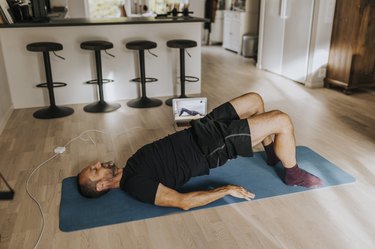
1. Hip Bridge
- Lie flat on a mat with your knees bent and feet planted on the ground. They should be about hip-width apart and roughly 6 inches from your glutes.
- Press your heels into the floor and lift your hips toward the ceiling, squeezing your glutes.
- Pause at the top for a few seconds
- Gently lower your hips back down to the mat. That's 1 rep.
Also known as a glute bridge, this exercise helps strengthen your core and lower body. Plus, it can help improve the mobility in your hip joints and lower back, according to Grogan.
2. Happy Baby
- Lie flat on your back on a mat.
- Bend your knees to 90 degrees and bring them up to your chest, the bottom of your feet facing the ceiling.
- Keeping your knees bent, reach for the insides of your feet. If you can't reach that far, grab your shins or however far you can safely reach.
- Spread your knees apart to your shoulders and gently rock from right to left.
- Hold for 60 seconds.
The happy baby targets your pelvic floor, hips, inner thighs and glutes, helping relieve the tension in your lower-body joints, Grogan says.
3. Floating Leg Extensions
- Lie flat on your back on a mat with your knees bent and your feet planted firmly about 6 inches from your glutes.
- Slowly extend your left leg out while keeping your lower back flush against the mat.
- Once your leg is fully extended, pause and hover above the mat for one second before sliding your leg back to the starting position.
- Alternate sides and complete 10 reps on each leg.
4. Windshield Wipers
- Lie flat on your back with your knees bent and your feet planted firmly at a hip-width distance apart.
- Keeping your feet in the same place, rotate your hips to your right, letting your knees drop to the right gently, touching the ground.
- Rotate your hips to the left side, letting your knees drop to the left, tapping the ground lightly.
- Continue to alternate directions for one minute.
This exercise targets your core, lower back muscles and increases range of motion in your hip joints, Grogan says.
5. Pelvic Rocks
- Lie flat on your back and bend your knees with your feet flat on the mat.
- Take a deep breath in and as you exhale, gently tilt your pelvis up toward the ceiling. You'll feel your lower back press into the mat.
- Take another deep breath in, then exhale and return to a neutral spine position.
- Do this for 20 reps.
This move isolates and strengthens your core and pelvic floor, which is helpful for healthy sexual function, according to Grogan.
6. Lying Butterfly Stretch
1. Lie flat on your back with your hands to your side or on your stomach.2. Bring the soles of your feet together and open your knees as wide as possible. 3. Take deep breaths while holding this position for one minute.