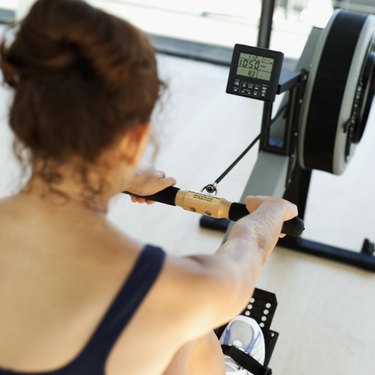
Rowing machines, also known as ergometers, are a popular feature at many gyms and health clubs. Indoor rowing also is a competitive sport with worldwide competitions culminating every year with the C.R.A.S.H.-B. Sprints World Indoor Rowing Championships. Ergometers can help you develop strong shoulder and upper back muscles, but injury can result if you do not employ proper technique.
Rowing Machines
Rowing machines use resistance force to simulate the motion of rowing on water. The components include a seat that slides back and forth on a track while you use the machine and a retractable resistance cord with hand grips that you pull from a flywheel on the front of the machine. Foot pedals keep your feet stationary while your arms, legs and trunk do the work. Although your arms and hands control the pulling of the resistance cord, using an ergometer is a full-body exercise.
Rowing Machines and Shoulder Muscles
Four major muscles control the shoulder, collectively known as the rotator cuff. The deltoids in the upper back and the pectoral muscles in the chest also are associated with shoulder and arm movements. Pulling the grip of the ergometer or controlling the oars on the water involves the rotator cuff as well as the deltoids and the pectoral muscles.
Ergometer Vs. Rowing
The motion of an ergometer does not exactly duplicate that of rowing on water, according to Douglas H. Lamb, Ph.D., in a study reported in the June 1989 "American Journal of Sports Medicine." The study found differences between the motion of the upper arms when using the ergometer and when rowing on water. Specifically, using an ergometer could not not duplicate the motion of the arms and hands lifting an oar out of the water at the end of the stroke. Despite these differences, the study concluded that the ergometer provides a reasonable duplication of the major motions involved in rowing.
Avoiding Injury
Stretching before you use an ergometer along with using proper technique minimizes the risk of injury. The movement of your body should progress from your legs through your trunk and to your shoulders and arms, the Ewauna Rowing Club recommends. Balance your workout between the front and the back of your shoulder, chest and upper back. Take frequent breaks and apply a cold pack or heat if you feel muscle strain, MayoClinic.com recommends.
Although many rotator cuff injuries heal themselves with time and rest, serious injury can require surgery. The procedure, called ulnar collateral ligament, or UCL, repair, is commonly known as "Tommy John surgery," named after the Major League pitcher who had the surgery in 1974.
Benefits
Using an ergometer for an hour can burn up to 300 calories, according to Chris Santos, a personal trainer in New York City, quoted by Mind, Body + Spirit Fitness. Start with a 10-minute session, increasing the time on the machine up to 30 minutes at a time. Aim for a resistance of between 5 and 7 on the machine and a speed between 50 to 60 rpm, Santos advises.
References
- Ewauna Rowing Club: Ergometer
- Mind, Body + Spirit Fitness: How to Get Rid of Ugly Back Fat; Betsy Stephens, April 2006
- The American Journal of Sports Medicine: A Kinematic Comparison of Ergometer and On-Water Rowing; Douglas H. Lamb, PhD; June 1989
- Dummies.com: Rotator-Cuff Injuries
- MayoClinic.com: Rotator Cuff Injury -- Prevention
- USAToday: Tommy John Surgery -- Pitcher's Best Friend; Mike Dodd; July 28, 2003


Member Comments