What does fact checked mean?
At Healthfully, we strive to deliver objective content that is accurate and up-to-date. Our team periodically reviews articles in order to ensure content quality. The sources cited below consist of evidence from peer-reviewed journals, prominent medical organizations, academic associations, and government data.
The information contained on this site is for informational purposes only, and should not be used as a substitute for the advice of a professional health care provider. Please check with the appropriate physician regarding health questions and concerns. Although we strive to deliver accurate and up-to-date information, no guarantee to that effect is made.
Foods Containing Alpha Hydroxy Acid
Alpha hydroxy acids are best known for their skin-care powers -- apply products with this ingredient to smooth fine lines and surface wrinkles, improve skin's texture, cleanse pores and enhance your overall look 1. AHAs, as they're commonly known, may be applied topically, but they come from natural sources. AHAs are a collection of acids, including lactic, citric and malic acid; many familiar foods contain them.
Citrus
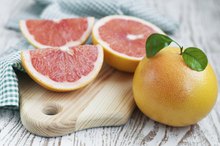
Lemon, grapefruit and other citrus fruits contain alpha hydroxy acids, primarily in the form of citric acid 1. In skin products, citric acid works as an astringent, a preservative and as an ingredient to balance the acid-alkali ratio. Lemon juice has a long history of being applied to the face to help fade freckles and skin discoloration. Be aware that citric acid, especially lemon juice, applied to the skin increases your sun sensitivity. If you eat more citrus fruits, you'll also load up on vitamin C, which helps boost your skin's appearance from the inside out.
- Lemon, grapefruit and other citrus fruits contain alpha hydroxy acids, primarily in the form of citric acid 1.
- Lemon juice has a long history of being applied to the face to help fade freckles and skin discoloration.
Lactic Acid
Benefits of Using a Grapefruit Peel on the Skin
Learn More
Lactic acid is prevalent in soured milk and yogurt. Apply full-fat plain yogurt to your skin as a natural mask. For a food to help bolster healthy skin, whip yogurt up into a smoothie with antioxidant-rich blueberries, strawberries and raspberries.
Malic Acid
Malic acid comes from apples -- both the whole fruit and cider. Use the acid as an astringent to help stimulate cell renewal. Applied to the face, it will make your skin feel smooth and tight.
Bitter Almonds
How to Make Your Own Strong Skin Peel at Home
Learn More
Mandelic acid is used in skin peels that help even out skin tone and repair sun damage. People who have acne scarring may also benefit from use of mandelic acid. Derived from bitter almonds, it undergoes a chemical process before being used as an ingredient in skin care products.
Other Good Skin Foods
Papaya and pineapple don't contain alpha hydroxy acids, but they do contain papain and bromelain, enzymes that work in much the same way 1. These enzymes stimulate you to exfoliate a layer of dead skin cells and result in a softer, smoother appearance. Apply straight pineapple juice to your face, or rub your face with the inner peel of the papaya to benefit.
Related Articles
Benefits of Using a Grapefruit Peel on the Skin
Learn More
How to Make Your Own Strong Skin Peel at Home
Learn More

How to Repair Skin Discoloration Caused by Hair Removal Products
Learn More
How to Hide Large Pores
Learn More
What Is Caprylic/Capric Triglyceride in Face Cream?
Learn More
Can You Add Aspirin to Skin Cream?
Learn More

How to Remove a Deep Scar on My Lip
Learn More
How to Get Rid of Dark Circles Around the Mouth
Learn More

How to Stimulate Collagen in the Face
Learn More

What Are the Benefits of Retinol Cream?
Learn More
References
- U.S. Food and Drug Administration: Alpha Hydroxy Acids
- Nonie of Beverly Hills: Natural AHA Ingredients
- BBC Good Food: Eat Your Way to Fabulous Skin
- Dermal Institute: Methods of Exfoliation
- Soleymani T, Lanoue J, Rahman Z. A practical approach to chemical peels: a review of fundamentals and step-by-step algorithmic protocol for treatment. J Clin Aesthet Dermatol. 2018;11(8):21–28.
- O'connor AA, Lowe PM, Shumack S, Lim AC. Chemical peels: a review of current practice. Australas J Dermatol. 2018;59(3):171-181. doi:10.1111/ajd.12715
- Tang SC, Yang JH. Dual effects of alpha-hydroxy acids on the skin. Molecules. 2018;23(4). doi:10.3390/molecules23040863
- Tran D, Townley JP, Barnes TM, Greive KA. An antiaging skin care system containing alpha hydroxy acids and vitamins improves the biomechanical parameters of facial skin. Clin Cosmet Investig Dermatol. 2015;8:9-17. doi:10.2147/CCID.S75439
- U.S. Food and Drug Administration. Alpha hydroxy acids. Updated May 7, 2019.
- Andersen F. Final report on the safety assessment of glycolic acid, ammonium, calcium, potassium, and sodium glycolates, methyl, ethyl, propyl, and butyl glycolates, and lactic acid, ammonium, calcium, potassium, sodium, and tea-lactates, methyl, ethyl, isopropyl, and butyl lactates, and lauryl, myristyl, and cetyl lactates. Int J Toxicol.1998;17(1_suppl):1-241. doi:10.1177/109158189801700101
- Babilas P, Knie U, Abels C. Cosmetic and dermatologic use of alpha hydroxy acids. J Dtsch Dermatol Ges. 2012;10(7):488-491. doi:10.1111/j.1610-0387.2012.07939.x
- U.S. Food and Drug Administration. Beta hydroxy acids. Updated November 15, 2017.
- Moghimipour E. Hydroxy acids, the most widely used anti-aging agents. Jundishapur J Nat Pharm Prod. 2012;7(1):9–10.
- U.S. Food and Drug Administration. Sunscreen: how to help protect your skin from the sun. Updated August 29, 2019.
- Weller, Richard P. J. B., Hamish J.A. Hunter, and Margaret W. Mann. Clinical Dermatology. Chichester (West Sussex): John Wiley & Sons Inc., 2015. Print.
Writer Bio
Andrea Boldt has been in the fitness industry for more than 20 years. A personal trainer, run coach, group fitness instructor and master yoga teacher, she also holds certifications in holistic and fitness nutrition.