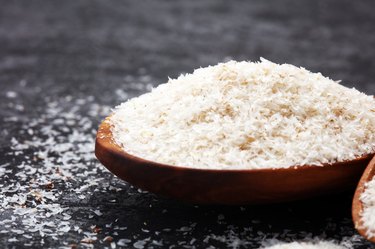
If you've had fewer than three bowel movements a week for a while, you may need to consider a laxative. You can use natural laxatives, like psyllium husk, for constipation. Psyllium is a bulk-forming laxative that can be taken as a powder or other forms, such as wafers and capsules.
Read more: 7 Signs Your Gut Is Out of Whack
Video of the Day
Video of the Day
Tip
If you’re taking psyllium husk for constipation, you should probably consume a daily dose that ranges between 5 and 10 grams.
What Is Psyllium?
Psyllium fiber comes from the seeds of an Indian herb called the Plantago plant. There are two main types of Plantago plants: Plantago ovata and Plantago psyllium. The Plantago plant is also known by a variety of other names, including blond plantain, desert Indian wheat, blond psyllium, ispaghula and isabgol.
Psyllium comes in a variety of forms, but psyllium-based products are typically made from either the seeds or the husks. According to a November 2018 study in the Journal of Food Process Engineering, psyllium is used as an additive in products like breakfast cereals and be considered a functional food.
Psyllium husks are used as a bulk-forming laxative — they are rich in soluble fiber, a carbohydrate that promotes elimination of the bowels. Psyllium seeds contain both soluble and insoluble fiber. They also contain a variety of nutrients, including protein, and trace elements, like zinc, manganese, copper, potassium, magnesium and calcium. Plantago ovata tends to be richer in nutrients compared to Plantago psyllium, however.
Fiber, Constipation and Healthy Diet
The Institute of Medicine recommends consuming 14 grams of fiber for every 1,000 calories you consume. For most people following a standard 2,000-calorie diet, this is equivalent to 28 grams of fiber per day. However, the average man typically eats more calories than the average woman. In general, women need about 25 grams of fiber per day, while men need about 34 grams per day.
Despite these recommendations, an April 2017 review in the Journal of the American Association of Nurse Practitioners reported that only 5 percent of adults get enough fiber. Most American adults consume just 15 grams of fiber per day. People on special diets, like low carbohydrate diets, usually consume even less — just 10 grams of fiber per day. Insufficient dietary fiber consumption is sometimes linked to gastrointestinal issues, including constipation.
The vast majority of healthy adults have regular bowel movements that range from three times per day to three times per week. In contrast, constipation is typically defined as having fewer than three bowel movements per week.
However, constipation can be a bit more complex. Even people who strain to pass stools and do so successfully on a daily basis can be considered constipated because they're having difficulty. This gastrointestinal issue typically occurs because of lack of fluid intake or because of a food or supplement you've ingested.
People who experience constipation regularly may need to take some form of laxative. You can use a variety of natural products, including isabgol, for constipation. Psyllium can help increase the water content in your stool, the amount of stool you excrete and the frequency of your bowel movements. This natural, plant-based laxative has even been shown to be more useful in relieving chronic constipation than other stool softeners.
Read more: 7 Weird Facts About Poop
Taking Psyllium Husk for Constipation
Psyllium husks are the part of this plant that are typically sold as fiber supplements. They work by increasing the amount of water in your large intestine. Psyllium softens and bulks up the stool in your intestines, making it easier to pass and relieving constipation.
You can find psyllium husks sold whole, in capsules, ground into powder or processed into wafers or bars. There are a variety of brand-name products that also contain psyllium, including Metamucil and Konsyl. If you're taking a product made from psyllium husk for constipation, you should follow the specific dosing instructions. If you're taking psyllium husk powder on its own, the University of Michigan recommends between 5 and 10 grams for the treatment of constipation.
Loose psyllium powder should always be mixed into water or another beverage before consumption. If you're taking your psyllium powder in capsule form, make sure you swallow each capsule one at a time and drink a full glass of water with them. Consuming enough liquid is very important. Liquid helps psyllium be effective and helps it pass through your gastrointestinal tract. Without the liquid, psyllium can be a choking hazard.
Husks are simply the exterior of the seed, and you can also use whole seeds to treat constipation. An April 2018 study in the Journal of Evidence-Based Integrative Medicine showed that psyllium seeds could be used to promote healthy bowel movements.
This study showed that psyllium can also help improve a range of gastrointestinal issues in people with gastroesophageal reflux disease (GERD), including functional constipation and indigestion. Around 5 grams of psyllium seeds are needed to promote one regular bowel movement.
Other Uses for Psyllium Husk
Using isabgol for constipation is certainly what this plant is most commonly known for. However, this plant can also be used for a variety of other purposes. Psyillium has been used to:
- Counteract diarrhea
- Relieve hemorrhoids
- Help people with diabetes manage blood glucose levels
- Help manage ulcerative colitis
- Manage irritable bowel syndrome
- Reduce cholesterol
- Reduce symptoms of diverticular disease
- Reduce triglycerides
However, the dosage for these purposes may be different from what's used for constipation. For example, when psyllium husk is used to reduce cholesterol levels, it is taken at daily doses that range between 10 and 20 grams. In contrast, when psyllium seeds are used to resolve symptoms of diarrhea, you may take doses as high as 30 grams per day.
Be careful not to take too much psyllium at once, or you may experience gastrointestinal issues that exacerbate your bowel problems. Common psyllium husk side effects include gas, bloating and bowel changes, like diarrhea and constipation. If you start taking this laxative gradually, you can usually avoid most of psyllium husk's side effects.
- Harvard Health Publishing: "Ask the Doctor: How Much Psyllium Is Needed to Lower Cholesterol?"
- Kaiser Permanente: "Psyllium"
- Journal of Evidence-Based Integrative Medicine: "Comparing the Effect of Psyllium Seed on Gastroesophageal Reflux Disease With Oral Omeprazole in Patients With Functional Constipation"
- UPMC: "Psyllium"
- University of Michigan Medicine: "Constipation (Holistic)"
- Harvard Heart Publishing: "Psyllium Fiber: Regularity and Healthier Lipid Levels?"
- Journal of the American Association of Nurse Practitioners: "Fiber Supplements and Clinically Proven Health Benefits: How to Recognize and Recommend an Effective Fiber Therapy"
- Mayo Clinic: "Constipation"
- Harvard Health Publishing: "Constipation and Impaction"
- Journal of Food Process Engineering: "Seeds of Plantago Psyllium and Plantago Ovata: Mineral Composition, Grinding, and Use for Gluten‐Free Bread as Substitutes for Hydrocolloids"
- Cleveland Clinic: "Improving Your Health With Fiber"