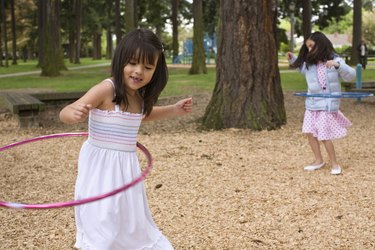
Hula-hooping is a fun way to keep fit, allowing you to target your arms, legs, abdomen and buttocks through a variety of exercises,. It improves flexibility, balance, motor skills, hand-eye coordination and endurance, and a weighted hoop can even provide enough resistance for a strengthening regimen. After a long day in front of a computer, hula-hooping offers a rejuvenating workout that can help you realign your spine.
Pump for the Core
Video of the Day
Pumping the hula-hoop around your waist provides a workout for your core muscles. To keep the hoop circling around your waist, move your hips in a forward and backward motion -- a push-pull -- as opposed to a circling movement. Begin by standing in the middle of the hoop with your feet staggered, lead foot about 12 inches in front of the trail foot, and knees slightly bent. Grasp the hoop and bring it to waist height, propping it against your back. Rotate your trunk to one side to wind up and then quickly push and release the hoop in the opposite direction. To keep the hoop spinning, immediately drive the hoop forward with your abdominal muscles and pull the hoop backward with your lower back muscles. Envision doing fluid and rhythmic hip thrusts to keep the hoop spinning for 10 to 20 minutes.
Video of the Day
Squat and Bump
If you squat while pumping, you can work your quads, hamstrings and glutes. Establish rhythm and then lower your body into a standard squat -- feet shoulder-width apart and knees bent at 90 degrees -- for three or four seconds. Another exercise that works the legs is the bump. Stand with your legs pressed together and knees slightly bent. Hold the hoop at waist height, propping it against the small of your back. Keeping your back straight, lean your body forward at the hips and shift your weight to the balls of your feet. Push the hoop to start it circling around your waist. Instead of performing hip thrusts, flex and extend your knees to keep the hoop circling on the vertical plane. Perform two or three reps of 30 seconds each.
Hand Rolls
Give your hips a rest and use only your hands and arms to work the upper body. For example, stand with the hoop in front of you, holding it vertically in one hand with an underhanded grip -- palm facing up. Push the hoop so it starts revolving around your hand. Take hold of the hoop for a split second to manage the angle and speed and then continue hooping. Focus on using your hand, wrist and arm for the exercise, keeping your shoulders relaxed. Once you've mastered the exercise with one hand, try it with the other. As you grow confident, add a step-touch with your feet, moving from side to side.
A Speedy Shimmy
By doing a rapid shimmy with the hoop around your buttocks you can tone your glutes. Begin by doing the standard pump. Slow your hip thrusts so the hoop edges below your hips. It should roll over your buttocks from behind and then roll above your pubic bone in the front. Boost the speed of the pumping motion as if you're beating an egg with a fork. Lead the shimmy with your tailbone, keeping your head and chest high and shoulders back. Your feet should be planted flat and firm on the ground. Push your feet against the ground to accelerate the pace of the hooping. Once you've grown adept at the shimmy, try marching in place while hooping to give your lower body a more challenging workout.