
Hockey Goalie Knee Injuries
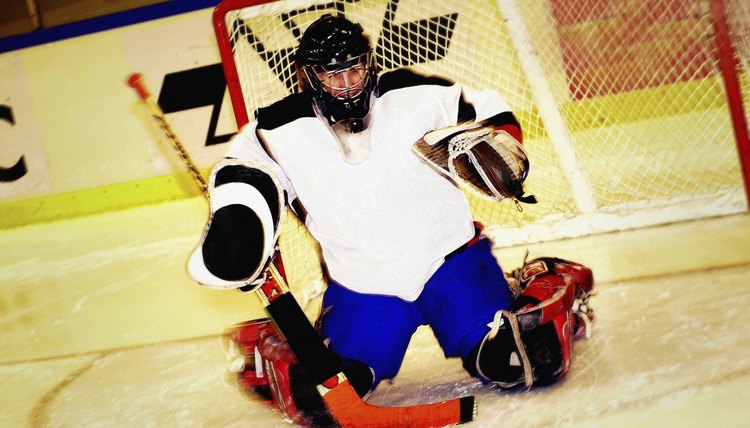
A goalie wears nearly 50 pounds in protective gear during a hockey game, which makes a goalie the most protected player on the ice. However, padding and protection can't always protect a goalie from injury. Approximately 31 percent of hockey injuries occur to the lower extremities. Many hockey goalies find themselves playing through or sidelined due to a knee injury. If you suspect you have sustained a knee injury while playing goalie, contact your physician.
Meniscal Injuries
Contact sport athletes -- including hockey players -- are at risk for meniscal injuries, according to the American Academy of Orthopaedic Surgeons. The meniscus is the cartilage that cushions and stabilizes the joint between your thigh bone and shinbone. Meniscus injuries frequently involve full or partial tears of the cartilage. Goalies sustain knee injuries during a collision with another player, taking a puck to the leg or twisting their knee in the wrong direction while making a save. Treatment depends on the severity of the tear and can range from rest to surgical repair.
ACL Injuries
The ACL is the anterior cruciate ligament, located in the middle of your knee. It connects your thighbone and shinbone. The ACL also helps to stabilize the knee joint. ACL injuries can cause a knee to feel loose and unstable. Injuries are often the result of a sudden change of direction, twisting or an over-extension of the knee, which are the main maneuvers of a goalie. Goalies are likely to feel pain, swelling and instability when bearing weight. A severe ACL injury is treated with surgery. Partial tears are treated with rest, bracing and physical therapy.
Patellar Tendinitis
The patellar tendon is located in your knee cap and plays an important role in the ability to extend your knee. Tendinitis is often an overuse injury. With patellar tendinitis, pain is felt between the knee and the shinbone. This pain can range from dull to a constant ache. Goalies are likely to feel more pain while practicing and during games than they will on off days. Rest is the number one treatment method for patellar tendinitis. Stretching and strengthening can help prevent further issues with patellar tendinitis.
Knee Contusion
Hockey is considered a high-impact sport by the American Academy of Pediatrics. With goalies constantly on their feet and knees, repeated and direct blows to the knee are common. Most knee contusions are minor and heal quickly. More serious knee contusions or repeat contusions can lead to deep tissue damage. Symptoms of a knee contusion include pain, swelling and bruising. Rest, ice, elevation, compression and anti-inflammatory medicines are the recommended treatments for most knee contusions.
Explore In Depth
References
- Saint Vincent: Ice Hockey Injuries
- AAOS: Mensical Tears
- University of Maryland Medical Center: ACL Injuries
- University of Maryland Medical Center: Anterior Knee Pain
- AAOS: Muscle Contusion
- Lespasio MJ, Piuzzi NS, Husni ME, Muschler GF, Guarino A, Mont MA. Knee Osteoarthritis: A Primer. Perm J. 2017;21:16-183. doi:10.7812/TPP/16-183
- Kiapour AM, Murray MM. Basic science of anterior cruciate ligament injury and repair. Bone Joint Res. 2014;3(2):20-31. doi:10.1302/2046-3758.32.2000241
- Doral MN, Bilge O, Huri G, Turhan E, Verdonk R. Modern treatment of meniscal tears. EFORT Open Rev. 2018;3(5):260-268. doi:10.1302/2058-5241.3.170067
- Reinking MF. CURRENT CONCEPTS IN THE TREATMENT OF PATELLAR TENDINOPATHY. Int J Sports Phys Ther. 2016;11(6):854-866.
- Petersen W, Rembitzki I, Liebau C. Patellofemoral pain in athletes. Open Access J Sports Med. 2017;8:143-154. doi:10.2147/OAJSM.S133406
- Frush TJ, Noyes FR. Baker's Cyst: Diagnostic and Surgical Considerations. Sports Health. 2015;7(4):359-65. doi:10.1177/1941738113520130
- Huang YC, Yeh WL. Endoscopic treatment of prepatellar bursitis. Int Orthop. 2011;35(3):355-8. doi:10.1007/s00264-010-1033-5
- Beals C, Flanigan D. A Review of Treatments for Iliotibial Band Syndrome in the Athletic Population. J Sports Med (Hindawi Publ Corp). 2013;2013:367169. doi:10.1155/2013/367169
- Tsai CH, Hsu CJ, Hung CH, Hsu HC. Primary traumatic patellar dislocation. J Orthop Surg Res. 2012;7:21. doi:10.1186/1749-799X-7-21
- Ragab G, Elshahaly M, Bardin T. Gout: An old disease in new perspective - A review. J Adv Res. 2017;8(5):495-511. doi:10.1016/j.jare.2017.04.008
- Lee PYF, Nixion A, Chandratreya A, Murray JM. Synovial Plica Syndrome of the Knee: A Commonly Overlooked Cause of Anterior Knee Pain. Surg J (N Y). 2017;3(1):e9-e16. doi:10.1055/s-0037-1598047
- Vaishya R, Azizi AT, Agarwal AK, Vijay V. Apophysitis of the Tibial Tuberosity (Osgood-Schlatter Disease): A Review. Cureus. 2016;8(9):e780. doi:10.7759/cureus.780
- Zanon G, Di vico G, Marullo M. Osteochondritis dissecans of the knee. Joints. 2014;2(1):29-36.
- Hindle P, Davidson E, Biant LC. Septic arthritis of the knee: the use and effect of antibiotics prior to diagnostic aspiration. Ann R Coll Surg Engl. 2012;94(5):351-5. doi:10.1308/003588412X13171221591015
- Gwinner C, Märdian S, Schwabe P, Schaser KD, Krapohl BD, Jung TM. Current concepts review: Fractures of the patella. GMS Interdiscip Plast Reconstr Surg DGPW. 2016;5:Doc01. doi:10.3205/iprs000080
- Voskuil R, Evenski AJ, Montgomery C, Emory CL. Malignant Bone Tumors of the Knee: How to Identify and Treat. J Knee Surg. 2019;32(4):305-314. doi:10.1055/s-0038-1675828
- Gupte C, St mart JP. The acute swollen knee: diagnosis and management. J R Soc Med. 2013;106(7):259-68. doi:10.1177/0141076813482831
- American Academy of Orthopedic Surgeons. Unstable Kneecap.
- Bhatia D, Bejarano T, Novo M. Current interventions in the management of knee osteoarthritis. Journal of Pharmacy & Bioallied Sciences 2013 Jan-Mar;5(1):30-38. doi:%2010.4103/0975-7406.106561
- Bronstein RD, Schaffer JC. Physical Examination of the Knee: Meniscus, Cartilage, and Patellofemoral Conditions. J Am Acad Orthop Surg. 2017 May;25(5):365-374.
- Browne K, Kurtz CA. How to perform a comprehensive examination of the knee. JAAPA. 2009 Jun;22(6):20-25.
- Hergenroeder AC, Harvey BS. (2017). Osteochondritis dissecans (OCD): Clinical manifestations and diagnosis. Bachur RG, ed. UpToDate. Waltham, MA: UpToDate Inc.
Resources
Writer Bio
Michelle Zehr started writing professionally in 2009. She has written on health, fitness, fashion, interior design, home decorating,sports and finance for several websites. Zehr possesses a Bachelor of Arts in communication from the University of Pittsburgh, a Master of Arts in professional writing from Chatham University and a graduate certificate in health promotion from California University of Pennsylvania.