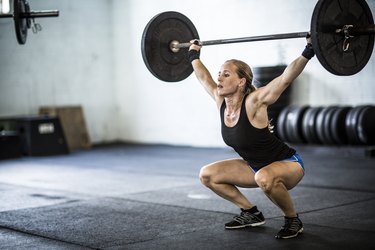
Like many women, you may prefer sweating it up in your aerobics class, but weight training is an essential component of your exercise program. Though your fears of bulking up are unfounded, following a well-balanced strength training meal plan can help you lose fat and tone your muscles.
Women Resisting Weight Training
Video of the Day
Women exercise to lose weight and tone up, according to a September 2016 study published in the International Journal of Liberal Arts and Social Science, and most often opt for aerobic activity. Though your morning run burns calories and improves heart health, regular strength-training may be more effective at helping you lose weight and tone your muscles.
Video of the Day
You may be resistant to adding regular weight training to your exercise routine because you don't want to get too "bulky." Physiologically that's not possible, unless you're spending hours in the weight room most days of the week and eating massive amounts of food. Because women produce less testosterone than men, adding two days of strength training a week to your usual workout routine improves your lean muscle mass, but doesn't add bulk, says the American Council on Exercise (ACE).
In addition to not turning you into a she-hulk, regular strength training increases production of somatotropin, also known as human growth hormone, which improves your body's metabolism of fats. Upping production of this hormone may also slow down the biological aging process.
Read more: Toning Diet for Women
Weight-Training Benefits for Women
As if turning you into a strong, toned, fat-burning machine wasn't convincing enough, combining a healthy weight-lifting meal plan with a regular strength-training routine offers many health benefits.
Your body naturally loses muscle mass as you get older, resulting in a higher percentage of body fat and a decrease in your metabolism. However, you don't have to let the aging process dictate your physique. Regular weight training helps you retain your lean muscle mass and may keep your metabolism burning at maximum capacity, making it easier for you to lose weight and keep it off.
Weight training is also good for your bones. Of the 10 million people in the United States diagnosed with osteoporosis, 8 million are women, notes the National Osteoporosis Foundation. Osteoporosis is a chronic bone disease that makes you more susceptible to fractures.
Women are at greater risk of developing osteoporosis because their bones are smaller, thinner, and less dense. Also, bone loss increases after menopause due to declining estrogen levels. Further, risk of osteoporosis increases with age, and women tend to live longer than men.
Your muscles and bones are strongly interconnected anatomically, physiologically, and chemically. The force placed on your muscles when you strength-train activates bone cell production to improve bone density, health and strength. When it comes to the best exercises for muscle strength and bone health, weight training is the most beneficial, according to a December 2018 article published in Endocrinology and Metabolism.
Though you should always consult with your primary care provider first, the Mayo Clinic reports that your strength-training workout may also help you manage your chronic health issues, such as your arthritis, back pain, diabetes or depression.
Read more: The Only 5 Exercises Women Need to Get Lean
Strength-Training Diet for Women
Of course, crunches, lunges and bicep curls are good muscle-building activities, but you may not get all the benefits that strength training has to offer if your nutrition isn't on point. Muscle building is an anabolic process, which means it requires more energy to not only build the muscle, but also meet the energy demands created by your workout.
A strength-training diet for women needs to supply an adequate number of calories and a healthy balance of carbohydrates, protein and fat. According to the ACE experts, if you skimp on your weight-lifting meal plan, you may not get all the benefits your strength-training routine offers. Additionally, you may end up losing the muscle mass you're trying to build, which may lead to muscle fatigue that affects the quality of your workouts, increases your risk of injury and prolongs your recovery time.
Improperly fueling your workout may also increase your risk of nutritional deficiencies.
Consume Enough Calories
One of the most important elements of a strength training diet for women is calories. As noted, your body needs a surplus of energy in order to build muscle. The number of calories you need to eat on your strength-training meal plan may depend on many factors, including your height and weight, age, physical activity and overall health.
According to the USDA 2015-2020 Dietary Guidelines, the calorie needs for women range from 1,600 to 2,400 calories a day. This includes women of all ages and activity levels. So, if you lead a fairly active lifestyle — engaging in aerobic activity on a regular basis and strength training at least two days a week — you should probably lean towards the upper end of the calorie range for women, consuming about 2,000 to 2,400 calories a day.
Track your calories, weight and body composition to help you determine if you're eating enough calories — or too many — and adjust by adding or subtracting in 50- to 100-calorie increments. Better yet, consult with your primary care provider or a registered dietitian who can provide specific calorie recommendations based on your needs and goals, as well as help you monitor your progress and adjust your plan as you go.
Need for Protein
Intense weight training creates microscopic tears in your muscle fibers and connective tissue. To repair and grow your muscles, you must provide your damaged tissue with an adequate supply of nutrients, including the essential amino acids needed to heal the microscopic tears and build the muscle. In addition to calories, a weight-training diet for females must supply enough protein to meet your increased demands so you can achieve your goals.
When lifting weights and engaging in aerobic exercise to lose weight and tone your muscles, the American College of Sports Medicine recommends you aim for 1.2 to 1.7 grams of protein per kilogram of body weight (or 0.5 to 0.8 grams per pound). That means if you weigh 150 pounds, you need 75 to 120 grams of protein per day.
That may sound like a lot of protein, but you can easily get the amount of protein your muscles need from whole foods, such as:
- 8 grams from a cup of skim milk
- 7 grams from one large hard-boiled egg
- 27 grams in 3 ounces of cooked lean chicken breast
- 15 grams in 1 cup of cooked chickpeas
- 17 grams in a 7-ounce container of nonfat Greek yogurt
- 8 grams in 1 cup of cooked quinoa
In addition to helping you build more calorie-burning muscle, protein also supports your weight-loss efforts. An April 2015 review published in the American Journal of Clinical Nutrition reports that eating a high-protein diet increases satiety so you feel full longer, helping you eat less. Eating more protein also gives your metabolism a bit of a boost because it requires more energy to digest and metabolize protein than carbohydrates and fat.
What About Carbohydrates and Fat?
Yes, protein is an essential part of your weight-lifting meal plan, but you can't lose the fat and tone those muscles if you're not getting an adequate supply of carbohydrates and fat. Both carbohydrates and fat provide your body with the energy it needs to maintain your muscle tissue and get through your intense workouts. Getting an adequate supply of carbs and fat also prevents your body from using the protein you're consuming to build muscle as a source of energy.
The National Academies of Sciences, Engineering and Medicine recommends that adults get 45 to 65 percent of their calories from carbohydrates and 20 to 35 percent of their calories from fat. Your specific carbohydrate and fat needs may depend on the amount of protein you need, as well as your daily calorie needs.
For example, if you're following a 2,000-calorie diet and you need 120 grams of protein a day, then you're getting about 25 percent of your calories (480 calories) from protein, leaving you with 1,520 calories to split between carbohydrates and fat, or about 45 to 50 percent of your calories from carbs and 25 to 30 percent from fat.
However, when it comes to the types of carbohydrates and fat you eat on your weight-lifting meal plan, you need to include healthy sources to maximize your nutritional intake. Whole grains, fruits, vegetables, low-fat milk, yogurt and beans are healthy sources of carbohydrates. Vegetable oils, avocados, nuts and seeds are smart fat choices for your weight-lifting meal plan.
Read more: Your Guide to Strength Training for Women
Strength-Training Meal Plan
When it comes to the number of meals you need to eat per day on your strength-training meal plan, there's no hard-and-fast rule. However, eating at regular intervals keeps your body and muscles well-fueled. Harvard Health Publishing suggests you aim for three meals a day to keep hunger levels in check and prevent those uncontrollable snack attacks that cause you to devour an entire box of crackers while you mindlessly watch TV.
While guidelines are a bit loose about how many meals you need to eat on your weight-lifting meal plan, the recommendations for your pre- and post-workout meals are clear.
In an August 2017 position statement on nutrient timing published in the Journal of the International Society of Sports Nutrition, says that eating a pre- and post-workout meal consisting of carbohydrates and protein or just protein improves both strength and body composition.
What you eat to fuel your workout may depend on timing. ACE recommends that two to three hours before your workout you eat a high-carb meal with plenty of protein, such as tuna sandwich with an apple or roasted chicken with sweet potatoes and carrots. About 30 to 60 minutes before your workout, you need a simple carbohydrate and protein snack, such as a banana with peanut butter or low-fat Greek yogurt with fresh blueberries.
To maximize muscle-building after your workout, International Society of Sports Nutrition suggests you consume a high-quality source of protein within two hours of your weight-training session. Good options include nonfat Greek yogurt, low-fat milk, grilled fish or hard-boiled eggs.
- International Journal of Liberal Arts and Social Science: "Gender Differences in Exercise Habits and Quality of Life Reports: Assessing the Moderating Effects of Reasons for Exercise"
- American Council on Exercise: "4 Myths About Strength Training for Women"
- National Osteoporosis Foundation: "Osteoporosis Fast Facts"
- Office on Women's Health: "Osteoporosis"
- Endocrinology and Metabolism: "Effects of Resistance Exercise on Bone Health"
- Mayo Clinic: "Strength Training: Get Stronger, Leaner, Healthier"
- American Council on Exercise: "Pre- and Post-Workout Nutrition for Strength Training"
- USDA 2015-2020 Dietary Guidelines: "Appendix 2. Estimated Calorie Needs per Day, by Age, Sex and Physical Activity Level"
- Journal of the International Society of Sports Nutrition: "International Society of Sports Nutrition Position Stand: Diets and Body Composition"
- American Council of Sports Medicine: "Protein Intake for Optimal Muscle Maintenance"
- MyFoodData: "Skim Milk, Quinoa Cooked, Nonfat Greek Yogurt, Chickpeas, Lean Chicken Breast, Hard Boiled Egg"
- American Journal of Clinical Nutrition: "The Role of Protein in Weight Loss and Weight Maintenance"
- Academy of Nutrition and Dietetics: "4 Keys to Strength Building and Muscle Mass"
- National Academies of Sciences, Engineering and Medicine: "Dietary Reference Intakes for Energy, Carbohydrate, Fiber, Fat, Fatty Acids, Cholesterol, Protein and Amino Acids"
- Harvard Health Publishing: "Eating Frequency and Weight Loss"
- Journal of the International Society of Sports Nutrition: "International Society of Sports Nutrition Position Stand: Nutrient Timing"