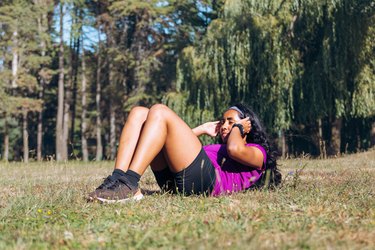
Abdominal crunches can help you strengthen your core a bit, improving the muscle tone in your stomach. But unfortunately, you can't spot-reduce belly fat and this move probably won't give you the results you're looking for.
Learn why crunches probably aren't the best exercise to strengthen and flatten your stomach and what you can do to reach your desired results.
Video of the Day
Video of the Day
Do Crunches Flatten Your Stomach?
Building a stronger core can help you cut belly fat, ultimately giving you a flatter stomach, according to Carolina Araujo, CPT, a New York-based strength coach. But crunches aren't necessarily the best exercise to get you there.
"For absolute beginners crunches can help build a bit of core strength because your body is responding to a brand-new type of exercise," she says. "But standard crunches aren't effective for very long and there are other moves that can give you your goal more quickly."
Although you can't spot-reduce fat in your belly, you can build strength in your core to start shedding fat and develop the look of a more toned abdomen. The best way to build strength is with resistance exercises, according to the National Academy of Sports Medicine (NASM).
So, while crunches may help you build a bit of strength at first, chances are, you'll need to vary your core exercises to keep seeing results.
Strengthening Your Core
Strengthening your core muscles -- the muscles throughout your torso -- helps keep your body strong and stabilized. And, as mentioned above, a stronger core can give you a flatter-looking midsection.
But there are plenty of core-focused exercises that can get you faster, more effective results. Adding some resistance exercises into your ab workouts is the best way to build a stronger midsection, according to Araujo.
For instance, medicine ball slams and farmer's walks both use weights to add some extra resistance, giving your muscles more challenge. But if you don't have equipment handy, even leg raises add a little extra weight (because your legs are suspended in the air) that your core has to lift.
"A lot of exercises that are focused on other body parts also strengthen your core but you wouldn't expect it," Araujo says. "When you do deadlifts, for instance, your core is working the whole time to stabilize the weight and protect your back. So, any kind of resistance training will likely help strengthen your stomach."
Don't Neglect Cardio
While you can't spot reduce belly fat, cardio training can help increase your overall calorie burn, which also helps burn fat. Aim to get at least 150 minutes of steady-state cardio (like walking or hiking) per week or about 75 minutes of vigorous cardio (like running or swimming) each week, recommend the Centers for Disease Control and Prevention.
High-intensity interval training (HIIT) circuits can help you build strength and torch calories at the same time. In a HIIT workout, you can incorporate exercises like squat thrusters and burpees, which help build core strength and stability.
Tailoring Your Nutrition
To build strength and trim some body fat, your daily diet makes a big difference. You want to make sure you're fueling your workouts with healthy, nutrient-dense foods, while minimizing processed ingredients.
Many packaged snack foods, like candy bard, chips and sodas, are high in calories but low in nutrients, so you're not really getting much benefit. Instead, focus on whole, minimally-processed foods.
Prioritize lean protein options to help build strength and muscle tone, Araujo says. Chicken, salmon, Greek yogurt and cottage cheese are just a few options you can try.
Single-ingredient carbohydrates (like potatoes or rice) can help provide energy for your workouts. And don't forget to fill your plate with plenty of vegetables, too.