
The History of Weightlifting
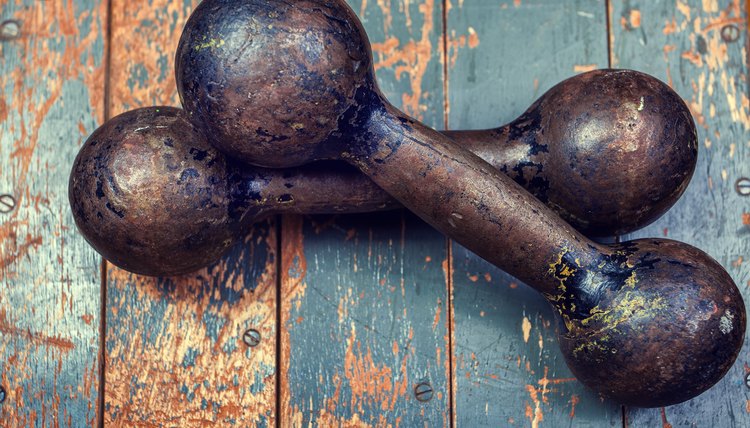
Tests of power and strength have remained a popular competitive sport throughout the ages. Since those early years, men have challenged each other in hopes to be bigger and stronger than everyone else. Over many millenniums, these tests of strength have continued. In fact, the history of weightlifting shows a vivid display of male and female weightlifting competitors.
Ancient History
The earliest evidence of weightlifting dates to China’s Zhou Dynasty, which took place from the 10th century B.C. until 256 B.C. During this time, military recruits were required to pass weightlifting tests before they were accepted into the military. Various sculptures from ancient Greek civilizations also portray the sport, depicting Greeks lifting heavy stones. Eventually, the Greeks substituted large heavy bells for primitive dumbbells. Ancient Egyptian artifacts also depict the sport of weightlifting; according to these artifacts, Egyptians lifted heavy bags of sand as a form of physical training.
Early Olympics
The sport of weightlifting made its first Olympic appearance at the 1896 games. During these games, Launceston Elliott of Great Britain won the “One-Hand Lift” contest; Viggo Jensen of Denmark won the “Two-Hand Lift.” The sport did not appear in the 1900 Olympic Games but returned to the scene for the 1904 games. In the 1904 games, a Greek competitor secured the gold medal for “Two-Hand Lift” and Oscar Osthoff secured the gold for the “All-Around Dumbbell” contest. The sport was again eliminated from the Olympic Games in 1908 and 1912 but returned to the Olympics permanently in 1920. By the 1932 Olympic Games, five weight divisions had been established and competition featured three disciplines: the press, snatch and clean and jerk.
Women and Weightlifting
Ivy Russell of England was a pioneer of weightlifting for women. Russell began her weight training career in 1921 at 14. In the early 1930s, Russell won the first women’s weightlifting competition sanctioned by the British Amateur Weight Lifting Association. Several years later, the Miss Universe bodybuilding contest was initiated in 1965. At the 2000 Olympic Games, women were officially allowed to compete in the weightlifting competitions. Tara Nott of the United States was the first woman to win an Olympic gold medal for weightlifting. As of the 21st century, women from across the world continue to compete within seven different weight classifications.
Olympic Events
In 1972, the press competition was eliminated from the Olympic Games. Since then, the snatch and clean and jerk have remained the only two Olympic weightlifting events. For the snatch, the athlete places a wide grip on the barbell and lifts the bar from the floor to over the head in one swift movement. For the clean and jerk, the athlete uses a close grip to pull the bar from the floor to the shoulders in one swift movement. After pausing briefly, the athlete then pushes the bar over the head while spreading the feet.
Fun Fact
Since its introduction in the 1896 Olympics, the sport of weightlifting remains the only Olympic sport that involves the use of weights.
Writer Bio
Krista Sheehan is a registered nurse and professional writer. She works in a neonatal intensive care unit (NICU) and her previous nursing experience includes geriatrics, pulmonary disorders and home health care. Her professional writing works focus mainly on the subjects of physical health, fitness, nutrition and positive lifestyle changes.