
What does fact checked mean?
At SportsRec, we strive to deliver objective content that is accurate and up-to-date. Our team periodically reviews articles in order to ensure content quality. The sources cited below consist of evidence from peer-reviewed journals, prominent medical organizations, academic associations, and government data.
The information contained on this site is for informational purposes only, and should not be used as a substitute for the advice of a professional health care provider. Please check with the appropriate physician regarding health questions and concerns. Although we strive to deliver accurate and up-to-date information, no guarantee to that effect is made.
Bathtub Exercises
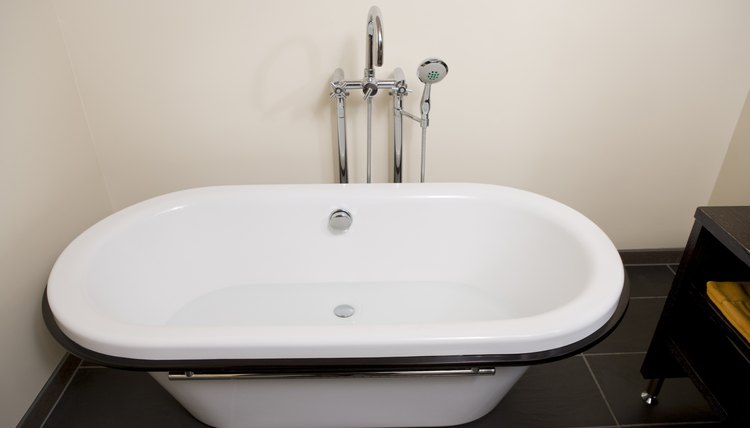
Your time may be limited on certain days, leaving you searching for a way to get in short workouts. As you go through your day, one room of your home that you will visit most often is the bathroom. That's where you'll find a non-traditional workout tool: the bathtub.
Strength
Without getting into the tub, you can perform strength training exercises on the edge. These do not take a lot of time--fit them in between brushing your teeth and washing your face. Do eight to 10 push-ups with your hands on the side of the tub and your legs extended behind you or with your knees on the floor. You can also strengthen your arms by performing a dip. A dip begins with you sitting on the side of the tub and placing your hands next to your hips. Perform the dip by bending your knees and moving your hips off the tub; then bend your elbows, lowering your hips toward the floor. Straighten your arms to return to the starting position. You should feel the strengthening in the backs of your upper arms.
Stretch
Stretch your legs by placing one foot on the edge of the bathtub and the other foot on a nonslip mat. Perform the stretch by straightening the leg on the tub and folding your body forward, bringing your chest toward your leg. Hold this stretch for 30 to 60 seconds to increase your flexibility.
Core
In the bathtub, either with a small amount of water or resting on a bathmat, you can do crunches to strengthen your core. Place your feet on the wall and lie on your back with your face above water. Cross your arms over your chest and tighten your stomach as you lift your shoulders and chest out of the water. Repeat this crunch eight to 10 times for two or three sets.
Flexibility
In warm water, your muscles relax, so you have the opportunity to increase flexibility. A forward fold is a leg and lower back stretch that can take place in the bathtub. Perform this stretch by inhaling and sitting tall with your legs straight out in the water; then exhale and fold forward from the hips to bring your chest toward your legs, leaving your face out of the water. Hold the stretch for five to 10 deep breaths.
Explore In Depth
References
Writer Bio
A mother of two and passionate fitness presenter, Lisa M. Wolfe had her first fitness article published in 2001. She is the author of six fitness books and holds an Associate of Arts in exercise science from Oakland Community College. When not writing, Wolfe is hula-hooping, kayaking, walking or cycling.