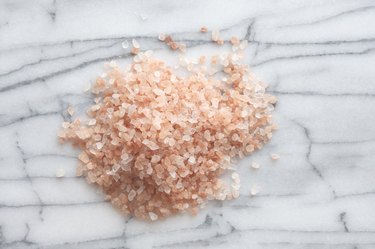
Gray salt and Himalayan pink salt are both popular specialty salts that look and taste great, but are they healthier than regular table salt? From lower sodium claims to salt that cures cancer, find out what's true and what's hype.
Gray Salt vs. Himalayan Salt
Video of the Day
There are many types of gourmet salts available, including Himalayan salt, black lava salt and gray sea salt. They all contain a mixture of sodium and chloride — just like regular table salt, says the Mayo Clinic. The differences in taste and appearance are due to their mineral content.
Video of the Day
Salt occurs naturally in seawater and saltwater in the form of halite, a mineral that is mined and processed so it looks like the salt you use to season your dishes. The white table salt that is normally found on kitchen tables comes from underground salt deposits that are processed until all minerals are removed. It is pure sodium chloride. Most salt varieties also have iodine added to keep your thyroid healthy.
Himalayan pink salt is rock salt that comes from the large Khewra Salt Mine in Pakistan. It gets it pretty pink color from the trace amounts of iron oxide (or rust) that it contains, explains the University of Hawaii. This salt does have small amounts of magnesium, potassium, iron and calcium. Many people like the taste of Himalayan pink salt, as well as its appearance when sprinkled on food.
Gray salt, also known as Celtic Sea salt or Sel Gris salt, is made in France. The crystals fall to the bottom of the sea where it is then collected. Its gray color comes from the clay that lines these saltwater ponds. The salt crystals are then collected by hand using special wooden tools.
The type of salt has large crystals and a moist texture. It also contains trace minerals — similarly to Himalayan pink salt.
Read more: Health Benefits of Celtic Sea Salt
Which Salt Is Healthiest?
You need salt in your diet to maintain your fluid balance. However, eating too much of it as opposed to healthier seasonings like spices may increase your blood pressure and put you at risk for heart disease, stroke and kidney failure, warns the U.S. Food and Drug Administration (FDA).
Consume no more than 2,300 milligrams of sodium per day, advises the FDA. That's about 1 teaspoon of salt, so it adds up fast. If you're middle-aged or older, African American or have hypertension, try not to exceed 1,500 milligrams of sodium per day.
Read more: Signs and Symptoms of Too Much Salt in the Diet
How do these gourmet salts rank in terms of sodium content? One teaspoon of table salt has 2,300 milligrams of sodium. Grey salt and Himalayan pink salt have larger crystal sizes than regular table salt, so they contain less sodium by volume simply because fewer crystals fit in a spoon, reports the American Heart Association (AHA).
Gray salt and Himalayan salt aren't processed, so they do retain trace amounts of minerals. Table salt, on the other hand, is mined and processed and therefore, it doesn't have any minerals.
Although specialty salts are higher in minerals, they don't contain enough to provide health benefits, states the AHA. You can easily get these minerals from whole foods. Furthermore, specialty salts and table salt contain about the same amount of sodium. The added iodine in table salt may help protect against thyroid issues.
If you like the taste and the appearance of grey salt or Himalayan pink salt, then go ahead and sprinkle it on your favorite dishes. Otherwise, don't fall for TV commercials and online ads saying these products are healthier than regular table salt.
Salt That Kills Cancer Cells?
A study came out regarding salt and cancer, resulting in confusing reports touting salt as a cure. Could sprinkling some sea salt on your favorite meal help stop cancer? Unfortunately, not.
The study had headlines buzzing that there is a salt that kills cancer cells, which is true — but that's not the entire story. This August 2014 study in Nature Chemistry has found that increasing salt levels in the cells caused death to cancer cells in lab tests. The experiment has been conducted in vitro (a lab-controlled environment) and no human trials have been done, so its findings are subject to debate.
The University of Southampton says that even though this study has opened up possibilities for further research, it's important to note that the salt did kill cancer cells, but it also destroyed the healthy cells. More studies are required to determine how the salt can target only the cancer cells and not the healthy cells as well. Currently, no type of salt is known to kill cancer cells, but who knows what the future will hold?
- Mayo Clinic: "Slide Show: Guide To Gourmet Salt"
- University of Hawaii: "Traditional Ways of Knowing: Salt Harvesting"
- American Heart Association: "Sea Salt vs. Table Salt"
- Nature Chemistry: "Synthetic Ion Transporters Can Induce Apoptosis by Facilitating Chloride Anion Transport Into Cells"
- University of Southampton: "Synthetic Molecule Kills Cancer Cells With Salt"
Is this an emergency? If you are experiencing serious medical symptoms, please see the National Library of Medicine’s list of signs you need emergency medical attention or call 911.