
How to Tone the Stomach With Swimming
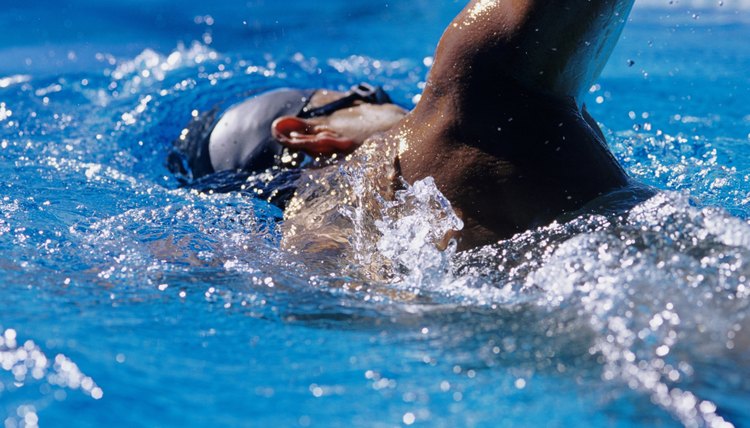
Swimming itself is effective for building strength and tone in your stomach, especially when performing the butterfly, breaststroke and underwater dolphin kick, but you can also incorporate additional swimming drills that specifically emphasize the muscles in your stomach. To build tone, begin your workout with ab-toning swimming strokes and then move on to exercises like the ab-buster stroke, k-tread, otter roll and wave maker. Do the workout three days per week.
Swimming Strokes
Work your abdominals and obliques with a workout consisting of the butterfly stroke, breaststroke and underwater dolphin kick. Start with five minutes of light freestyle swimming to warm up your muscles. Complete five 50-meter sets of the butterfly stroke. In between each set, do 50 meters of the underwater dolphin kick. Rest for two or three minutes and then do five 50-meter sets of the breaststroke. Again, add in 50 meters of the underwater dolphin kick in between each set.
Ab-Buster Stroke
For the ab-buster stroke, you need a pair of a fins and a pull buoy. Place the fins on your feet and squeeze the pull buoy between your thighs. With your arms extended out in front of you and your hands together, dolphin kick the length of the pool from your back. By squeezing the buoy and using your legs to propel your body through the water, you increase the demand on your abdominals and obliques. Continue for two lengths of the pool.
K-Tread Drill
The k-tread exercise strengthens muscles in your arms, back, chest, butt and legs, but it also works your abdominals as they must contract to keep your torso still within the water while your limbs are moving. Move to the deep end so that you can’t touch the bottom of the pool with your feet. Cup your hands and make small circles as you simultaneously lift and lower your legs. Keep your legs straight and have them work in an alternating fashion, so that when one leg is driving down to point vertical, the other leg is driving upward to become horizontal. Continue treading water for 30 seconds. Do three sets.
Otter Roll
The otter roll exercise works both your abdominals and your obliques as they twist your torso around against the resistance of the water. Float on your back while hugging a beach ball to your chest, Keep your legs together and extended. Roll to the right and bring the ball under the water as you move up and over it. Complete a full revolution and then roll in the opposite direction. Perform the exercise for 30 seconds, alternating the direction of the roll. Do two sets.
Wave Maker
To perform the wave maker swimming exercise, wear a pair of fins on your feet and hold onto the edge of the pool while lying on your stomach with your legs extended out behind you. Hold your legs and feet together as you try to make large waves by performing dolphin kicks. Continue for 30 seconds and complete a total of two sets.
References
Writer Bio
Kim Nunley has been screenwriting and working as an online health and fitness writer since 2005. She’s had multiple short screenplays produced and her feature scripts have placed at the Austin Film Festival. Prior to writing full-time, she worked as a strength coach, athletic coach and college instructor. She holds a master's degree in kinesiology from California State University, Fullerton.