Lordosis is a normal curve that creates the arch in your lower back. However, this term is also used to describe too much of an arch in this area — a condition also called hyperlordosis, as explained by Physiopedia.
Hyperlordosis can be caused by weak core muscles, tight hip flexors, poor exercise form and weak gluteal muscles. Some of these conditions may be corrected with hyperlordosis treatment exercises.
Video of the Day
Video of the Day
If you have pain associated with your lordosis, consult a doctor to determine the underlying cause.
1. Hip Flexor Stretches
Lordosis stretches target the hip flexors. Due to a biomechanical process known as reciprocal inhibition, when your hip flexors are tight, the gluteals, which are the opposing muscle group, become weak. This has an adverse effect on pelvic alignment. There are two ways to stretch hip flexors.
Myofascial self-release with a foam roller combines the benefits of stretching and massage. Manual stretches increase flexibility and range of motion.
Move 1: Myofascial Release
- Lie facedown, aligning your hip flexors with the center of the roller.
- Allow your weight to sink into the roller.
- Hold the position for at least 30 seconds, as advised by Mayo Clinic.
Move 2: Hip Flexor Stretch
- Stand up, bend your knee and reach behind you to grab your ankle.
- Tilt your pelvis forward as you pull your heel toward your buttock.
- Hold the stretch for at least 30 seconds.
2. The Pelvic Tilt
The pelvic tilt position — also called an abdominal draw-in — is the opposite of an arched back. Performing this exercise, as demonstrated by Princeton University Athletic Medicine, can help correct a lordotic posture.
- Lie on your back with your knees bent and your feet flat on the floor.
- Inhale to prepare.
- As you exhale, tilt the lower part of your pelvis from the floor, forming a hollow bowl between your pelvis and your navel.
- Perform 20 repetitions daily.
3. Stability Ball Bridge
The stability ball bridge strengthens your gluteal muscles. Since the ball is an unstable object, it requires deep core activation. As such, this exercise will work your butt and your deep abdominal muscles.
- Lie on your back with your calves draped over the ball.
- Begin with the pelvic tilt.
- Then squeeze your butt until you are in a bridge position.
- As you roll down, try to feel each vertebra touch the floor. Make sure that the lower back touches the floor before the pelvis.
- Perform 12 repetitions every day.
4. Stability Ball Crunch
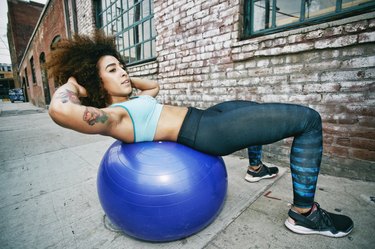
Strengthening your abdominal muscles is essential for correcting spinal lordosis. Performing your crunches on a stability ball, as demonstrated by the American Council on Exercise, will make use of your deeper abdominal muscles.
- Position yourself on the ball so that your butt, lower back and mid-back are against the ball's surface.
- Rest your fingers at the edge of your head.
- Inhale to prepare.
- As you exhale, curl your upper torso so that your rib cage moves toward your pelvis.
- Perform 20 repetitions daily.
Read more: Flat Back Exercises
5. Knees to Chest Stretch and Heel Slide
Perform the knees to chest stretch and heel slide to increase both flexibility and strength.
- Lie on your back with your knees bent.
- Lift both legs from the floor and draw your knees to your chest.
- Hold the stretch for 30 seconds.
- Then lower one heel to the floor. Keep the opposite knee close to your chest.
- Slide the other heel along the floor until the leg is straight. Keep your back flat on the floor the entire time.
- Perform eight repetitions on each leg.
Is this an emergency? If you are experiencing serious medical symptoms, please see the National Library of Medicine’s list of signs you need emergency medical attention or call 911.