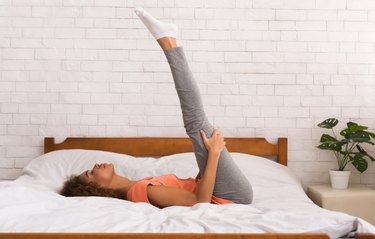
After a long, stressful day, it can be challenging to relax in the evening, and you may still feel too revved up at bedtime. While some people turn to a glass of wine (or two) to unwind, that can actually make it harder to get restful sleep.
A vigorous workout can help ease stress, but if done too close to bedtime, you may have some trouble falling asleep. Although some styles of yoga (like Vinyasa) can be considered vigorous and should be avoided before bedtime, practicing a few gentle, relaxation-inducing postures, along with deep breathing, can help ready you for a good night's sleep.
Video of the Day
Video of the Day
Keep a yoga mat rolled up by your bed and spend about 20 minutes before bed performing these 10 poses to catch some truly restful zzzs.
1. Lotus Pose With Deep Breathing (Padmasana)
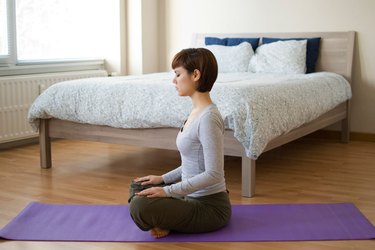
Although not considered a physical posture itself, breath work is a key factor in calming the brain and body. "To stabilize and strengthen the nervous system, I like to focus on the simple in and out flow of the breath," says Laurence Lisa Lebreton, a certified yoga teacher and holistic medicine practitioner.
- Sit in a comfortable position (like Lotus pose, pictured above).
- Breathe in and out through your nostrils up to 25 times, lengthening the exhalation as much as possible.
Tip
Temani Aldine, a certified yoga instructor and vice president of communications at Arizona-based Dahn Yoga, recommends abdominal breathing — drawing the breath deep into your belly, letting it expand with each inhale, then exhaling completely so that your navel pulls in toward your spine.
2. Hero Pose (Virasana)
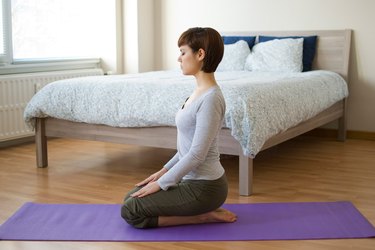
Although its name sounds energizing, spending several minutes in Hero pose before bed can help you relax, says Aldine. It helps ground you physically and emotionally. The position also stimulates pressure points on the tops of your feet that promote total-body relaxation, Aldine says.
- Sit with your knees bent and your shins underneath you. The tops of your feet should be flat on the floor, and your spine should be straight with your shoulders and head aligned over your hips.
- If this is too much pressure on your knees, place a block or pillow between your feet and rest your buttocks on it.
3. Standing Forward Bend (Uttanasana)
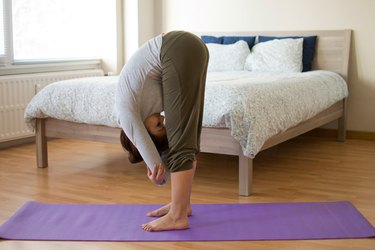
- Stand with your feet hip-distance apart and fold forward at your hips, reaching your fingertips toward the ground.
- Keep a slight bend in your legs and rest your ribs on your thighs.
- Bend both arms at the elbows and grab your elbows with the opposite hand, letting your upper body completely relax.
- Next, Lebreton recommends using your fingertips to gently "brush off" the back of your head. "Manually remove the residue, the big stress of your day from your body. It's almost as if you could brush off the energy all around you," she says.
Tip
If you have a lot of tension in your neck or shoulders or a tension headache, Lebreton recommends pressing your thumbs along the occipital bone at the base of your skull during this pose.
4. Cat-Cow Pose (Marjaryasana and Bitilasana)
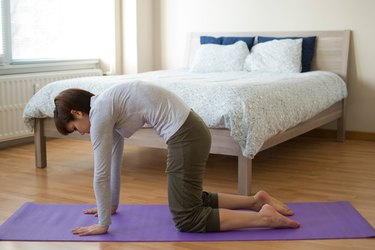
This pose emphasizes relaxing and extending the spine, Aldine says. "In today's lifestyle, people hold a lot of tension in their backs," he says. "Any posture that can help you move your back and stretch your back is going to help you get deeper rest."
- Get onto your hands and knees with your wrists directly under your shoulders and your knees directly under your hips.
- As you inhale, gently drop your belly toward the floor as you lift your head and tailbone up toward the ceiling.
- Reverse the movement, exhaling deeply as you round your spine, tucking your chin in toward your chest.
5. Plow Pose (Halasana)
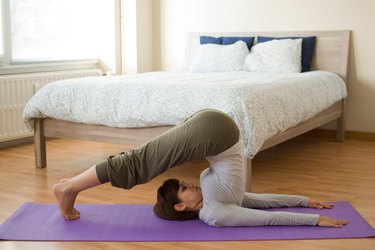
- To get into this somewhat more advanced posture, lie on your back and bring your legs up and over your torso so that you can grab your feet or calves.
- Lower your feet as close to the floor behind you as you can and extend your arms in the opposite direction along the ground.
Tip
You don't have to go all the way into the full Plow pose, but Aldine says it's important to keep your shoulders firmly on the floor while lifting your tailbone.
"The focus of your weight should be in the center of your back, just below the shoulders, which is also an important pressure point," he says. "If you open that pressure point, it creates deeper breathing and relaxation."
6. Child's Pose (Balasana)
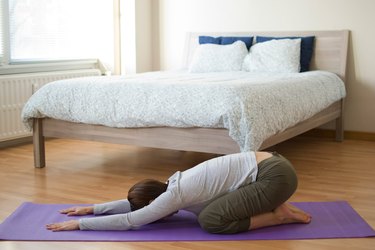
"We need to teach this to everyone," Lebreton says about Child's pose, which she recommends sitting in for several minutes before bedtime. "Because we press our head down, it really soothes the nervous system," she says.
- Start on all fours, then bring your knees apart very wide, keeping your big toes touching.
- Lower your torso down and rest your forehead on the floor.
- Keep your core engaged and extend your arms out in front of you or along your sides.
Tip
Lebreton also emphasizes that your buttocks should be touching your heels in this pose if possible. If that's not possible, take a pillow or bolster and place it behind the backs of your knees to elevate your sit bones.
7. Extended Corpse Pose (Savasana)
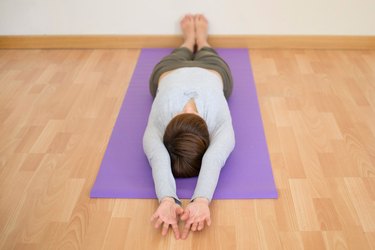
Many people hold tension in the upper back, so this can help release that tension and promote relaxation."You create a line from the feet all the way up the arms, elbows and those index fingers, and this really helps to relax the upper back," Aldine says. "The only thing you have to stretch is your index fingers. It really helps to relax the spine and upper back."
- Lie on your back, extend your arms overhead, then point your index fingers.
- Aldine recommends just breathing naturally in this posture, focusing on relaxing your arms above your head and feeling your shoulders relax.
8. Legs-Up-the-Wall Pose (Viparita Karani)
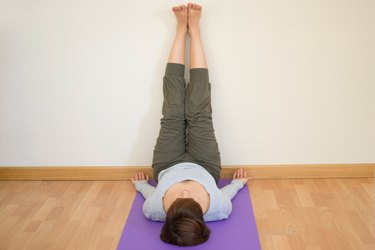
In inverted poses, such as the Legs-Up-the-Wall pose, the blood rushes back toward your heart and head, which Lebreton describes as "clearing up your head" and says is very effective at relieving stress.
- Sit on the floor facing a wall.
- Swing your legs up so that your buttocks are square with the wall and as close to it as possible while resting your entire back on the floor.
- Extend your legs up the wall.
- Extend your arms alongside your body with your palms facing up.
- Lebreton recommends staying here for as long as you can but says that 5 minutes is ideal.
Tip
You can put a pillow or bolster underneath your hips to make this pose a little easier and more supported.
9. Reclined Spinal Twist (Supta Matsyendrasana)
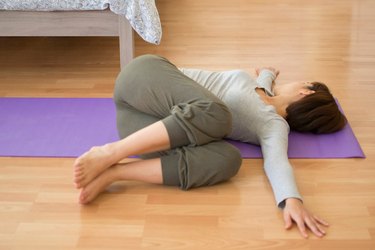
Drawing on her background in holistic medicine, Lebreton recommends performing a twist to compress the your abdominal organs, which she says are responsible for digestion "not only of food, but of your day, the digestion of what's going on."
Spending a few minutes in a twist, she says, can help you clear away some of the mental debris that makes it harder to sleep peacefully.
- Lying on your back, extend your arms out to either side with your palms facing down so that your body forms a T.
- Draw your knees toward your chest and, keeping your shoulders on the floor, drop your knees over to the right as you turn your head to the left.
- Breathe here for one or two minutes and then bring your knees over toward the left side as you turn your head to the right.
Tip
If your knees can't touch the floor without your shoulders lifting, place a pillow underneath them for support.
10. Corpse Pose (Savasana)
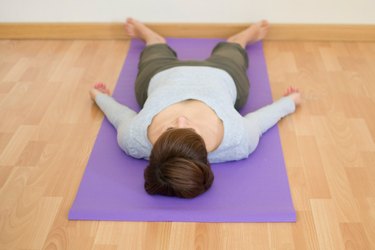
In your final posture before bed, you'll let your body completely relax and allow the full benefits of the poses you've just done to take effect. "In this [pose], what matters is to stay aware of what's going on without engaging into the process," Lebreton says. "The mind and the body deeply rest, relax and renew."
- Returning to normal breathing, lie on your back with your arms at your sides and a little away from your body, with the palms of your hands facing up toward the ceiling.
- Let your legs relax so that your feet fall out to the side.
- Close your eyes and let your body fully release, but don't fall asleep just yet.